SpaceX shares have remained under pressure ahead of their Nasdaq-100 debut, even as the upcoming index inclusion is expected to trigger roughly $4.3 billion in passive fund buying. Summary Sp
SpaceX shares have remained under pressure ahead of their Nasdaq-100 debut, even as the upcoming index inclusion is expected to trigger roughly $4.3 billion in passive fund buying.
Summary
- SpaceX joins the Nasdaq-100 on July 7, with JPMorgan estimating about $4.3 billion in passive fund buying.
- The stock is holding above $155 support while traders watch for a breakout above $160 and $165.
- Limited public float and heavy insider ownership could increase volatility during the index rebalancing.
According to Nasdaq, SpaceX will officially join the Nasdaq-100 before the opening bell on July 7 after qualifying under the exchange’s updated rules that allow certain large newly listed companies to enter the benchmark much sooner than under the previous seasoning requirements. The company, which made its public market debut in June, will become one of the fastest IPOs to reach the technology-heavy index.
Nasdaq-100 inclusion brings major institutional demand
JPMorgan estimates that the index addition could generate about $4.3 billion in compulsory purchases from index-tracking exchange-traded funds and passive investment portfolios. Those funds are required to rebalance their holdings to match the Nasdaq-100, creating a one-time surge in demand for SpaceX shares.
The accelerated inclusion follows Nasdaq’s rule revision for qualifying large IPOs. Under the updated framework, companies with sufficiently large market capitalizations no longer need to wait as long before becoming eligible for the index. The change has allowed SpaceX to enter the benchmark only weeks after listing, a timeline that would previously have taken much longer.
You might also like: Solana price remains on recovery path as on-chain activity reaches new high
Despite the expected buying, the stock’s ownership structure remains a potential source of volatility. Elon Musk and other insiders continue to control a significant portion of the company’s equity, leaving a relatively small public float available for trading. As passive funds compete for those shares during the rebalance, limited supply could amplify price swings in either direction.
While forced buying often provides temporary support, the effect typically fades after index funds complete their purchases, leaving subsequent price action dependent on normal investor demand and company fundamentals.
Technical levels keep $180 in focus
SpaceX traded around $157.62 on Monday, down about 2.7%, after failing to hold gains near the $160 resistance zone. The pullback has left the stock testing support around $155, a level traders are watching closely ahead of Tuesday’s index inclusion.
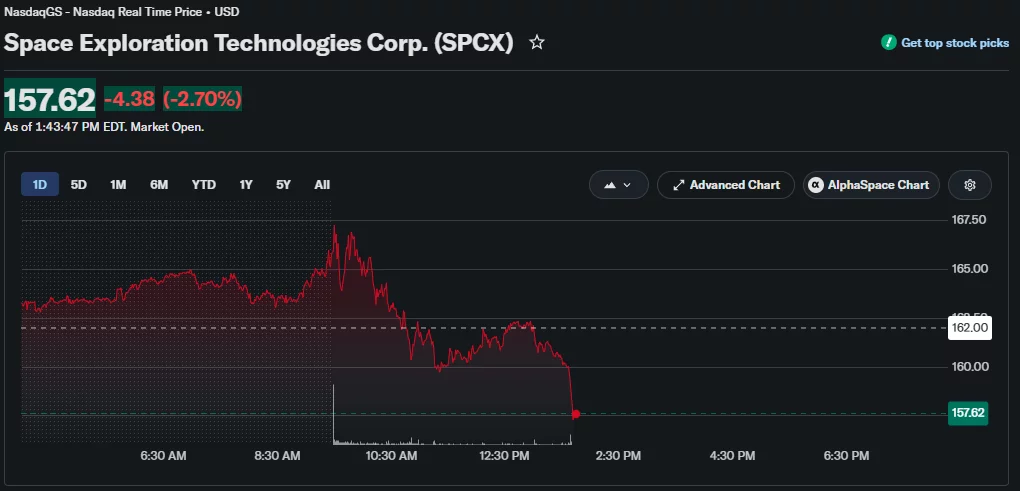
Source:
Yahoo FinanceA move back above $160 would indicate that buyers are regaining short-term control. If trading volume strengthens alongside the breakout, the stock could revisit resistance near $165 before attempting another move toward $170.
A sustained push above $170 would strengthen the bullish case for a rally toward $180 during the week. If momentum continues beyond that level, technical traders could begin monitoring the next upside objectives around $190 and $200.
On the downside, maintaining support at $155 remains critical for the current recovery attempt. A break below that level could expose the stock to a decline toward $152, while heavier selling pressure may extend losses to the next support area near $150.
For now, the Nasdaq-100 addition remains the primary catalyst for SpaceX. The expected wave of passive buying may provide near-term support, but whether the stock can build on that demand will likely depend on its ability to reclaim resistance around $160 and sustain buying interest after the index rebalance is complete.
Disclosure: This article does not represent investment advice. The content and materials featured on this page are for educational purposes only.
Read more: TeraWulf jumps as $19B Anthropic lease accelerates AI data center expansion