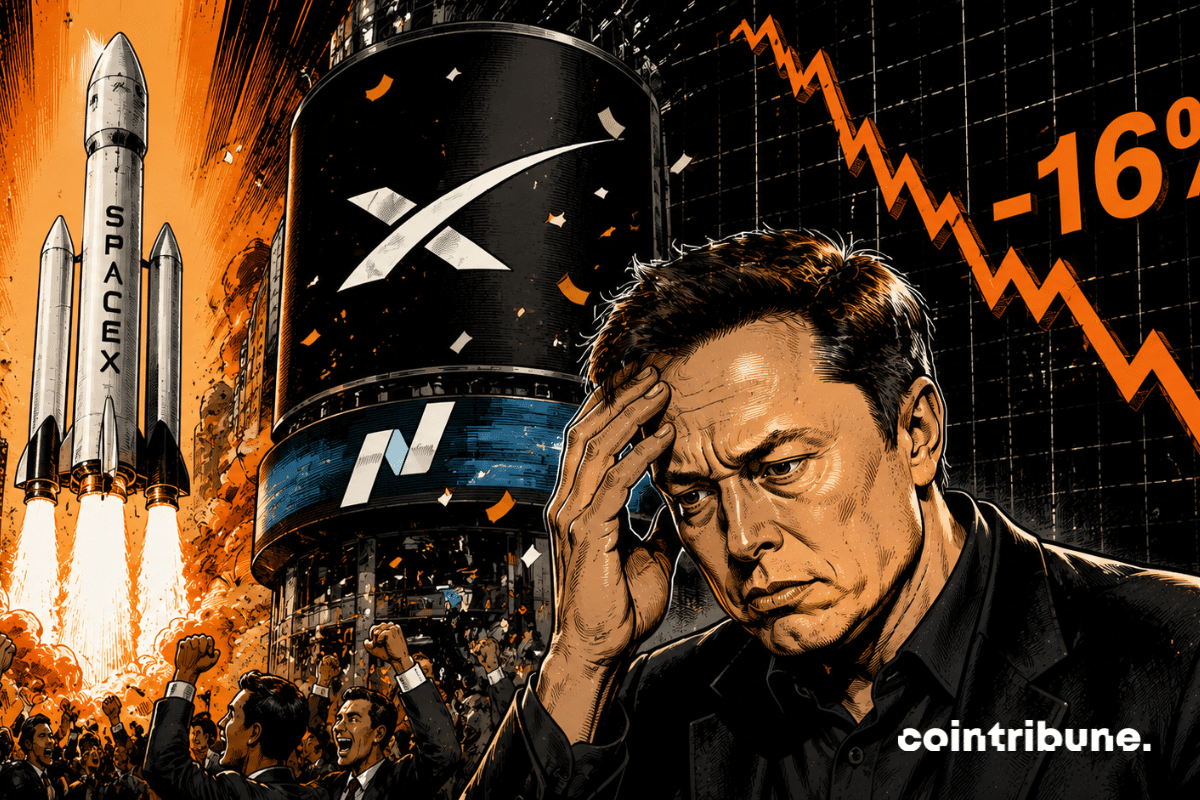
The euphoria only lasted a few days. SpaceX was propelled to a valuation of over $2,000 billion by a historic IPO. After this rapid rise, the stock of Elon Musk’s group underwent a correction
The euphoria only lasted a few days. SpaceX was propelled to a valuation of over $2,000 billion by a historic IPO. After this rapid rise, the stock of Elon Musk’s group underwent a correction, reigniting questions about the sustainability of its stock surge. Behind the largest IPO of all time, Wall Street is looking to see if the company’s fundamentals match its ambitions.
In brief
- SpaceX’s IPO triggered a spectacular surge in the stock, driven by unprecedented enthusiasm from retail investors and an extremely limited float.
- After reaching a record valuation of $2.66 trillion, the stock quickly corrected, fueling doubts about the strength of this rally.
- Behind the group’s space ambitions, losses linked to massive investments, notably in artificial intelligence via xAI, weigh on financial outlooks.
- Risks of shareholder dilution and future financing needs add further pressure on the stock, amid a return to greater caution on Wall Street.
A historic surge in SpaceX stock
The firm’s Nasdaq IPO under ticker SPCX triggered an early buying frenzy fueled by financial milestones and a unique market structure :
- A first-of-its-kind retail allocation: no less than 30 % of shares available at the IPO were reserved for retail investors via mainstream brokerage platforms ;
- A dizzying valuation peak: after opening at $150, the stock soared to a historic intraday high of $225.64, pushing theoretical capitalization to $2.66 trillion and temporarily surpassing Amazon and Microsoft ;
- A sharp correction: in the sessions that followed, the stock retreated to trade around the $165-$170 range this Monday, June 22, erasing much of the buyers’ unrealized gains.
This extreme volatility largely results from a form of structural imbalance between public interest levels and the volume of shares actually offered for sale. By allowing only an ultra-restricted float (less than 5% of total capital) into the market, the company mechanically created a bottleneck such that even the smallest wave of retail buying caused an exponential price explosion.
This technical configuration led seasoned observers to raise alarms about behavior decoupled from traditional accounting realities. Faced with such a scene, former Nasdaq CEO Robert Greifeld stated: “SpaceX is not traded on fundamentals”, but rather “on the aspiration of what is possible with the human spirit in the future”. This statement captures the nature of the initial rally, fueled by technological promise and the story of space expansion, not by consolidated financial indicators.
The artificial intelligence abyss and the weight of accounting fundamentals
The shine of rockets and Starlink satellites conceals a financial architecture weighed down by colossal investments, especially in artificial intelligence. Financial documents reveal that SpaceX suffered a massive net loss of $4.94 billion for fiscal 2025, largely due to the costly strategic integration of startup xAI in February 2025.
Rather than easing, this cash-flow erosion intensified in the first quarter, with an increased net loss of $4.28 billion over just three months of activity. To justify a stock valuation still more than 100 times its historical revenue, company management relies on particularly ambitious long-term projections, with Elon Musk mentioning on social media a goal of $1 trillion in annual revenue by 2030.
This harsh confrontation between growth forecasts and accounting reality is beginning to weigh on fund managers’ overall morale. According to many analysts focused on intrinsic company value, the gap remains huge today, and proof of operational profitability in the short term is now required. Investors are no longer satisfied with the illusion of future revenues from the Starlink constellation, supposedly to offset massive, hard research and development costs needed for xAI’s supercomputers.
This exact breaking point fuels the current selling movement. The market, even if accustomed to Silicon Valley’s generous valuations, applies a stricter filter, recalling that promises of a multiplanetary future must first rest on financial statements capable of withstanding earthly economic cycles.
Start your crypto adventure safely with KrakenThis link uses an affiliate program.Technical dilution risks and debt restructuring prospects on Wall Street
SPCX stock’s short-term evolution faces dual technical and structural pressures worrying Wall Street’s trading rooms. Indeed, lock-up agreements designed to prevent executives and big investors from simultaneously selling large blocks post-IPO are more flexible than usual in this case. This looser structure will allow insiders to liquidate part of their positions well before the standard 180-day deadline, threatening to flood order books with a massive share supply and cause harmful dilution for minority shareholders.
Moreover, the need to maintain a very high investment rhythm leads the company to rebalance its financing structure. SpaceX plans to initiate high-level talks next week with a major bank syndicate including JPMorgan, Bank of America, Citi, and Goldman Sachs aiming to issue at least $20 billion in investment-grade bonds.
This historic transition from an overvalued private entity to a transparent public company disrupts the foundations of global finance. SpaceX’s case shows that even disruptive companies cannot escape financial gravity laws, and current news reflect an adjustment phase signaling institutional caution toward multiple excesses. Historical analysis of mega-IPOs exceeding $50 billion reveals a median negative profitability of -31.9% one year after initial listing.
Going forward, SpaceX’s success will depend solely on its ability to turn innovations into positive cash inflows. For investors, this stock adventure marks an absolute milestone in evaluating future tech sector IPOs, indicating that company sustainability primarily relies on overall economic viability. Nevertheless, the firm continues to generate strong futures contract activity.