Key Highlights SpaceX’s allocation within the Nasdaq-100 will increase from approximately 1.28% to roughly 2.82% following Friday’s market close, taking effect September 21 Analysts project p
Key Highlights
- SpaceX’s allocation within the Nasdaq-100 will increase from approximately 1.28% to roughly 2.82% following Friday’s market close, taking effect September 21
- Analysts project passive index fund purchases ranging from $15.5 billion to $22 billion during Friday’s closing auction, representing one of the quarter’s most significant programmatic trading events
- SPCX advanced 2.6% to reach $154.81 during Thursday’s session, climbing more than 4% for the week in anticipation of the index adjustment
- The company delivered Q2 revenues of $7.81 billion, representing 91.9% annual growth and surpassing consensus forecasts, while posting EPS of -$0.09 versus the anticipated -$0.26
- Potential headwinds include more than 2.3 billion restricted shares scheduled for lockup expiration during October and November, plus a valuation approaching $2 trillion
SpaceX (SPCX) finished Wednesday’s trading at $150.88 before advancing to $154.81 on Thursday, marking a 2.6% intraday gain. Shares have appreciated over 4% during the current week as market participants prepare for Friday’s Nasdaq-100 quarterly adjustment.
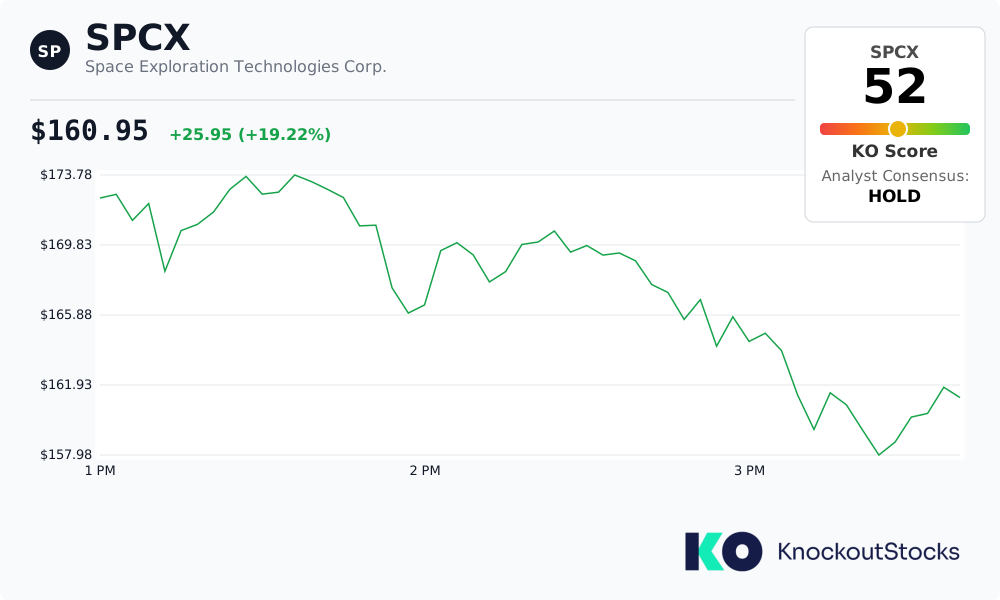 Space Exploration Technologies Corp., SPCX
A frequent misunderstanding surrounding Friday’s event is that SpaceX is receiving its initial Nasdaq-100 inclusion. In reality, that occurred on July 7, 2026, merely 15 trading sessions following its $75 billion initial public offering. Friday’s development represents something distinct: a quarterly index recalibration that will expand SPCX’s weighting by more than 100%.
The company’s index allocation is scheduled to increase from roughly 1.28% to approximately 2.82%, becoming effective Monday, September 21. Given that approximately $1.7 trillion in assets track the Nasdaq-100, this adjustment corresponds to projected mandatory purchases between $15.5 billion and $22 billion, concentrated during the single closing auction at 4:00 PM Eastern Time.
Morgan Stanley calculated the net passive influx at $15.5 billion, though alternative projections extend to $22 billion. To provide perspective, the July 7 inclusion generated approximately $4.3 billion in mandatory purchases. Friday’s occurrence represents a magnitude 3.5 to 5 times greater.
The weighting expansion stems from a specific regulation: the Nasdaq-100’s float-adjusted capitalization methodology. When a corporation’s publicly available shares constitute less than 33.3% of aggregate share count, the index applies triple the free float instead of complete market capitalization for weighting calculations. During SPCX’s initial index entry, only 4% to 5% of its equity traded freely, constraining its weighting to approximately 1.28%.
Two post-IPO lockup terminations during August released over 1.2 billion shares into the available trading pool. Significantly, primary venture capital stakeholders and extended-term institutional shareholders predominantly elected to retain positions, enabling float expansion without saturating the market with excess supply.
Lessons From the July 7 Trading Pattern
Before assuming Friday’s mandatory purchases will automatically elevate prices, examining the July 7 precedent proves instructive. During that session, $4.3 billion in passive capital was mandated to enter at the closing bell. Nineteen analysts had issued virtually unanimous Buy recommendations. The stock declined almost 6%.
Index fund purchasing represents a singular mechanical operation. During the period preceding that moment, institutional participants who established positions ahead of the forced demand can leverage that price-insensitive buying to liquidate at advantageous levels. The passive purchaser possesses no alternative except to absorb available supply.
Palantir depreciated approximately 23% during the weeks subsequent to its December 2024 index addition. Strategy reached its maximum valuation a complete month prior to its inclusion date.
SpaceX’s second quarter 2026 performance demonstrated robust momentum. Revenue totaled $7.81 billion, climbing 91.9% on an annual basis, substantially exceeding analyst projections. The EPS deficit reached -$0.09, significantly outperforming the consensus forecast of -$0.26.
The SpaceXAI computing segment has emerged as a substantial revenue contributor. CFO Bret Johnsen verified a new computing contract valued at $1.11 billion monthly, marking its fourth agreement surpassing $11 billion in annualized recurring revenue within four months. Leadership has projected $100 billion in annual recurring revenue by 2026’s conclusion.
Analysts project 142% revenue expansion for the complete fiscal year. Morgan Stanley maintains an Overweight rating with a $300 price objective, while Arete Research established a $450 target during August.
The subsequent significant concern: over 2.3 billion restricted shares are scheduled to complete lockup periods in late October and mid-November, constituting the calendar’s largest individual supply occurrence, aligning with Q3 earnings disclosure.
The post SpaceX (SPCX) Stock Climbs 3% as Nasdaq-100 Weight Increase Could Drive $22B in Passive Inflows appeared first on Blockonomi.