Quick Summary SpaceX debuted publicly on June 12, 2026 at $135 per share, climbed above $200, then retreated toward debut pricing Starlink represents approximately 60% of total revenue; the c
Quick Summary
- SpaceX debuted publicly on June 12, 2026 at $135 per share, climbed above $200, then retreated toward debut pricing
- Starlink represents approximately 60% of total revenue; the company brought in $18.67B during 2025
- SpaceX recorded a $4.94B net loss in 2025, a significant swing from the $791M profit earned in the previous year
- The IPO price implied a valuation near $1.75T — roughly 94 times 2025 revenue
- Analyst consensus stands at Moderate Buy with a mean price target of $239.12
Shares of SpaceX (SPCX) began trading at $150 on June 12, 2026, quickly climbing beyond $200 before retreating back toward the $135 initial offering price. The volatile debut trading pattern has investors pondering a simple question: does the current dip represent a buying opportunity?
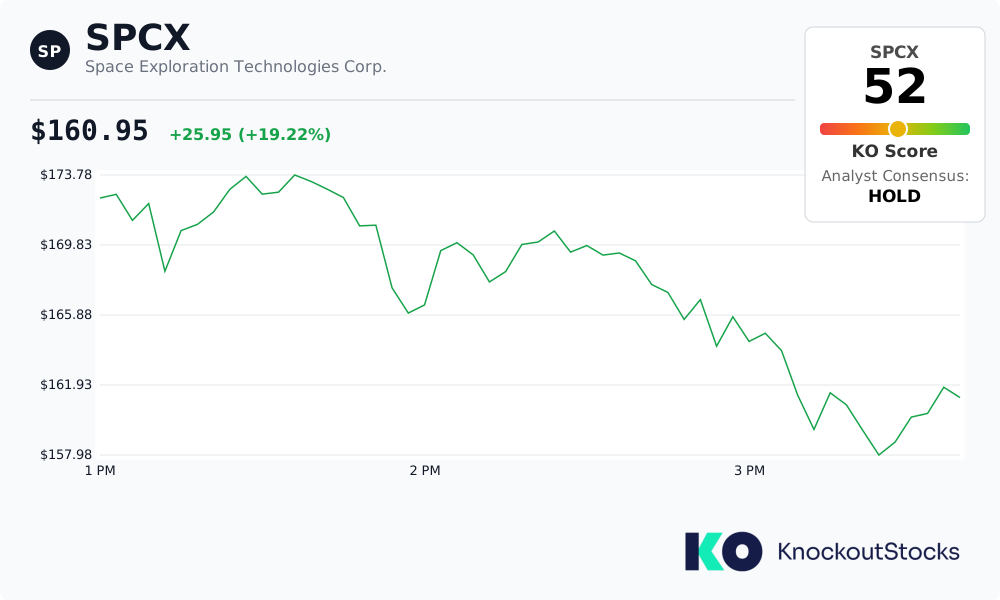 Space Exploration Technologies Corp., SPCX
The response hinges on your conviction in an extraordinarily expensive vision of tomorrow.
When priced at $135 per share, SpaceX commanded a market capitalization approaching $1.75 trillion. That translates to approximately 94 times the company’s 2025 revenue of $18.67 billion. After the opening bell rang, the valuation surpassed $2 trillion.
That represents a premium valuation for a business currently operating at a loss.
The company recorded a $4.94 billion net loss during 2025, representing a dramatic shift from the $791 million profit generated in the preceding year. While revenue expanded from $14.02 billion to $18.67 billion—demonstrating robust growth—profitability still swung dramatically negative.
Starlink Drives Current Revenue
Starlink serves as the primary revenue driver at present. The satellite internet service generates approximately 60% of overall revenue, supported by an expanding customer base, contracts with government entities, and increasing adoption across aviation and maritime sectors.
What distinguishes Starlink from typical subscription models is that SpaceX manufactures and deploys its own satellite constellation using reusable Falcon launch vehicles. This creates a cost advantage that competitors struggle to replicate.
The company possesses a genuine competitive advantage. The critical question is whether that advantage justifies a valuation approaching $2 trillion.
Starship Represents the Future Bet
The more ambitious wager involves Starship. Should SpaceX achieve complete reusability with this system, launch costs to orbit could drop substantially—enabling faster Starlink constellation expansion and unlocking markets currently considered economically unfeasible.
However, Starship remains under active development. It’s a high-stakes initiative vulnerable to schedule slippage, engineering setbacks, and substantial capital requirements before generating meaningful commercial returns.
The present valuation assumes considerable Starship success. That assumption carries significant risk.
Wall Street maintains a generally optimistic outlook. MarketBeat data indicates a Moderate Buy consensus among 35 analysts—comprising 4 Strong Buy, 23 Buy, 7 Hold, and 1 Sell rating.
The mean price target over the next twelve months stands at $239.12, with individual analyst projections spanning from $115 to $800.
That $685 gulf between the most bearish and bullish forecasts speaks volumes. Even market professionals demonstrate wide disagreement regarding appropriate valuation.
Corporate governance merits consideration as well. Class B shareholders maintain concentrated voting authority, ensuring control remains with Musk and other insiders irrespective of public shareholder sentiment.
Share price will also respond to factors beyond quarterly results—launch performance, regulatory developments, Starlink subscriber metrics, and Musk’s public statements.
With analyst price targets averaging $239.12, significantly above current pullback levels, Wall Street’s view suggests meaningful upside potential remains from these prices.
The post SpaceX (SPCX) Stock Retreats to IPO Levels: Should Investors Buy the Dip? appeared first on Blockonomi.