Key Takeaways SPCX shares declined 0.5% to $114.60 on Monday following a successful Starship test flight on Friday The stock has tumbled approximately 38% across three weeks and now trades be
Key Takeaways
- SPCX shares declined 0.5% to $114.60 on Monday following a successful Starship test flight on Friday
- The stock has tumbled approximately 38% across three weeks and now trades beneath its $135 debut price
- HSBC launched coverage with a Hold recommendation and $115 target, factoring in a 2x “innovation premium” yet still pricing below market
- The investment bank forecasts approximately $106 billion in cumulative cash consumption before positive free cash flow emerges circa 2030
- Critical August milestones include Q1 financial results on Aug. 4 and a substantial lock-up release on Aug. 6 potentially expanding tradable shares significantly
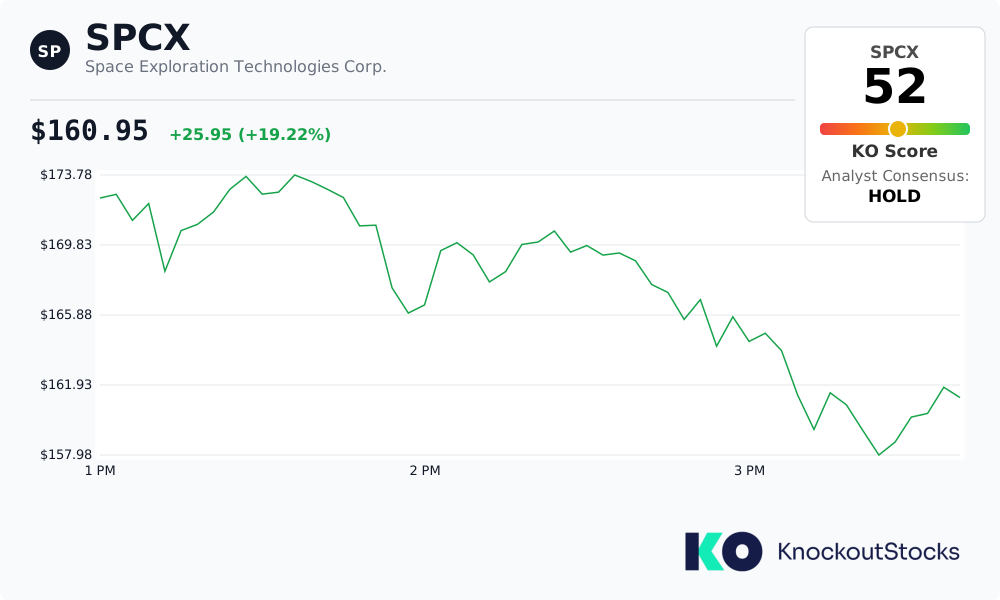
Shares of SpaceX (SPCX) dipped 0.5% to $114.60 during Monday morning trading, despite the aerospace manufacturer executing a largely successful 13th Starship test mission Friday night. The decline occurred while broader equity markets advanced — S&P 500 futures gained 0.9% and Dow futures added 1.1% — highlighting the stock’s divergent performance.
 Space Exploration Technologies Corp., SPCX
SPCX has experienced three consecutive weeks of losses, shedding approximately 38% during this period. The current price represents a decline from its $135 initial public offering level in June and trades more than 40% beneath its peak closing price of $201.80.
The Friday Starship mission accomplished the majority of its objectives. The spacecraft’s upper stage successfully deployed 20 Starlink V3 satellites, executed an engine restart in space’s vacuum, and completed a controlled splashdown in the Indian Ocean. While the booster failed to achieve its targeted soft landing, KeyBanc analyst Michael Leshock characterized the mission as “near perfection” and a “meaningful success.”
The company anticipates Flight 14 within weeks. CEO Elon Musk indicated that SpaceX intends to attempt capturing the upper stage using the launch tower’s mechanical arms — a maneuver previously accomplished only with the booster component.
Investment Bank Questions Current Valuation
HSBC emerged as the first major financial institution to publish SPCX coverage on July 25, assigning a Hold rating with a $115 price objective — beneath the prevailing $118.24 market price. The bank constructed its valuation by assessing each business division independently and incorporating a 2x “innovation premium” reflecting Musk’s execution history. Despite this favorable adjustment, HSBC’s target remained below market levels.
The firm’s baseline projections anticipate revenue expanding to $38.2 billion in 2026 from $18.7 billion in 2025. However, HSBC expects GAAP profitability to remain elusive through 2027, with free cash flow generation delayed until approximately 2030, necessitating cumulative cash consumption of roughly $106 billion.
Under HSBC’s optimistic scenario, SPCX could reach $293 per share — contingent upon Starship commercialization success, accelerated Starlink user adoption, and earlier-than-expected AI revenue materialization.
AI Division Generates Substantial Losses
SpaceX’s Q1 2026 financial disclosure revealed $4.69 billion in total revenue alongside a $1.94 billion operating deficit. Starlink dominated performance with $3.26 billion in sales and $1.19 billion in operating profit. Conversely, the AI division generated $818 million in revenue while incurring a $2.47 billion operating loss.
Total capital expenditures reached $10.1 billion during Q1, with $7.7 billion allocated to AI infrastructure — the competitive segment HSBC considers most challenging given formidable rivals including Amazon, Microsoft, and Google.
Starlink demonstrated robust subscriber expansion, achieving 10.3 million users by Q1’s conclusion, compared to 5 million twelve months prior. However, average monthly revenue per customer contracted to $66 from $86 as the company penetrated lower-priced international markets.
The company will release its inaugural public quarterly results following market close on Aug. 4. Subsequently, on Aug. 6, the initial lock-up period expires, potentially releasing 911.5 million shares for trading — increasing the public float from approximately 4.9% to roughly 12%.
Short sellers have accumulated approximately $15.5 billion in unrealized profits since the IPO, with short interest representing nearly 31% of available tradable shares.
The post SpaceX (SPCX) Stock Struggles Despite Successful Test Flight as HSBC Issues Cautious Rating appeared first on Blockonomi.