SpaceX stock is back in the headlines this week. Shares of Space Exploration Technologies Corp, which trade under the ticker SPCX on the Nasdaq, closed at $141.29 on August 13. That is a 3.33
SpaceX stock is back in the headlines this week.
Shares of Space Exploration Technologies Corp, which trade under the ticker SPCX on the Nasdaq, closed at $141.29 on August 13. That is a 3.33% drop from the prior close of $146.15.
The pullback came right after Elon Musk filed paperwork with the SEC. The filing confirmed he holds a 48.4% stake in the company, worth more than $900 billion at current prices. His holdings include 849.5M Class A shares, 5.22B Class B shares, and options for another 350M shares.
This SpaceX price prediction looks at what is driving the moves, what the lockup calendar looks like, and where SPCX could go next.
What is SPCX stock price today?
As of the August 13 close, SPCX traded in a range of $139.80 to $145.02.
The 52-week range runs from $104.83, hit on August 3, to an all-time high of $225.64, set on June 16, just days after the June 12 IPO.
Metric
Value
Last close (Aug 13)
$141.29 (-3.33%)
Previous close
$146.15
Day range
$139.80 to $145.02
52-week range
$104.83 to $225.64
IPO price
$135.00 (June 12, 2026)
Market cap
approx. $1.9 trillion
Shares outstanding
approx. 13.16 billion
Why did the stock rally after the $100 billion lockup?
Investors were bracing for a crash. On August 6, roughly 911.5 million insider shares, worth close to $100 billion, became eligible for sale for the first time since the IPO.
The selloff many expected never really showed up. Instead, SPCX climbed. Shares that opened the week of August 3 near $114.53 closed near $138.74 by August 10, a weekly gain of more than 21%.
A few things helped absorb the extra supply.
The company beat second-quarter estimates, with revenue of $7.8 billion, up 92% year over year. Adjusted EBITDA came in at $3.5 billion, though it still posted a net loss of $541 million.
The AI segment, built around the Grok models after SpaceX merged with xAI in February, brought in $2.6 billion in revenue, up 247% year over year. Connectivity, which covers Starlink, added $4.3 billion.
Norway's sovereign wealth fund also disclosed a $1.2 billion stake in the company. Some traders read that as a vote of confidence from a long-term institutional holder.
How much of SpaceX does Elon Musk own?
Musk's SEC filing this week showed he beneficially owns 6,418,547,515 shares on an as-converted basis. That works out to a 48.4% economic stake, worth over $900 billion.
Not all of this is fully vested. Musk himself said a portion only vests if the company hits very ambitious performance milestones, so the real vested share is lower than the headline number.
Because SpaceX uses a dual-class share structure, Musk's economic stake actually understates his control. Class B shares carry ten votes each, giving him more than 82% of total voting power.
His 6.4 billion locked shares cannot be sold until June 12, 2027, a full year after the IPO. That is separate from the shorter, staggered schedule that applies to other insiders and employees.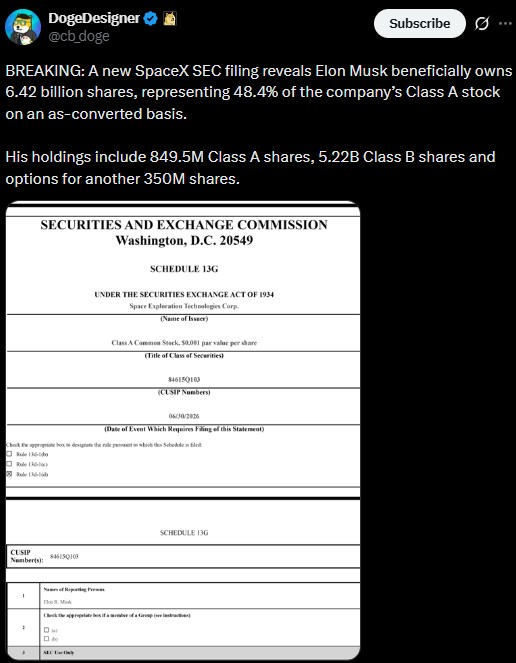
When does the next SPCX share lockup expire?
SPCX did not use one single lockup date. Instead, shares free up in stages.
Date
Event
Jun 12, 2026
IPO priced at $135/share, 555.6M shares sold
Aug 6, 2026
First tranche, approx. 911.5M shares eligible
Aug 21, 2026
Next 7% tranche reported to unlock
Sep to Oct 2026
Rolling 7% tranches, every 2 to 4 weeks
Late Oct/Nov 2026
Larger tranche tied to Q3 earnings, approx. 28% of block
Dec 8, 2026
Full 180-day lockup expires
Jun 12, 2027
Musk's 6.4B shares become transferable
Each of these dates can add fresh supply to the market. That does not automatically mean the stock falls. August 6 showed strong demand can absorb a lockup event, but every new date is still a real test for the stock.
Is SPCX stock overvalued?
Not everyone is convinced the rally has legs.
Morningstar analyst Nicolas Owens keeps a $62 fair value estimate on the stock, well below the current price. Its price-to-sales ratio sits near 75, high for any sector.
Capital spending is another concern, with reports pointing to heavier AI infrastructure spending into 2027 and 2028.
Other analysts are more upbeat. Argus Research holds a Buy rating with a $160 target, and Morgan Stanley has an Overweight rating with a target as high as $300, pointing to the AI and Starlink growth story.
SPCX price prediction: what the chart shows
Since bottoming near $105 to $110 in early August, SPCX has made higher highs and higher lows.
The stock has already reclaimed $133.36, the 23.6% Fibonacci retracement from the June high. The next resistance sits near $150, which lines up with the 38.2% retracement level.
A close above $150 that holds, with short-term moving averages staying in a bullish order, could open the door toward $165, then the $179.48 zone, the 61.8% retracement.
On the downside, a rejection at $150 followed by a break below $133.36 could point to a pullback toward $120 to $125. A deeper break under $105 would put the recent low back in play.
The relative strength index sits near 68, close to overbought territory, so some sideways action would not be unusual even in a bullish scenario. None of this is a guarantee, since the stock has already moved more than 20% in a single week, in both directions, since its IPO.
Bottom line
SPCX has proven more resilient than many expected through its first major lockup test. Strong earnings and Musk's own locked-up position have helped support sentiment.
But the stock trades at a steep valuation by most traditional measures, and more supply is coming through the rest of 2026 and into 2027. Whether SPCX holds above $140 or slips back toward the $120s may depend on how the next few unlock dates play out.
Disclaimer
This article is for general information only and is not financial, investment, tax, or legal advice. Past performance does not predict future results, and technical levels such as Fibonacci retracements are tools for context, not guarantees. Always do your own research and speak with a licensed financial advisor before making any investment decision.