The euphoria around SpaceX gave way to a violent disillusionment. In a few weeks, the SPCX stock went from the status of the largest IPO in history to a correction that erased hundreds of bil
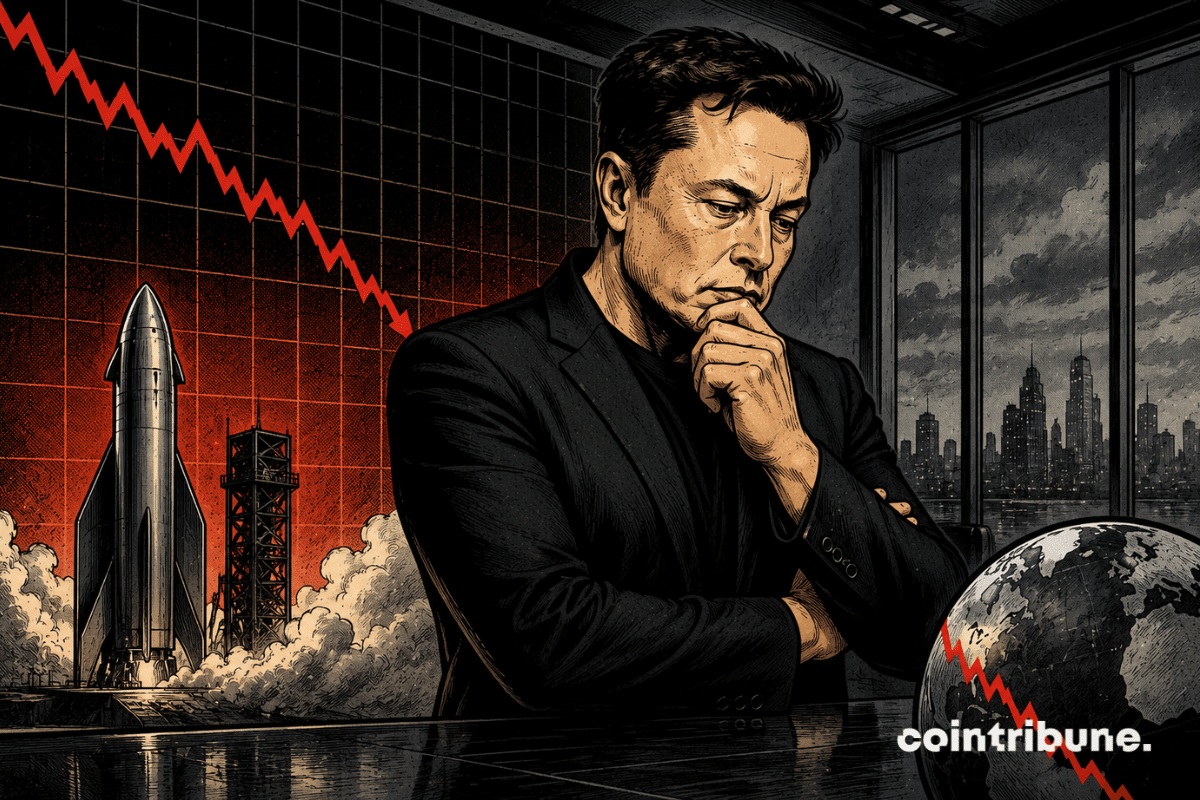
The euphoria around SpaceX gave way to a violent disillusionment. In a few weeks, the SPCX stock went from the status of the largest IPO in history to a correction that erased hundreds of billions of dollars in valuation. This drop not only affects shareholders. It also cuts Elon Musk’s fortune and revives questions about the valuations of tech giants, several of which have made bitcoin a strategic asset on their balance sheets.
In Brief
- The SPCX stock falls around $111, marking an 18% drop below its $135 IPO price and wiping out over $1 trillion in market capitalization from its peak.
- Low float amplified volatility, allowing short sellers to generate $15.5 billion in virtual gains by betting against the stock.
- The one-second delay of the Starship flight and net losses of $4.28 billion in Q1 2026 weigh heavily ahead of earnings release on August 4.
- The simultaneous fall of SpaceX and Tesla (-14%) melts Musk’s fortune by $35.2 billion in a single day.
A Historic Correction for SPCX Stock of SpaceX on the Markets
This Thursday, July 23 marks a dark turning point for the aerospace giant’s public listing. During the morning session, the SpaceX (SPCX) stock slid to nearly $110.99, trading around $111 before stabilizing slightly above $112. Such a level reflects a sharp 18% drop compared to the initial IPO price set at $135.
The contrast is all the more striking since the market entry, which occurred last June 12, had raised $85.7 billion thanks to the exercise of the overallotment option by underwriters, pushing the price to $160.95 by the close of the first session. Driven by initial investor enthusiasm, the stock rose to an intraday high of $225.64 on June 16, briefly pushing market capitalization above $2.6 trillion. The drop back to $111 thus erases about 51% of that maximum valuation, bringing the company’s total value down to nearly $1.5 trillion and cutting its capitalization by over $1 trillion.
This rapid decline, accelerated by profit-taking after a close at $135.27 on July 15 and a 6.7% drop on Wednesday, is explained by the speculative dynamics and the structure of the tradable capital :
- A low initial volume of shares floating : the scarcity of available shares at the IPO fueled the initial rise before accelerating downward volatility during the first massive sell-offs ;
- The short sellers’ offensive : according to Ortex Technologies, short positions generated about $15.5 billion in virtual profits during this decline ;
- Massive pressure on stock borrowings : nearly 360 million shares, representing about 56% of tradable shares, were loaned to bearish speculators ;
- Questioning of multiples : investors doubted a valuation reaching nearly 40 times the estimated 2026 revenue.
Operational Doubts, Financial Losses, and the Lock-Up Challenge
Beyond stock market dynamics, technical issues and looming financial deadlines are deteriorating investor confidence. On July 16, SpaceX had to abort the 13th Starship test flight less than a second before launch after four of the 33 Raptor engines on its Super Heavy booster failed at startup. Elon Musk specified that two engines would need replacement before the next attempt rescheduled for Thursday evening. On the accounting side, the situation is equally demanding. Data around earnings announcements reveal a net loss of $4.9 billion for the full year 2025, complemented by a $4.28 billion loss in Q1 2026. Thus, pressure may intensify when the first post-IPO quarterly results are published on August 4 after the market close.
The August 6 deadline constitutes a second major financial challenge for the company’s stability. On this date, corresponding to the second trading day after earnings presentation, the end of the lock-up period could release up to 911.5 million restricted shares onto the secondary market. At the current price of $111, this potential liquidity injection equates to an excess supply exceeding $100 billion. Investors will scrutinize Starlink’s revenue growth, rocket launch cadence, and capital expenditure intensity to assess the group’s ability to absorb this stock volume without further valuation degradation.
Your 1st cryptos with BitMartThis link uses an affiliate program.Impact on Elon Musk’s Wealth and Bitcoin Stance
This negative context weighed on the founder’s personal wealth. According to the ranking by Forbes on July 23, Elon Musk’s net worth fell to around $715 billion, recording a colossal loss of $35.2 billion in a single day, a 4.69% decline. This drop stems from a double direct shock, as Tesla simultaneously experienced a plunge of about 14% in the same morning, trading near $322.
Although this contraction in fortune does not affect Musk’s executive control of SpaceX nor force him to liquidate his shares, it wipes out the historic $1 trillion net worth milestone he briefly crossed after the IPO.
In this context of high growth stock volatility, SpaceX’s stance on cryptos is carefully monitored by the ecosystem. The company remains the 8th largest public institutional holder of bitcoin, with a treasury valued at 18,712 BTC recorded on its balance sheet. As the firm approaches its financial and operational deadlines, the strength of its business trajectory will determine its ability to preserve this strategic asset against profitability constraints demanded by traditional investors.