Stablecoin Redemption Gap Explained : Why it matters? A stablecoin can cross the planet in seconds. Turning it back into money in your bank account is a different story. That distance is the
Stablecoin Redemption Gap Explained : Why it matters?
A stablecoin can cross the planet in seconds. Turning it back into money in your bank account is a different story.
That distance is the USDC redemption gap. It sits between a token you can send at 3 a.m. and a dollar you can spend on Monday. Most holders never notice it until the day they try to cross it.
What Is the Stablecoin Redemption Gap in Plain Words?
The USDC redemption gap is the distance between moving a token and getting dollars into a bank account. Two different systems sit on each side of it.
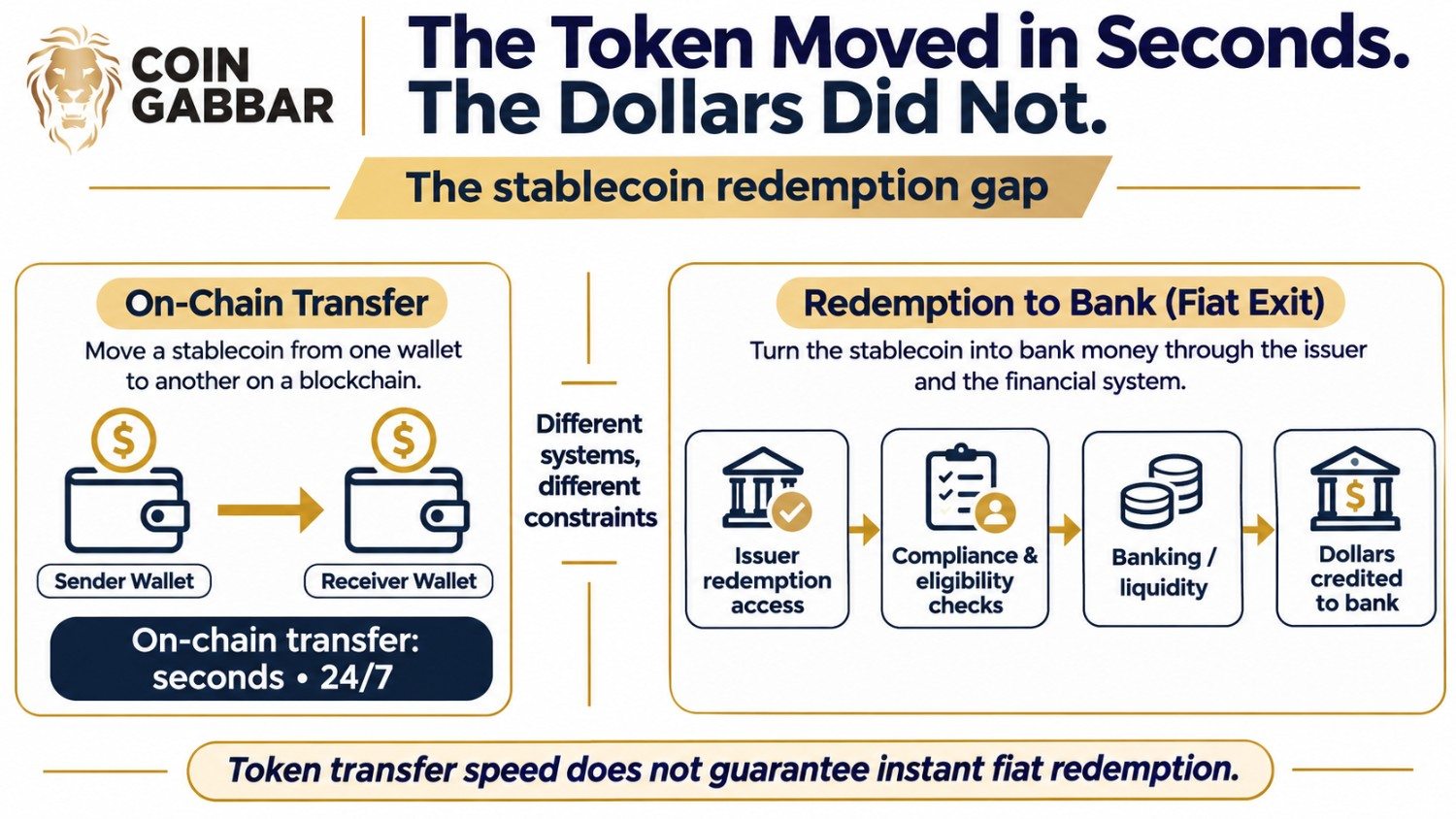
On a blockchain, a transfer takes seconds and runs around the clock. In banking, cashing out needs an eligible account, ID checks, open bank rails, and cash on hand. Our guide tostablecoins and US debt covers what backs the tokens. This one covers the exit.
Short version: sending is easy for everyone. Everyone else sells to a buyer and hopes the price stays near one dollar.
Who Can Redeem a Stablecoin Directly With the Issuer?
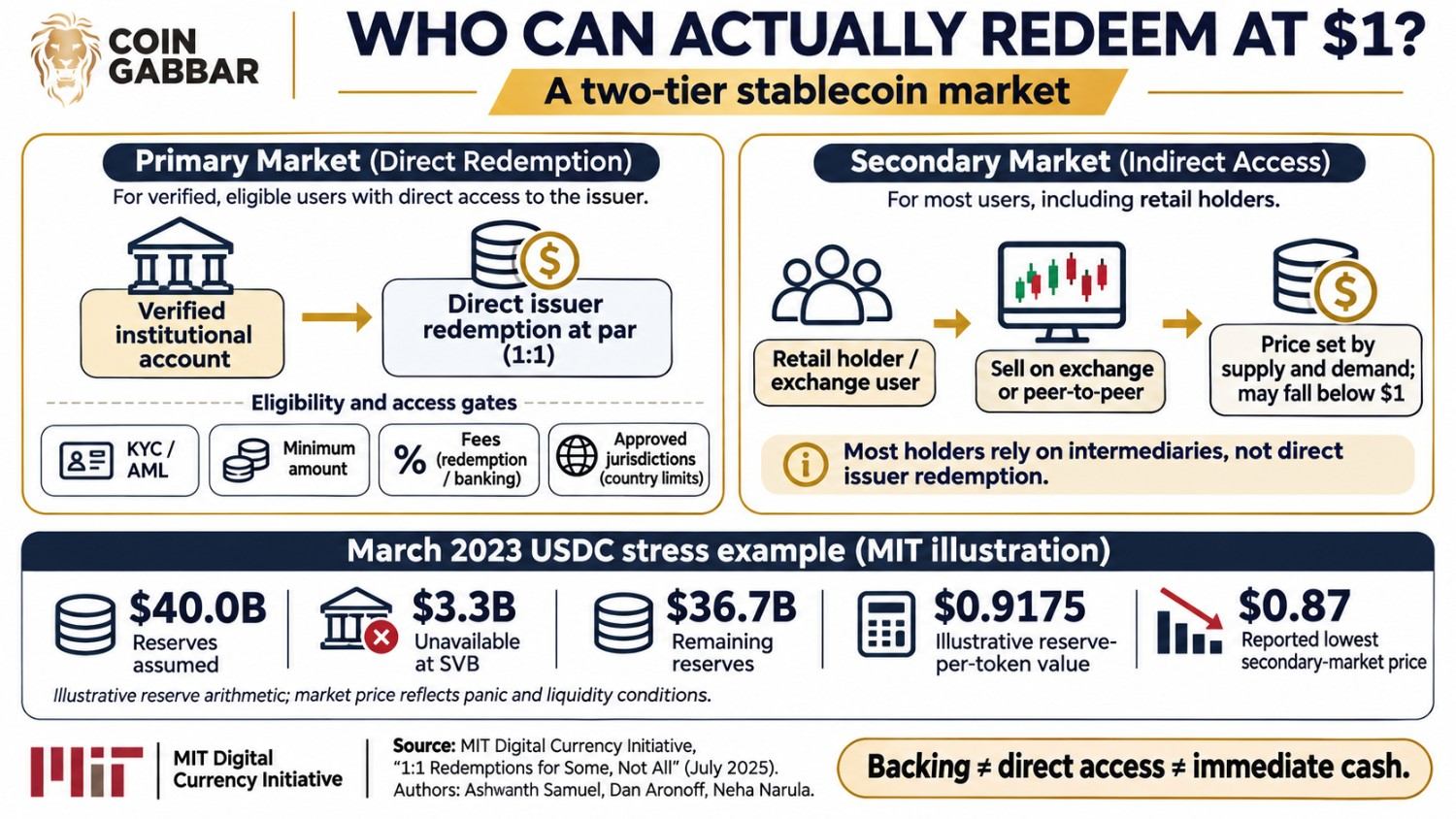
Not most people. Researchers at theMIT Digital Currency Initiative say most users can't redeem with issuers like Circle (USDC) or Tether (USDT).
Direct redemption at one dollar is open to account holders the issuer has verified. That means full identity checks (KYC and AML), minimum amounts, fees, and approved countries.
Everyone else uses an exchange, where the price moves with supply and demand. MIT calls this a two-tier system. Big firms sit in the primary market. Retail users sit in the secondary one. Their access to a dollar is indirect, and that is the stablecoin redemption gap in action.
What Happens Between a Redemption Request and Your Bank?
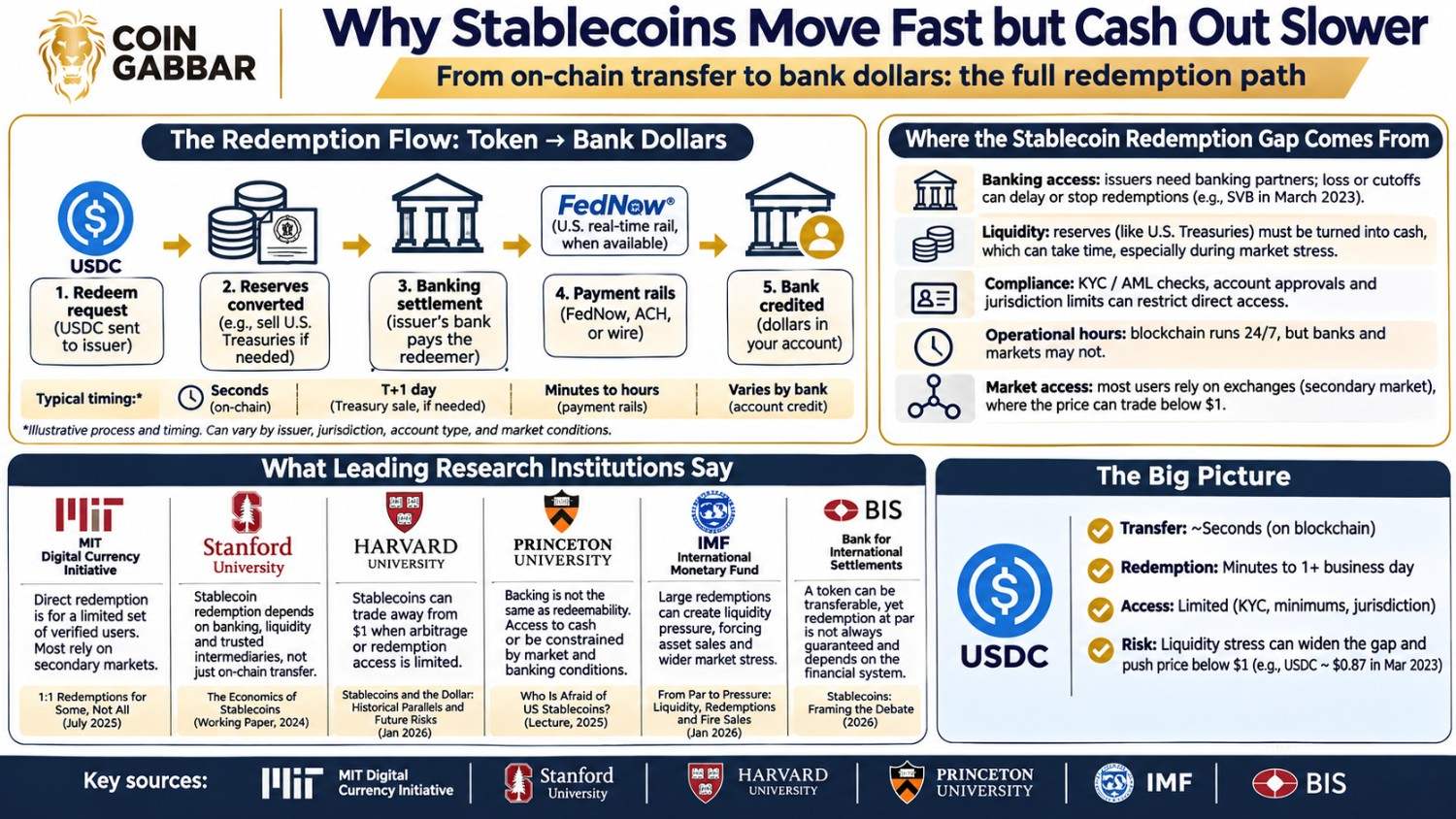
A simplified path, drawn from a 2026 paper by MIT-linked researchers, looks like this. Real timing varies by issuer, country, and account.
Step
What happens
Speed
Token sent
The issuer takes it out of circulation.
Seconds
Reserves sold
The issuer sells Treasuries to a dealer if it holds no spare deposits.
Settles next business day (T+1)
Banks settle
The issuer's bank pays the redeemer's bank.
Can be instant on FedNow
Account credited
The holder sees dollars.
Depends on the bank
If the issuer already holds bank deposits, step 2 drops out. Selling Treasuries adds a layer of risk and delay, the paper notes. That is where the stablecoin drop out gap tends to widen.
Can a Fully Backed Stablecoin Still Fail to Pay Out?
Backing and payout are different things. Backing means the assets exist. Payout needs those assets turned into cash fast and without a loss.
The paper calls this the split between solvency and liquidity. Reserves can be safe treasuries and still be slow to sell when the market jams. It puts the 2020 Treasury panic at just over $200 billion of selling. That was under 1% of Treasuries held by the public. It was also about two thirds of its market's size.
The dealers who buy those Treasuries have limited balance-sheet room. A rush of redemptions could hit that wall. So the authors conclude that even safely backed coins can face stress.
Why Did USDC Fall to 87 Cents With Mostly Safe Reserves?
In March 2023, Silicon Valley Bank (SVB) failed. Circle, the issuer of USDC, said about $3.3 billion of its reserves were stuck there. Exchange prices dropped as low as $0.87.
MIT walks through the sums with a round $40 billion example. This table repeats that arithmetic.
Item
Figure
Reserves in MIT's example
$40 billion
Stuck at SVB
$3.3 billion
Still reachable
$36.7 billion
Implied value per token
$0.9175
Lowest exchange price
about $0.87
On $1,000 of USDC, a sale at $0.87 returns $870. The implied value was $917.50. Meanwhile, on-chain data suggests Circle processed at least $2 billion of redemptions. The USDC episode shows the stablecoin redemption gap at work.
What Happens When an Issuer Loses Banking Access?
MIT's researchers explain that redemptions finish only when dollars land in a bank account. If an issuer loses its bank accounts, it can't process redemptions. It likely can't issue new tokens either.
Then only peer-to-peer markets remain. They can't adjust supply or demand to hold the peg.
Direct access isn't a clean fix either. The paper notes that EU rules (MiCA) require direct access, while Circle and Tether use middlemen. It cites research on a trade-off. Direct rights can stop price drift. They can also raise the urge to run in a panic. So the stablecoin redemption gap stays an open design question.
Do Thin Capital Buffers Widen the Stablecoin Redemption Gap?
The paper also tests issuers on a simple bank-style yardstick. It divides spare assets by total assets. US banks need at least 4% to count as adequately capitalized.
Issuer
Ratio, Q2 2025
Circle (USDC)
0.11%
Tether (USDT)
3.36%
US bank minimum
4%
Tether's reserves held riskier assets, so its figure isn't a clean comparison. The authors add that the law doesn't appear to apply bank capital rules to issuers. Thin buffers can make the stablecoin redemption gap harder to close.
Can Stablecoins Replace Bank Payment Rails Today?
Not for every job. The paper ranks stablecoins below bank deposits in the hierarchy of money. Redemption normally settles in bank deposits, and it may need markets to turn securities into cash.
On-chain, tokens are fast. Once they must reach a bank, they inherit bank limits. Bank deposits can move instantly on FedNow. Treasury trades still take a day.
One idea is central bank access for issuers, like the "skinny account" Fed Governor Waller described. The authors call it speculative. They say it wouldn't fix every bottleneck.
How Can Holders Test Their Own Exit Route?
Before treating a stablecoin as cash, a holder can ask a few plain questions. None of them needs a finance degree.
Do I hold a direct account with the issuer, or only an exchange account?
What are the minimums, fees, and supported countries?
Which bank and which hours does the cash-out use?
How did the price behave in past stress?
The issuer's own terms are the last stop. They list the delays and limits that can apply, and they can change.
Expert Opinion: How Wide Is the Stablecoin Redemption Gap?
CoinGabbar analysis suggests the stablecoin redemption gap is a design choice, not a bug. Tokens are built to move freely. Redemption is built to be controlled. Both can be true at once.
This view rests on the MIT post and the 2026 arXiv paper above. It weighs access rules, reserve cash, bank links, and the 2023 USDC episode. The paper is a preprint, so its findings may change.
The gap matters most in stress for holders without direct accounts. In calm markets, most never feel it.
Disclaimer: This article explains research. It is not financial, legal, or tax advice. No outcome can be promised or assured. Stablecoin prices can fall below one dollar, and redemption rights differ by issuer, country, and account. Check the issuer's current terms before acting.