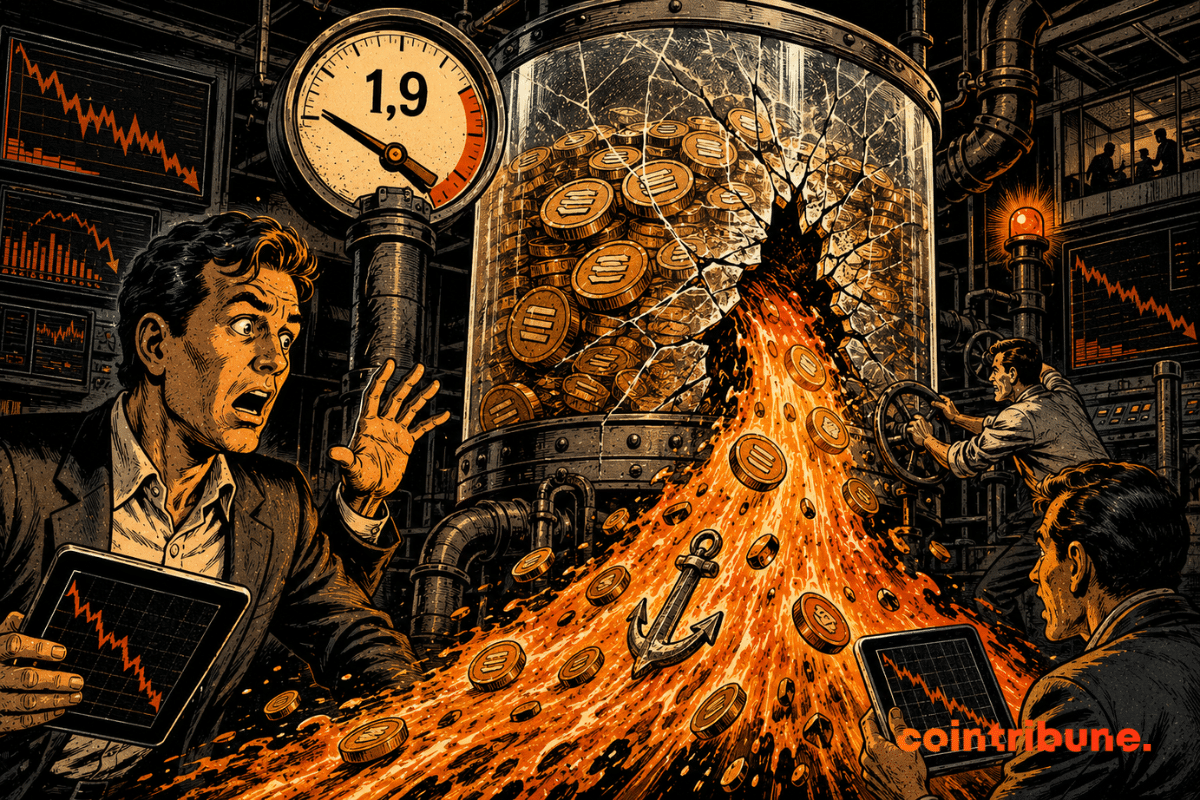
The stablecoin market lost 1.9 billion dollars in one week, despite a capitalization still exceeding 311 billion. The decline remains limited in percentage, but it shows that the liquidity av
The stablecoin market lost 1.9 billion dollars in one week, despite a capitalization still exceeding 311 billion. The decline remains limited in percentage, but it shows that the liquidity available in crypto is contracting slightly. Tether weighs the most in this drop, while Sky Dollar records the sharpest fall among the major stablecoins.
In brief
- The stablecoin market lost 1.9 billion dollars in one week.
- USDT accounts for 41% of the total decline.
- PYUSD grows despite the sector’s overall decline.
Stablecoin: a moderate but visible decline
The stablecoin market shows a total capitalization of 311.311 billion dollars. Over seven days, this represents a decline of 0.61%, or about 1.911 billion dollars withdrawn. This movement follows several months where stablecoins had rather served as a refuge in an unstable crypto market.
The drop is not a collapse. It remains low compared to the fluctuations observed on bitcoin, ether, or altcoins. But it deserves attention because the stablecoin supply often acts as a gauge of the available liquidity.
When stablecoin capitalization increases, it may signal the arrival of new dollars in the ecosystem. When it falls, it may indicate redemptions, capital outflows, or a rotation towards other financial products.
Tether’s USDT lost 791 million dollars over the week. Alone, this decline represents about 41% of the total stablecoin market drop. This is explained by its size: with 184.112 billion dollars capitalization, USDT still largely dominates the sector. Its market share reaches 59.14%. Therefore, Tether’s stablecoin remains the main settlement tool on crypto platforms. Even a limited drop of 0.43% moves several hundreds of million dollars.
Circle’s USDC also declines. Its capitalization reaches 73.098 billion dollars after a 1.05% drop over seven days. Together, USDT and USDC still represent more than 82% of the top 15 capitalization. This duopoly offers a clear market reading. When the two largest stablecoins fall simultaneously, the contraction does not come from a single isolated issuer. It affects the core of crypto liquidity.
Your 1st cryptos with BitpandaThis link uses an affiliate program.Sky Dollar leads the decline of the stablecoin market
Sky Dollar, or USDS, records the largest weekly drop among the top fifteen stablecoins. Its capitalization falls by 2.36%, to around 8.02 billion dollars. The decline remains contained, but it contrasts with the stronger dynamics recently shown by some competitors.
World Liberty Financial USD1 also declines by 1.77%, to 4.61 billion dollars. Global Dollar loses 1.19%, while Ethena USD slips 0.49%. Thus, the pressure focuses mainly on several mid-tier stablecoins. DAI resists better, gaining slightly 0.09% to 4.851 billion dollars. This gain is too small to change the market balance, but it shows that not all stable assets follow exactly the same trajectory.
PayPal’s PYUSD stands out in the opposite direction. Its capitalization grows by 4.25%, to 2.836 billion dollars. This increase confirms that some payment players continue to attract capital in the stablecoin sector despite the general retreat.
A liquidity signal to watch
The 1.9 billion drop is not enough to announce a massive exit from the crypto market. The stablecoin sector remains close to its recent range, between 300 and 315 billion dollars. The movement looks more like an adjustment than a sudden flight.
However, the trend must be monitored over several weeks. A lasting contraction would reduce the dry powder available to buy digital assets. Traders often use stablecoins as a waiting reserve before returning to bitcoin, ether, or riskier tokens.
The stablecoin market is also changing in nature. Alongside settlement tokens like USDT and USDC, new products seek to offer yield or exposure to tokenized Treasury bills. Circle USYC, BlackRock BUIDL, and Ondo USDY show that the boundary between stablecoin, money market fund, and tokenized asset is becoming finer.
This transformation can attract more stable capital, but it can also fragment the market. Users no longer just seek a liquid digital dollar. Some want yield, others prioritize compliance, speed, or payment access. That is why the current decline must be read with nuance. The stablecoin market contracts this week, but it remains at the center of crypto usage, notably in cross-border payments.