SpaceX is planning its first orbital attempt with Starship on Flight 14.The company said in a September 15 update that the rocket pushes for orbit only if it passes a health check partway thr
SpaceX is planning its first orbital attempt with Starship on Flight 14.The company said in a September 15 update that the rocket pushes for orbit only if it passes a health check partway through the flight.
Orbit is the gate SpaceX must pass before Starship can carry its bigger V3 satellites and conduct in-space refueling tests.
More than 500 sensors feed the abort call
First, the plan keeps Starship on a well-known path. The upper stage will trace the same passively safe, suborbital arc to the Indian Ocean after the ascent burn that SpaceX used on previous tests, the company’s update said.
Flight controllers get their decision point in the next coast. They clear the vehicle to proceed or let it fall back and splash down.
If the vehicle is good, one Raptor sea-level engine fires a circularization burn to place Starship into orbit.
SpaceX describes the flight profile as a deliberate staging approach that keeps an ocean splashdown option open at several pre-set points, rather than committing to orbit the moment the engines cut off.
A deorbit burn on that same engine ends a nominal mission. The spacecraft can either splash down in the ocean or return to the launch site to be caught and reused.
The flight is expected to run close to 10 hours. Starship will fly about 275 km above Earth and complete about six orbits before splashing down in the Pacific Ocean west of Chile.
SpaceX will also test the booster through launch, ascent, stage separation, and a boostback burn. Its landing burn targets an offshore point in the Gulf of America.
Starship will deploy 26 Starlink V3 satellites, the first of that type to fly. Each one adds 1 Tbps of capacity, or 26 Tbps on this mission alone.
SpaceX says its early abort rules will be cautious. The watch list includes Raptor engine health, the flight computers and navigation sensors, and the integrity of the propellant tanks and feedlines.
The controllers also track whether the vehicle sustains tank pressure and attitude control. They look for common-mode failures such as a loss of power or communications.
More than 500 physical sensors throughout the vehicle take measurements of temperature, pressure, acceleration, and other readings, with additional components reporting their own status, the company said.
If a monitored system falters once Starship is circling Earth, controllers can opt to perform an early water landing.
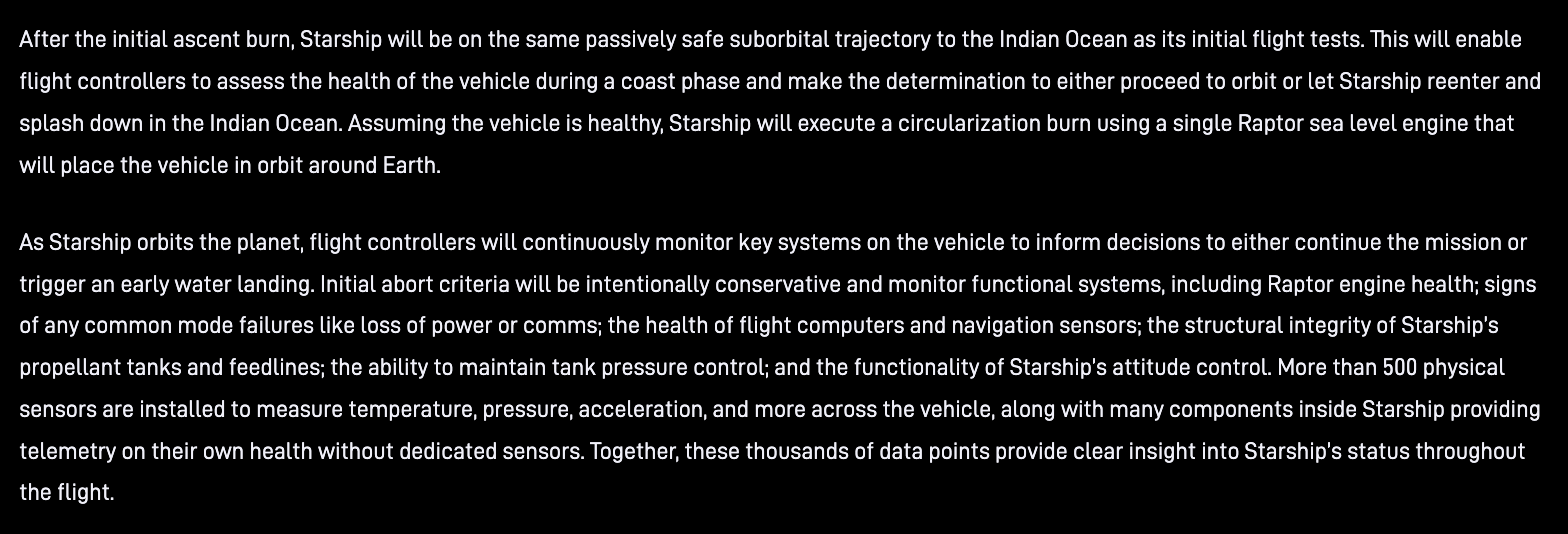
SpaceX’s September 15 update setting out the coast-phase go/no-go and the abort criteria for Starship Flight 14. Source:
SpaceX.
The FAA cleared airspace from 7:15 to 9:14 a.m. CT
On all 13 previous test flights, SpaceX purposely withheld the forward speed needed to stay aloft so that a loss of control would still end in a planned reentry and ocean splashdown. This allowed engineers to collect flight data while limiting public risk.
Rather than an expendable upper stage, Starship is designed to survive reentry intact, the company says, and that’s how it handles the transition.
SpaceX points out that several Starships endured reentry even after tests stripped away heat-shield tiles to simulate failures and stressed the airframe with stress maneuvers.
Orbit, the company says, is a prerequisite to its longer-range goals of deploying satellites at scale, returning crews to the Moon, and, eventually, moving cargo and people to make life multiplanetary.
Starship could cut the cost of getting to orbit by 99%, its SEC filing said, Cryptopolitan reported in June.
The FAA penciled in September 22 as the next opportunity to launch Starship and Super Heavy from Boca Chica Beach, Texas. The launch attempt window opens from 7:15 to 9:14 a.m. CT with a backup window in the same slot.
SpaceX aborted Flight 13 in the final seconds before liftoff on July 16, and its stock closed at $131.11 that day.
Flight 13 was the second flight of the Starship Version 3 design, a 124-meter rocket capable of carrying more than 100 tons.
Don’t just read crypto news. Understand it. Subscribe to our newsletter. It's free.