The Stellar Development Foundation announced that MoneyGram, Figure Markets and Range will run Tier 1 validators on the Stellar network, with full quorum integration expected by mid-August. R
The Stellar Development Foundation announced that MoneyGram, Figure Markets and Range will run Tier 1 validators on the Stellar network, with full quorum integration expected by mid-August.
Read past the headline and there is a design argument underneath it that most validator announcements do not have.
What a Tier 1 validator actually signs up for
"Became a validator" sounds like flipping a switch. On Stellar, at the Tier 1 level, it is a standing operational commitment. Per SDF, each organization has to:
- run three geographically dispersed full validators
- publish a complete history archive
- sustain 99.9% uptime or higher
- complete SEP-1 and SEP-20 self-verification
- coordinate actively with the existing Tier 1 community
That is a staffed obligation with a pager attached, not a press release. It is worth holding onto that detail, because it is the thing that makes the identity of the operator mean something.
Why identity matters more here than on most networks
On a lot of networks you do not choose your validators. The set is whoever meets the stake threshold, and you inherit it.
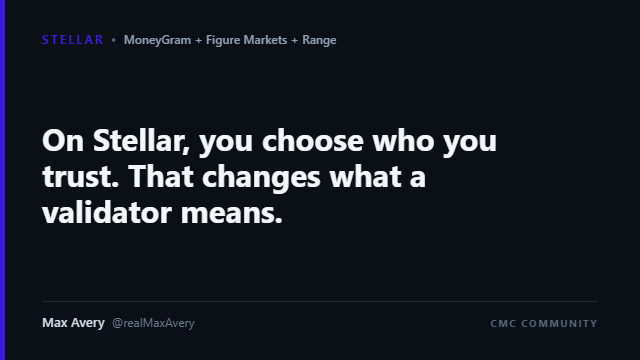
Stellar works differently. Under the Stellar Consensus Protocol, in SDF's own description, "each validator chooses which others it trusts, its quorum set, to agree on the state of the ledger." Trust is configured, not assumed. SDF is direct about who that is aimed at: it lets institutions select "exactly whom to trust, giving risk teams a vetted set of recognizable peers."
That single design choice is why this announcement is different in kind from a partnership announcement. Adding MoneyGram to the network is a business development outcome. Adding MoneyGram to the set of entities a risk committee can name, look up, and point at in a memo is an infrastructure outcome. The second one is what unblocks a compliance review.
What these three specifically bring
The composition is not accidental. Each covers a different failure mode.
MoneyGram has partnered with Stellar since 2021 and operates cash on and off ramps at global scale. It is an operating payments company with its own money at risk on the network, which is a different kind of participant from a crypto-native validator running nodes as a service.
Figure Markets brings regulated capital markets experience and issues $YLDS on the network. Karl Samsen, Principal for $YLDS at Figure, framed issuing and validating as two halves of the same commitment.
Range is a security platform that monitors stablecoins and digital assets across more than 200 blockchain networks and secures $30 billion in assets. Its CEO, Andres Monteoliva, described the point as bringing monitoring expertise "directly to the consensus layer."
Jose Fernandez da Ponte, SDF's President and Chief Growth Officer, put the goal plainly: the additions make Stellar "an even better network for regulated finance to run on."
The honest limitation
Three organizations is a small number, and adding named institutions is a particular kind of decentralization rather than decentralization in general. A network where the trusted set is a short list of recognizable regulated firms is more legible to a risk team and less permissionless than one where anyone can join the validating set. Those are real trade-offs, and Stellar is choosing a side deliberately.
It is a defensible choice for a network explicitly targeting regulated finance. It is still a choice, and anyone evaluating Stellar should price it as one rather than read "more validators" as strictly better.
What I'd watch next
- Whether quorum integration actually completes in mid-August. A date was given. It either lands or it slips, and that is checkable.
- Whether a fourth regulated institution follows within two quarters. One cohort is an initiative. A queue behind it is a trend.
- Whether the Tier 1 list starts showing up in risk documentation rather than in marketing. That is the actual test of whether a vetted set of recognizable peers does the job SDF says it does.
- Whether uptime holds. 99.9% is a published commitment, and it is measurable in public.
The part that generalizes
Strip out the protocol detail and Stellar is making an argument that a lot of people holding digital assets never make explicitly: that trust should be configured rather than inherited, and that you should be able to name the parties you are relying on.
Institutions get to encode that in a quorum set. Individuals mostly inherit whatever their exchange decided. Getting deliberate about who actually holds your assets is the same exercise a risk committee runs, at a different scale.
Trust that is chosen and written down survives contact with a bad week. Trust that was never examined tends not to.