Six of the most prominent names in blockchain infrastructure have signed onto a joint letter addressed to the U.S. Securities and Exchange Commission, a coordinated move that signals a new le
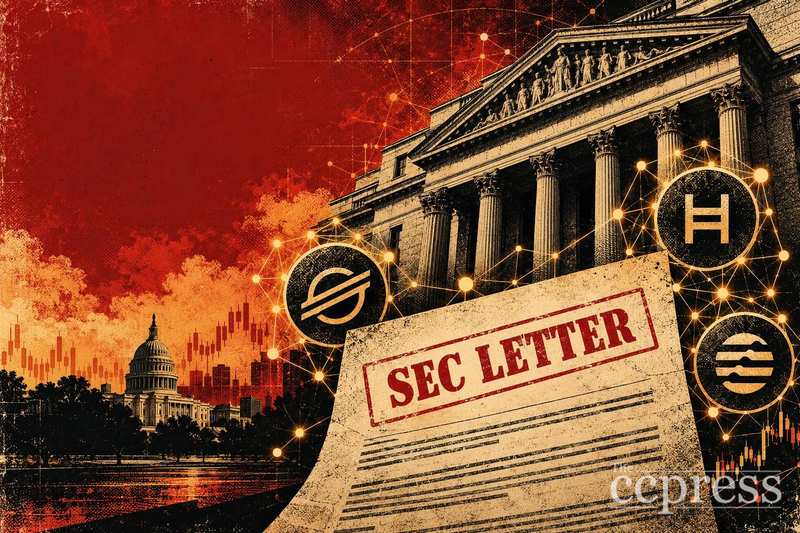
Six of the most prominent names in blockchain infrastructure have signed onto a joint letter addressed to the U.S. Securities and Exchange Commission, a coordinated move that signals a new level of industry unity on the question of crypto regulation. Stellar, Hedera, Aptos, Avalanche, Cardano and Chainlink are among the signatories, spanning layer-1 networks, enterprise distributed ledger platforms, and decentralized oracle infrastructure.
The breadth of the coalition is what makes this notable. These are not fringe players or newcomers. They represent networks that collectively underpin payments infrastructure, enterprise tokenization, institutional DeFi, and smart contract data feeds used across hundreds of protocols. For related coverage, see Turbo Energy Launches Tokenized Solar Financing on Stellar.
Which Crypto Networks Joined the Letter to the SEC?
The signatories cover a wide cross-section of the blockchain industry. Stellar is a payments-focused network with a track record in cross-border settlement and asset tokenization; the Stellar Development Foundation has previously backed real-world asset projects, including tokenized debt instruments explored by Spanish energy firm Turbo Energy on the Stellar network. For related coverage, see Spain's Turbo Energy Trials Debt Tokenization on Stellar.
Hedera is the enterprise-grade distributed ledger backed by a governing council of major corporations, designed for high-throughput, low-cost transactions. Aptos is a newer layer-1 built on Move, the language developed from Meta’s Diem project, positioned for scalable application deployment. For related coverage, see Omni by Variational Review 2026: Complete Beginner's Guide.
Avalanche brings its subnet architecture and active DeFi ecosystem. Cardano, one of the longest-standing proof-of-stake networks, has built its identity around peer-reviewed research and deliberate protocol development. Chainlink rounds out the group as the dominant decentralized oracle network, providing the off-chain data feeds that DeFi protocols depend on to function. For related coverage, see How Instant Crypto Swaps Work in 2026: Mechanisms, Routing, and Risk.
What unites them here is not a shared technical architecture. It is a shared frustration with regulatory uncertainty in the United States and a decision that collective action carries more weight than individual engagement with the SEC’s ongoing review of crypto asset regulation. For related coverage, see Is ChangeNOW Legit? What the Evidence Shows in 2026.
What Does the Letter Ask the SEC to Do?
The specific demands of the letter have not been independently verified in the research available at time of publication. What is clear from the headline and the identity of the signatories is that this is a formal, coordinated communication directed at the Commission, not a public campaign or social media pressure effort.
Industry letters to the SEC typically request one or more of the following: clearer guidance on which digital assets qualify as securities under the Howey test, formal rulemaking rather than enforcement-only action, or safe harbor provisions for projects during development. Whether this letter takes one of those angles or a different approach entirely requires confirmation from the full text.
The involvement of Chainlink is particularly significant from a regulatory framing perspective. As an oracle network rather than a native blockchain, Chainlink sits in a category that regulators have found difficult to classify. Its inclusion suggests the letter may address infrastructure and middleware components of the crypto stack, not just layer-1 tokens.
Cardano and Avalanche are both networks whose native tokens have been the subject of ongoing SEC scrutiny debates within the industry. Their participation signals that the letter likely touches on the securities classification question directly. Hedera’s inclusion, given its enterprise focus and governing council model, may reflect concern about how permissioned and hybrid networks are treated under the same regulatory framework as public chains.
Why the Joint SEC Letter Matters for the Crypto Industry
A letter to the SEC does not change policy. The Commission is not obligated to respond, alter its enforcement posture, or open a formal rulemaking process as a result of industry correspondence. That caveat matters and should not be glossed over.
What coordinated letters do accomplish is create a documented record of industry engagement. In any subsequent litigation or Congressional review, the existence of a multi-network formal request strengthens the argument that affected parties sought regulatory clarity before enforcement action arrived. That is a legal and political strategy as much as a policy one.
The diversity of signatories also makes this harder to dismiss as a narrow self-interest play by a single project. Stellar and Chainlink serve meaningfully different constituencies. Aptos and Cardano are at very different stages of ecosystem maturity. When networks with diverging technical approaches and user bases align on a regulatory message, it carries more weight than a solo filing.
The timing also matters. U.S. crypto regulation has been in a state of contested flux, with multiple enforcement actions, court rulings, and proposed legislative frameworks all creating an unclear operating environment for networks trying to build compliant products. Projects exploring tokenized real-world assets, like the solar debt tokenization work done on Stellar, depend on clarity about whether the instruments they issue fall under securities law.
For users and developers building on any of these six networks, the letter represents an attempt to move the regulatory conversation from case-by-case enforcement toward something more durable. Whether the SEC engages substantively with that request is the question the industry is now waiting to have answered.
What happens if the SEC stays silent? That answer could determine whether the next coordinated move from this coalition is another letter, or something more confrontational entirely.
Additional source references: source document 1.
Disclaimer: This article is for informational purposes only and does not constitute financial or investment advice. Cryptocurrency and digital asset markets carry significant risk. Always do your own research before making decisions.
The article Stellar, Hedera, Aptos and Others Join SEC Letter first featured on theccpress.com.