Stellar has had a quietly consequential few weeks. While XLM's price has been grinding through a recovery from its February 2026 low near $0.14 — currently trading around $0.19 with a 7.72% g
Stellar has had a quietly consequential few weeks. While XLM's price has been grinding through a recovery from its February 2026 low near $0.14 — currently trading around $0.19 with a 7.72% gain over the past seven days — the more significant developments have been happening at the institutional and protocol level rather than on price charts.
Three events in rapid succession have repositioned how the market should be thinking about Stellar heading into the second half of 2026.
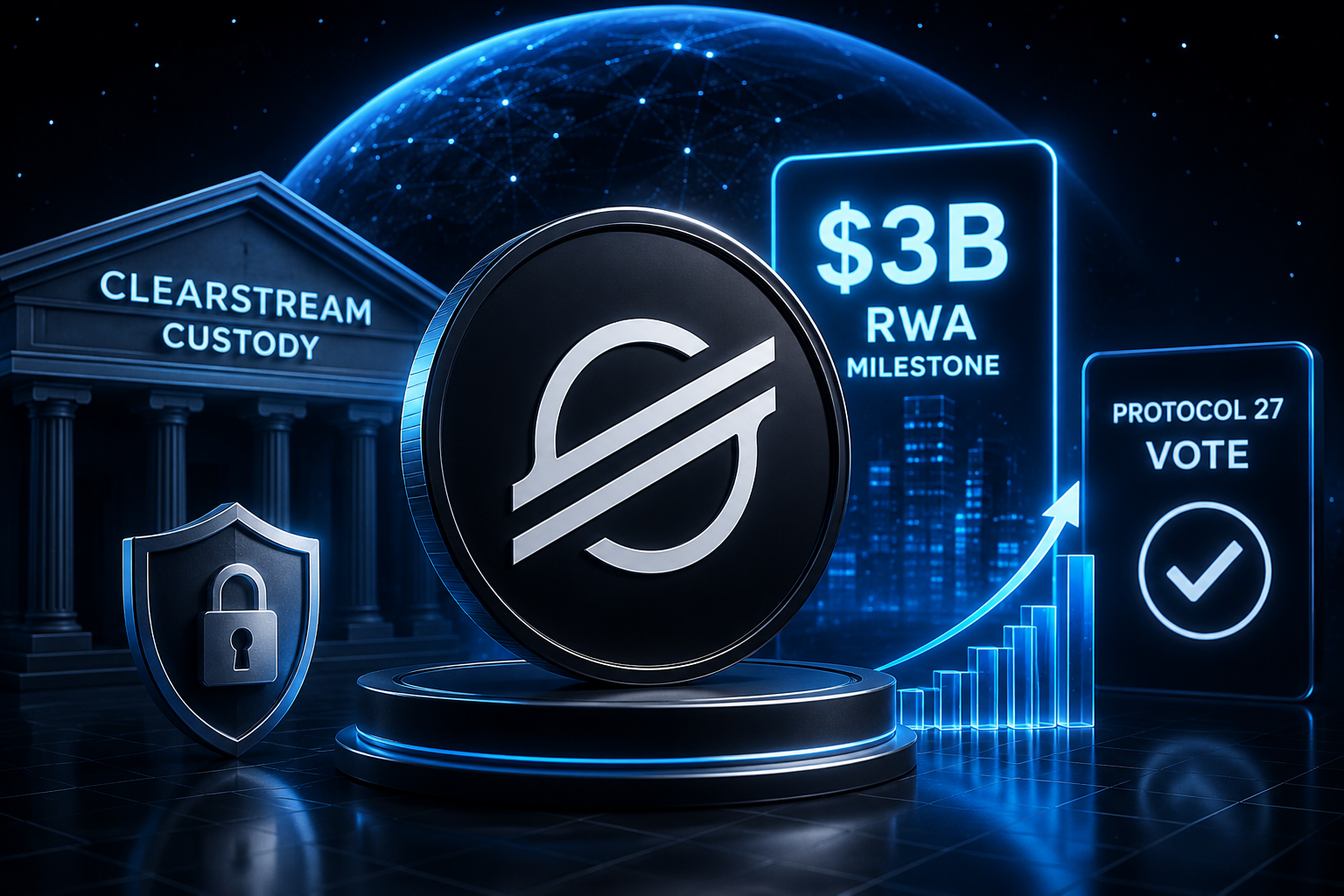
Clearstream Adds XLM to Regulated Custody
On July 8, Clearstream — Deutsche Börse Group's post-trade services provider and one of the most systemically important financial infrastructure operators in Europe — expanded its institutional crypto custody service to include XLM alongside five other major digital assets. With approximately 2,500 institutional clients including major banks and asset managers, Clearstream's custody service represents a MiCA-compliant on-ramp for European institutions that would otherwise lack a regulated pathway to XLM exposure.
This matters in a specific way. Institutional participants don't buy assets through retail exchanges. They require regulated custody infrastructure that meets their compliance obligations before they can allocate. Clearstream providing that infrastructure for XLM removes a structural barrier that has kept a meaningful segment of European institutional capital on the sidelines regardless of the investment thesis.
Tokenized RWA Volume Crosses $3 Billion
On July 7, the value of real-world assets tokenized on the Stellar network crossed $3 billion — a milestone that reflects several years of quiet infrastructure buildout finally generating measurable economic activity. Stellar's compliance-first architecture, built-in DEX, sub-cent transaction fees, and existing relationships with institutions like Franklin Templeton, Circle, and MoneyGram have made it a preferred rail for RWA tokenization projects that need regulatory defensibility alongside technical performance.
USDC is natively issued on Stellar, and Circle's CCTP integration announced in May 2026 now enables native cross-chain USDC transfers across 23 blockchains — dramatically expanding Stellar's interoperability footprint and making it a more practical settlement layer for multi-chain RWA structures. MoneyGram's integration provides access to 475,000 physical off-ramp locations globally, adding the last-mile infrastructure that purely digital rails typically lack.
Protocol 27 Vote and a Quantum Preparedness Plan
The July 8 Protocol 27 mainnet vote introduces delegated authentication features that improve smart contract security and developer flexibility on the Soroban platform. Soroban — Stellar's Rust and Wasm-based smart contracts layer — has been live since early 2024 and is in active but early adoption, with DEXs and AMMs like Phoenix and Aqua already running and lending markets currently in development.
The longer-term roadmap includes a three-stage Quantum Preparedness Plan. The 2026 phase introduces NIST-approved quantum-safe signature types for Soroban smart contract accounts. A 2027 protocol update will allow traditional Stellar accounts to add these new signers while maintaining their existing address and history. And a planned 2026 Protocol 24 upgrade will integrate zero-knowledge proofs and confidential assets — allowing private transactions that still provide the compliance verification data that regulated institutions require.
That combination — privacy plus compliance simultaneously — is a technically difficult problem that most privacy-focused chains have failed to solve. Stellar's approach, which prioritizes meeting institutional requirements rather than maximizing anonymity, reflects a deliberate choice about who the network is building for.
The Core Question Heading Into H2 2026
XLM is currently trading around 79% below its all-time high and below its 200-day moving average, with roughly one-third of total supply still to enter circulation. The infrastructure story — Clearstream custody, $3 billion in RWA volume, CCTP integration, Soroban buildout — is improving faster than price action suggests.
The thesis hinges on a single question: does Soroban adoption cross from infrastructure deployed to developers and users actually showing up? If Soroban's DeFi ecosystem develops genuine activity comparable to what Stellar's payment rails already process, XLM at current levels looks meaningfully undervalued relative to comparable L1s. If adoption stalls and Stellar remains primarily a payment network with an underutilized smart contract layer, the discount is more justified than it appears.
The $0.25 to $0.27 resistance zone is the near-term technical level to watch. A decisive close above that range would be the first signal that the institutional catalysts are beginning to feed through into sustained price recovery.