Key Highlights Wall Street futures advanced Monday following a diplomatic agreement between the U.S. and Iran to cease military operations and continue peace discussions Nasdaq 100 contracts
Key Highlights
- Wall Street futures advanced Monday following a diplomatic agreement between the U.S. and Iran to cease military operations and continue peace discussions
- Nasdaq 100 contracts jumped more than 1%, bouncing back after five consecutive days of losses
- The Magnificent Seven technology giants have shed approximately $2.8 trillion in combined valuation this month
- Crude oil markets saw modest increases but remained relatively calm despite Middle East tensions
- Investors await critical June employment figures Thursday and Fed Chair Warsh’s debut on the global stage
Wall Street equity futures posted solid gains Monday morning following news that Washington and Tehran reached an accord to suspend military operations and restart diplomatic discussions.
Contracts tied to the Nasdaq 100 spearheaded the advance, surging more than 1%. Futures linked to the S&P 500 climbed approximately 0.8%, while Dow Jones Industrial Average contracts added roughly 0.4%.
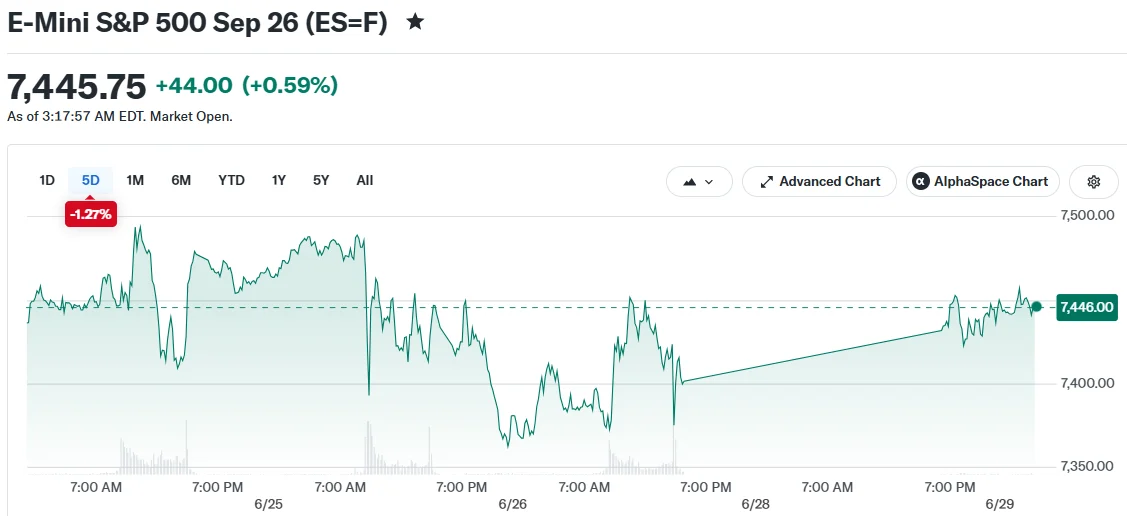 E-Mini S&P 500 Sep 26 (ES=F)
The diplomatic breakthrough materialized after an intense weekend marked by heightened military confrontation. Washington conducted precision strikes against Iranian military installations following allegations that Tehran executed attacks targeting shipping lanes near the Strait of Hormuz. President Trump indicated additional measures remained under consideration.
Both nations have now committed to suspending aggressive actions while advancing peace negotiations that originated from a memorandum of understanding executed on June 17.
Oil prices experienced modest initial gains but subsequently retreated. Brent crude edged up 0.6% to $73 per barrel. West Texas Intermediate increased 0.9% to approach $70.
Market analysts at ING observed that petroleum markets have remained relatively stable despite the military confrontation. They emphasized that the primary concern centers on potential interruptions to crude shipments through the Strait of Hormuz.
Technology Sector Faces Selling Pressure
Technology equities endured significant weakness entering Monday’s session. The Nasdaq Composite registered declines across five consecutive trading sessions — marking its most extended losing stretch since January.
Nvidia and Alphabet each surrendered more than 8% during the previous week. The collective Magnificent Seven cohort has erased nearly $2.8 trillion in aggregate market capitalization throughout this month, potentially establishing a monthly record according to FactSet data.
The technology sector’s recovery in pre-market trading Monday indicates certain market participants are capitalizing on discounted valuations. The sustainability of this bounce will likely hinge on forthcoming economic indicators.
Critical Market Catalysts This Week
Investors face a holiday-shortened week, with Wall Street shuttered Friday in observance of Independence Day.
Thursday’s June employment situation report from the Bureau of Labor Statistics represents the week’s marquee release. The nonfarm payrolls figures carry substantial weight in Federal Reserve monetary policy deliberations.
Preceding the jobs data, the Job Openings and Labor Turnover Survey releases Tuesday. The ISM Manufacturing PMI arrives Wednesday.
Newly appointed Fed Chair Kevin Warsh will participate in his inaugural international engagement at the European Central Bank’s annual symposium in Sintra, Portugal, scheduled from June 29 through July 1. His perspective on monetary policy trajectory will attract considerable market attention.
The 10-year U.S. Treasury yield registered 4.382% in early Monday trading, ticking modestly higher from the previous week.
Market participants remain vigilant entering a week where geopolitical developments and employment statistics possess the potential to generate significant price volatility.
The post Stock Futures Surge on U.S.-Iran De-escalation Agreement, Tech Stocks Rebound appeared first on Blockonomi.