Wall Street's biggest fundraisers this year read like a who's who of the future: a rocket company, Google's parent and America's most famous chipmaker. And then, according to its CEO, there's
Wall Street's biggest fundraisers this year read like a who's who of the future: a rocket company, Google's parent and America's most famous chipmaker.
And then, according to its CEO, there's Strategy (Nasdaq: MSTR), a company that used to sell business software and now mostly buys Bitcoin (BTC).
Strategy ranks fourth among U.S. companies raising money by selling stock in 2026, behind only SpaceX (Nasdaq: SPCX), Alphabet (Nasdaq: AAPL) and Intel (Nasdaq: INTL), CEO Phong Le wrote on X. He added that Strategy was No. 1 in 2025 and No. 2 in 2024.
"The AI investment cycle is massive. So is the Bitcoin capital cycle," Le wrote.
What 'equity issuer' means
When a company issues equity, it sells new shares to investors in exchange for cash. Most companies do it to raise capital to build factories, hire employees, or develop products.
SpaceX builds rockets. Alphabet builds AI. Intel builds chips.
Strategy builds a pile of Bitcoin.
For a sense of the company Strategy is keeping, SpaceX raised $75 billion in June in the largest IPO ever. The deal valued Elon Musk's rocket and AI company at about $1.77 trillion, Reuters reported.
Strategy's haul is smaller but still eye-popping. The company has raised about $21 billion from selling shares so far this year, it said in its third-quarter results released last week, and has spent $14.33 billion buying Bitcoin.
That pile is now enormous.
Strategy holds 849,327 Bitcoin, bought for about $64 billion in total, according to a filing on Monday. That's roughly 4% of all the Bitcoin that will ever exist.
Strategy bought another 811 Bitcoin last week, paying an average of $80,846 per coin, Monday's filing showed.
The timing wasn't perfect. Bitcoin traded near $77,000 on Tuesday. Across its whole stash, though, Strategy's average cost is $75,451 per coin, so its giant bet is still slightly in the green.
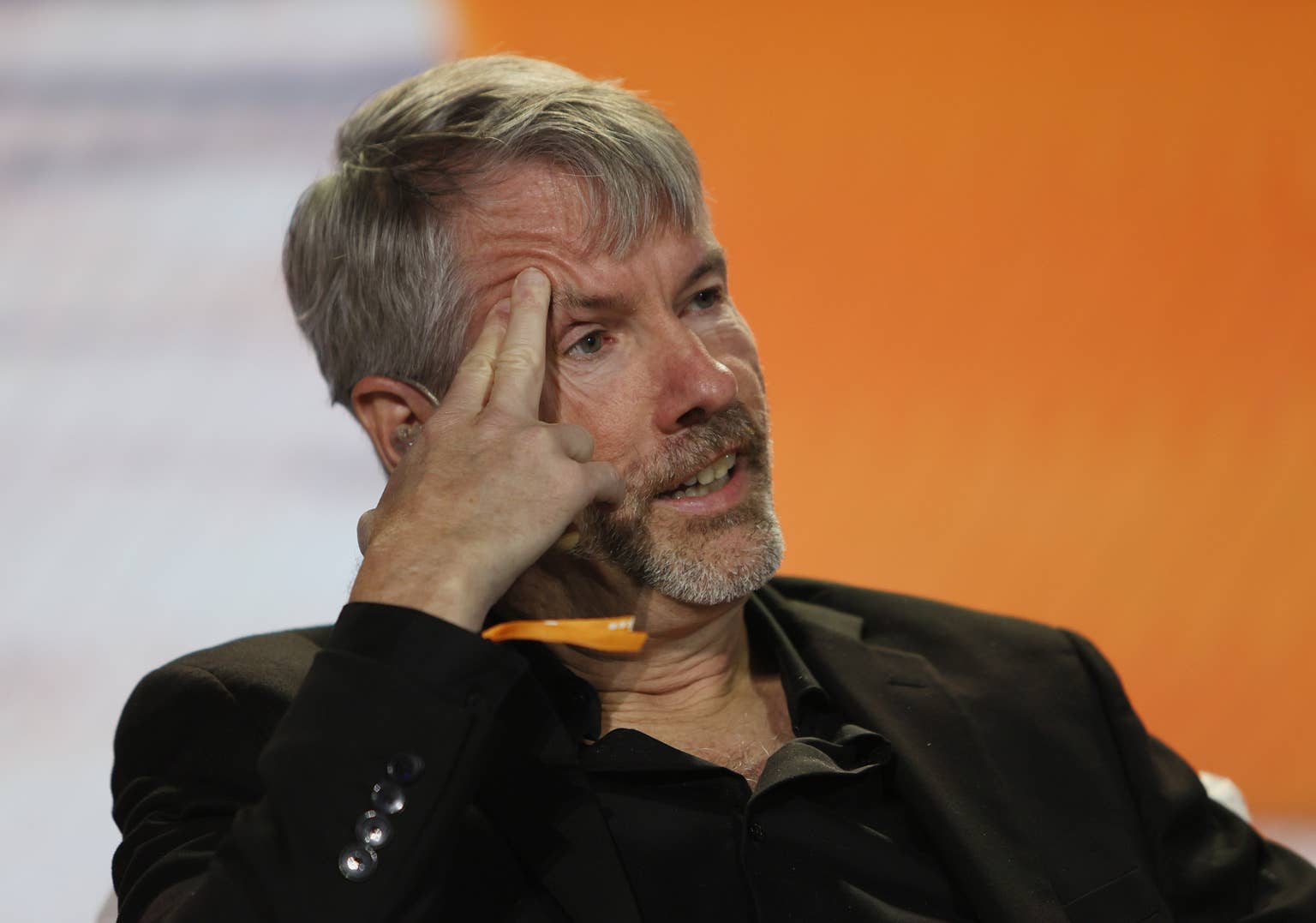
Cofounder and executive chairman Michael Saylor, who is among Bitcoin's loudest cheerleaders, isn't worried.
"We're at the beginning of the next bitcoin bull market," he remarked.
MicroStrategy CEO Michael Saylor speaks at the Bitcoin 2021 Convention.
Source: Getty Images
How the money machine works
Strategy raises cash in two main ways.
The first is selling its regular common shares, known by the ticker MSTR. This works best when investors pay more for Strategy's stock than the Bitcoin behind each share is worth.
The second is preferred stock, a kind of hybrid between a stock and a bond. Buyers get regular dividend payments, much like interest, and get paid before ordinary shareholders. But they usually don't get a vote. Strategy sells several of these with names that might sound like a gym class: Stretch, Strike, Stride and Strife.
Saylor has described the business as a company that sells credit to investors and uses the cash to buy Bitcoin.
That credit isn't free. Strategy's preferred dividends cost about $1.76 billion a year.
More on TheStreet Roundtable
The year 'never sell' got complicated
For years, Saylor's message to the world was simple: never sell your Bitcoin.
Then 2026 happened.
As Bitcoin slid from its October 2025 record, Strategy made its first Bitcoin sale since 2022 in May, and then sold 3,588 coins for about $216 million in late June and early July.
Saylor later explained that "never sell" was advice for regular people holding Bitcoin, not a rule for how a company like Strategy manages its money.
The buying resumed soon after, and the company is now back near its record stash.
Same league, different game
Le's comparison is bold, but the money is real.
Investors handed Strategy about as much cash this year as some of the biggest names in tech.
The difference is what that cash becomes. SpaceX's money turns into rockets, Alphabet's into data centers. Strategy's money turns into Bitcoin, and its fortunes rise and fall with it.
The Roundtable 100
If you follow our market coverage, don’t miss the Roundtable 100. Updated every Friday, it's a power ranking of the 100 most investable tech stocks, including digital assets. Check out the latest RTB 100 rankings at roundtable100.com.
Related: Musk could miss his $1 trillion payday but gain control of a $2 billion Bitcoin stash