The world's biggest corporate Bitcoin holder just lost its seat at the index table. MSCI confirmed on November 11 that it will drop Strategy from its benchmark equity indexes at the close of
The world's biggest corporate Bitcoin holder just lost its seat at the index table. MSCI confirmed on November 11 that it will drop Strategy from its benchmark equity indexes at the close of November 30, and the timing could hardly be worse. $Bitcoin trades around $64,700, well below the $75,452 Strategy paid on average for each of its coins.
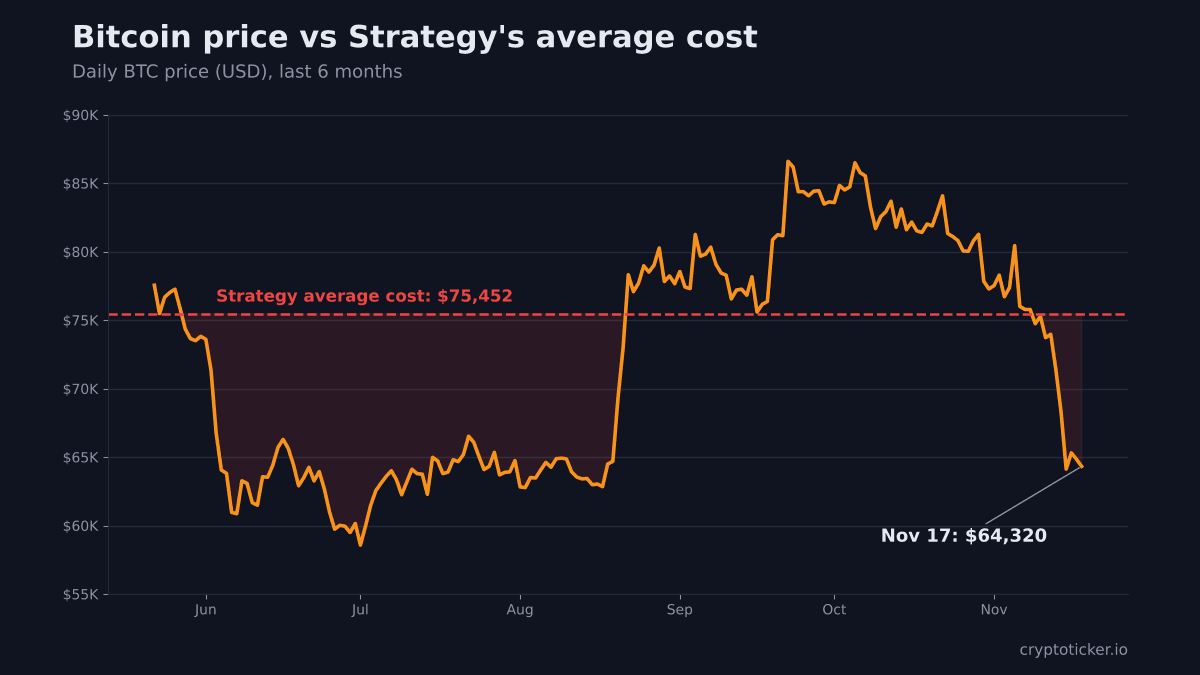
Bitcoin price vs Strategy's average cost over the last six months
So the question every MSTR holder and Bitcoin trader is asking right now: could Michael Saylor be forced to sell? Here is what MSCI decided, what it means for MSTR stock, and why a Bitcoin fire sale is less likely than the headlines suggest.
What Did MSCI Decide About Strategy?
In its November 2026 quarterly index review, MSCI listed Strategy's Class A shares among the deletions from the MSCI USA Index, its US large cap benchmark. The change takes effect after the close on November 30, and the revised index goes live on December 1.
Strategy is not alone. MSCI also removed Japan's Metaplanet, which held 44,000 BTC as of September 30, from the MSCI Japan Small Cap Index, as well as UK uranium holder Yellow Cake. Nearly two dozen other crypto and holding focused companies landed on an exclusion watchlist.
Why Did MSCI Remove Strategy From Its Indexes?
The removal comes from new MSCI rules for so called non-operating companies, adopted on October 15 after a consultation that started in August. The goal is to separate real operating businesses from companies that look more like investment vehicles.
- MSCI first checks whether a company has substantial operating assets.
- If it fails, MSCI runs five financial ratios. Flagged on at least four of them, the company becomes ineligible.
- Existing members must fail the screen in their two most recent annual filing periods before removal.
Strategy fought the rule, arguing that its Bitcoin business is an operating segment under US accounting standards. MSCI did not buy it. Management had already warned in its third quarter SEC filing that an exclusion was likely, so the decision did not come as a shock to the company itself.
How Much MSTR Stock Could Index Funds Sell?
Funds that track MSCI indexes do not get a choice: when a stock leaves the index, they have to sell it. Strategy itself estimated that funds tracking MSCI's Global Investable Market Indexes hold about 13 million MSTR shares, or 3.1% of basic shares outstanding.
At the November 12 close of $114.41, that is roughly $1.5 billion of stock, equal to about 60% of MSTR's average daily trading volume over the prior 30 days. Back in November 2025, JPMorgan had put the risk at $2.8 billion, and up to $8.8 billion if other index providers followed. That estimate was based on MSCI's earlier proposal, so treat it as a worst case rather than a forecast.
The market reaction was swift. MSTR fell 6.5% on November 12, and the stock kept sliding into this week alongside Bitcoin. Shares are down about 20% year to date.
Is Strategy's Bitcoin Stack Underwater?
Yes, and by a lot. According to its official purchase tracker, Strategy held 850,849 BTC as of November 15 after adding another 485 coins last week at an average of $68,887. The whole stack cost about $64.2 billion, or $75,452 per coin.
At around $64,700, those coins are worth roughly $55 billion. That leaves Strategy sitting on an unrealized loss of about $9 billion, with Bitcoin trading some 14% below its average purchase price.
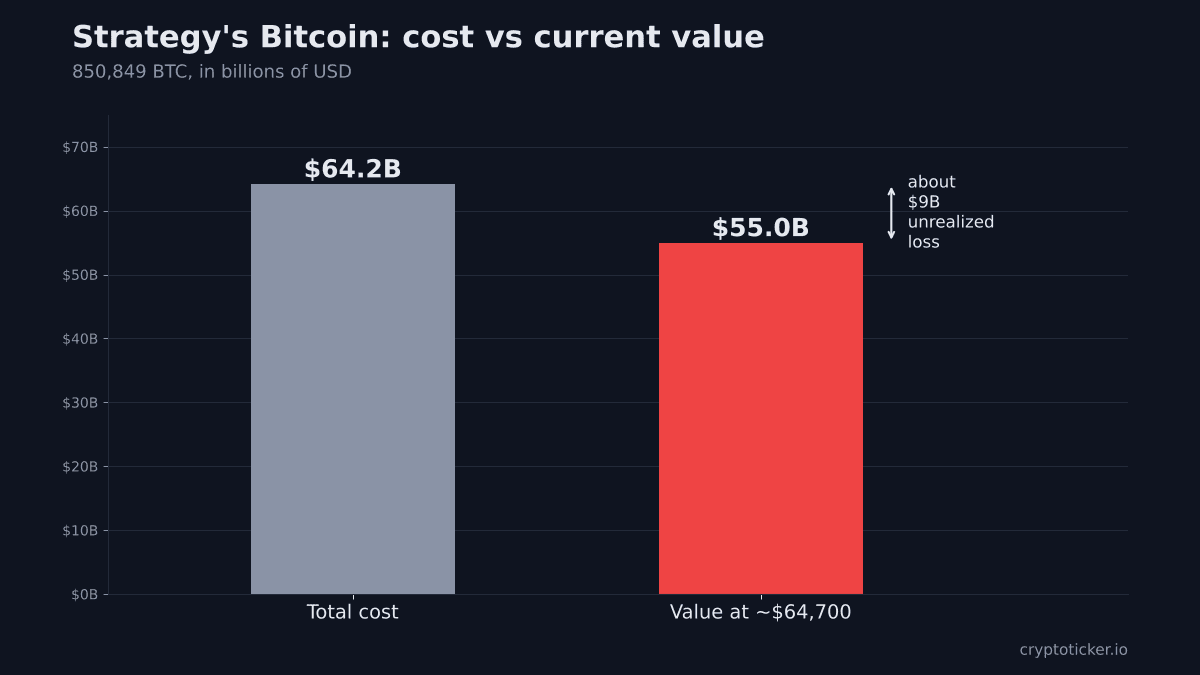
Strategy's Bitcoin holdings: total cost vs current value
The premium that made the whole machine work is also nearly gone. Strategy's mNAV, the ratio between its market value and the value of its Bitcoin, has dropped to around 1.08x, down from about 3.4x in November 2024. When that number is high, Strategy can sell new shares and buy Bitcoin without diluting existing holders. Near 1x, that trick stops working.
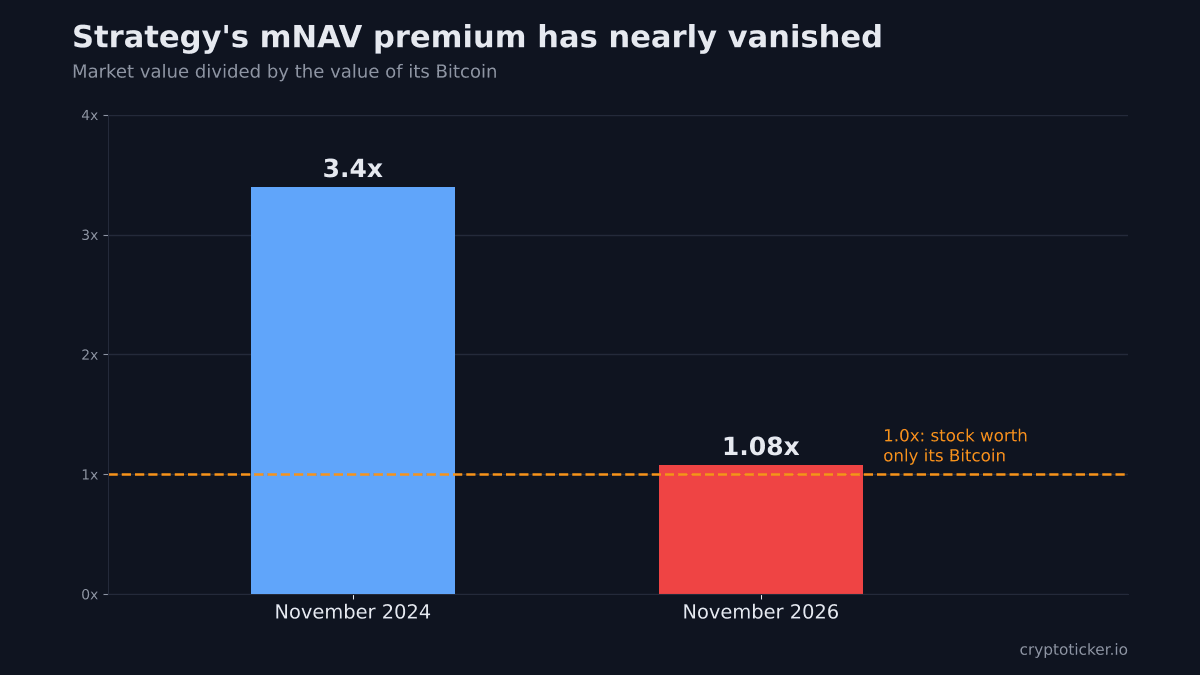
Strategy's mNAV in November 2024 vs November 2026
Will Strategy Sell Bitcoin?
Not because of MSCI, at least not directly. The index funds have to sell MSTR shares, not Bitcoin. The deletion forces nobody to touch Strategy's coins. Any Bitcoin sale would be a separate decision by the company.
There are also a few reasons Strategy is not under immediate pressure:
- A $4.75 billion USD Reserve: built to pay preferred dividends. Last week Strategy drew just $18.9 million from it, a pace that would keep the reserve going for years.
- It is still buying: Strategy added 811, 1,036 and 485 BTC over the past three weeks, about $181 million in total.
- Cash from stock sales: it raised $244.7 million from MSTR share sales last week, most of it spent on buying back its STRC preferred stock.
The real risk is the mNAV. Strategy CEO Phong Le has reportedly said that selling Bitcoin would be a last resort if the stock traded below the value of its holdings and the company could no longer raise capital, though this claim has not been confirmed. At 1.08x, Strategy is closer to that line than at any point in years. A drop below 1x would turn "will Saylor sell?" from a meme into a real debate.
What Does the MSCI Removal Mean for Bitcoin Price?
The direct impact on Bitcoin price should be limited, since the forced selling hits MSTR stock, not BTC. The indirect impact is another story. Strategy has been one of the steadiest Bitcoin buyers of the past two years, and a weaker share price makes it harder to keep buying at the same pace.
It also lands in a brutal market. Spot Bitcoin ETFs saw more than $1 billion in net outflows for a second straight week, traders are pricing a December Fed rate hike, and the Fear and Greed Index on our crypto charts page is stuck in Extreme Fear. Check the latest moves on our crypto prices page.
Key Dates to Watch
- November 19: Fed minutes from the October meeting
- November 30: Strategy leaves the MSCI indexes at the close, index funds rebalance
- December 1: Revised MSCI indexes go live
- December 8 to 9: FOMC meeting and rate decision
- December 11: Nasdaq-100 annual reconstitution announcement
The bottom line: MSCI's decision is a blow to Strategy's prestige and a short term headache for MSTR stock, but it does not force a single Bitcoin out of Saylor's wallet. The number to watch is the mNAV. As long as it stays above 1x, Strategy keeps its options open. If it breaks below, the pressure on the biggest Bitcoin treasury on the planet becomes very real.