Strategy closed Friday at $81.62 with a market capitalisation of $34.47 billion. The 850,364 bitcoin it reports holding were worth $50.58 billion at $59,485 on Sunday morning. Divide one by t

Strategy closed Friday at $81.62 with a market capitalisation of $34.47 billion. The 850,364 bitcoin it reports holding were worth $50.58 billion at $59,485 on Sunday morning. Divide one by the other and the equity market is paying about $40,536 for each coin in the treasury, roughly 32% under the price of the coin itself.
Monday’s close is the moment MSCI makes that gap expensive to ignore. The index provider’s November review takes effect at the close of November 30, and Strategy is on the deletion list. Funds that track an MSCI index have to own what the index owns, so their last compliant print is Monday’s session.
JPMorgan analysts put the index-related selling at about $2.8 billion, with up to $8.8 billion more if other providers adopt the same screen. That estimate is the number travelling through coverage of the decision. Put it against the tape and it reads smaller. Strategy traded 16,475,346 shares on Friday’s shortened session, about $1.35 billion of turnover at the closing price. The forced sale is a little over two days of ordinary volume, and 8.1% of the company’s market value.
What MSCI’s Review File Actually Sets
The paperwork is specific about timing. The MSCI Global Standard Indexes review file opens with the basis of the exercise: “This report presents the MSCI Global Standard Indexes review results based on data as of the price cutoff date of October 20, 2026.” Two lines later it fixes the implementation: changes are “effective as of the close of business on November 30, 2026.”
The accompanying press release repeats it in one sentence, “All changes will be implemented as of the close of November 30, 2026,” and quantifies the wider review: thirteen additions and 100 deletions from the MSCI ACWI Index, 171 additions and 243 deletions from the ACWI Small Cap Index. The USA Index alone takes 24 deletions against a single addition, Moderna. “STRATEGY A” sits in that deletion column.
MSCI also leaves itself room to move something before the effective date: “Results may be updated to reflect the impact of corporate events, Ineligible Alert Board (IAB) treatments, or other relevant adjustments occurring between the price cutoff date and the effective date.” That is standard language. It matters here only because the window has nearly closed. What MSCI called for on November 11, and what its non-operating screen produced, is now three sessions from execution.
The Premium Was the Product
Strategy’s balance sheet grew on a simple loop: sell equity at a premium to the value of the bitcoin it already held, use the proceeds to buy more bitcoin, and let the coin-per-share figure rise. The loop pays while the stock clears above net asset value. It runs backwards when the stock clears below it, because every new share then dilutes coin-per-share instead of adding to it.
Friday’s numbers put the stock on the wrong side of that line. At $59,485 for bitcoin, the treasury is worth $50.58 billion, and the equity market is valuing the whole company at $34.47 billion, or $16.1 billion below the coins alone. Even after adding back the company’s debt and preferred stock, the direction of travel is clear, and the index deletion removes a buyer that never asked about price.
That buyer base is the part the discount reflects. A fund that tracks the MSCI USA Index does not decide to buy Strategy because it likes the treasury model. It buys because Strategy is a constituent, in a weight set by float and market cap. Once the stock leaves, the same fund is structurally indifferent to it. One caveat deserves stating: market capitalisation is not enterprise value, so the $40,536-per-coin figure is a reading of equity pricing, not a NAV calculation. Strategy’s capital stack includes preferred series it repurchased during the week, and those claims sit ahead of the common.
A Treasury 21.5% Underwater
The 8-K filed on November 9 carries the position as of November 8: 850,364 bitcoin, an aggregate purchase price of $64.16 billion, and an average purchase price of $75,456 including fees and expenses.
At $59,485, that stack is worth $50.58 billion. The gap is $13.88 billion, or 21.5% of what the company paid. Bitcoin needs to gain 26.8% from Sunday’s price to bring the average cost back to break-even, and its last daily close above $75,456 was November 8.
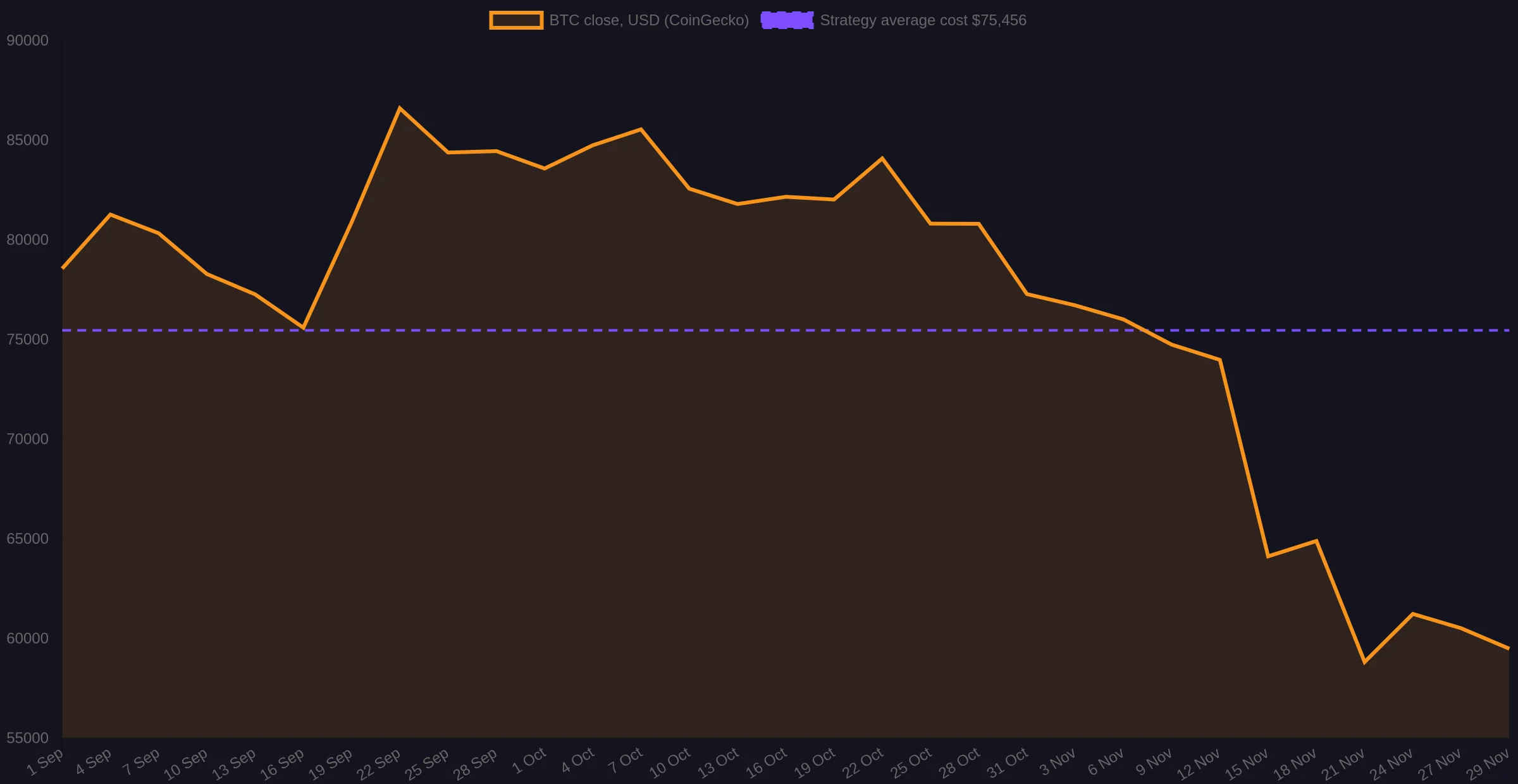
Bitcoin daily closes, September 1 to November 29, 2026, against Strategy’s reported average purchase price of $75,456. Data: CoinGecko.
None of this is a solvency event. Strategy said on November 20 that all of its coins are unencumbered and put its net reserve at $35 billion, a claim that holds up on the pledge question and less well on the arithmetic. A company that owes nobody a coin call can wait out a drawdown. The question the index change raises is different: what happens to the equity that funded the buying when the passive bid is gone and the treasury is under water.
Two Weeks Ago It Was Still Buying at $79,012
The purchase table in the same filing dates the company’s last buying spree. Between November 2 and November 8, Strategy bought 1,036 bitcoin for $81.9 million at an average of $79,012, and the footnote explains the funding: “The bitcoin purchases were made using net proceeds from MSTR Stock sales.”
Those 1,036 coins cost $81.86 million. At $59,485 they are worth $61.63 million. The tranche is down $20.2 million, or 24.7%, in less than three weeks, and it was accumulated at 32.8% above the current mark. The size is small against 850,364 coins, about 0.12% of the stack, but the price is the point. The company was still selling stock to buy bitcoin at $79,012 while bitcoin was already falling through $80,000.
The same filing shows where part of the stock sale money went: 1,887,464 shares of the STRC preferred series repurchased for $188.3 million, alongside $81.9 million of purchases. Strategy is managing two ends of its capital structure at once, retiring preferred while adding coin.
What Would Close the Gap
The honest answer is that nobody has published the number that would settle it. MSCI does not disclose how much money tracks the affected indexes. JPMorgan’s $2.8 billion estimate was built on MSCI’s earlier digital-asset proposal rather than the October screen the company actually applied, so treat it as an order of magnitude, not a measurement. The true figure sits somewhere between “two days of volume” and “a real repricing”, and the only way to see it is Monday’s closing print and Tuesday’s flow.
Index selling is mechanical and price-insensitive, which is why active buyers wait for it. A $2.8 billion sale into a $34 billion company, with bitcoin at $59,485 and the treasury trading at a 32% discount, is the kind of setup discretionary funds describe as liquidity, not information. If the discount narrows after Monday rather than widening, that interpretation wins on the evidence.
Three observations would settle which reading is right. First, Monday’s closing volume against Friday’s 16.5 million shares: a print well above that, with the stock holding $81, tells you the sale was absorbed. Second, where the market-cap-to-coin ratio lands on Tuesday, and whether it recovers above $40,536. Third, the December flow data for spot bitcoin ETFs, because the same institutional complex selling the equity has been redeeming the funds.
The Levels That Matter Into Monday
For bitcoin, Saturday’s UTC close was $59,872 and the 90-day closing low is $58,818, a level set on November 21 and computed from CoinGecko’s daily series. A close below $58,818 puts the treasury mark at a new three-month low and takes the paper gap past $14 billion. On the other side, the level that matters is an accounting one, $75,456, which is 26.8% above Sunday’s price and where the purchase average stops being a loss.
For the stock, the number to watch is a ratio rather than a price. While market cap per coin sits near $40,536 against a $59,485 spot price, new equity issuance destroys coin-per-share value. The financing model only restarts when the equity market pays more for the treasury than the treasury is worth.
The post Strategy Loses Its MSCI Seat on Monday With 850,364 Bitcoin Worth $13.9 Billion Less appeared first on Blockchainreporter.