SUI outperformed Bitcoin with a 2.55% daily gain as buyers maintained control despite declining trading volume across the market. Bitcoin-backed stablecoin lending is unveiled by Hashi and Fl
- SUI outperformed Bitcoin with a 2.55% daily gain as buyers maintained control despite declining trading volume across the market.
- Bitcoin-backed stablecoin lending is unveiled by Hashi and Fluid, enabling BTC owners to borrow without selling their current holdings.
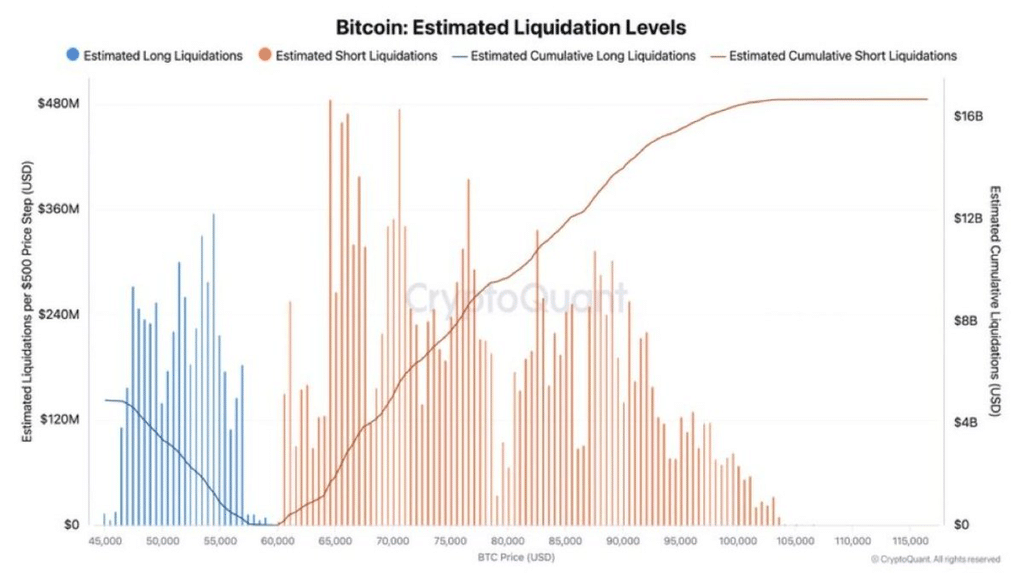
- Bitcoin's liquidation map shows nearly $16 billion in potential short liquidations, creating a major leveraged positioning zone.
SUI is attracting renewed attention as Bitcoin-backed lending expands its DeFi capabilities, while recent price action shows stronger performance against Bitcoin.
Bitcoin-Backed Lending Adds Another DeFi Use Case
Whale Factor reported that Hashi and Fluid now support Bitcoin-backed stablecoin lending. The deal lets individual Bitcoin users borrow against their holdings without having to sell. This will link Bitcoin collateral to the lending possibilities offered by the decentralized finance (DeFi) ecosystem across Sui.
Source:
X
This development adds another use case to Bitcoin in the DeFi realm. Holding can allow them to keep their Bitcoin holdings and borrow stablecoins. Thus, they have an alternative to selling their assets to get liquidity.
The potential benefit goes beyond the individual borrower(s). Bitcoin lending may inject more capital into lending markets and decentralized apps. The real volume, however, will depend on the demand for borrowing and their continued participation.
Bitcoin collateral also will tie in an established crypto asset to Sui financial products. This is funded by the lending infrastructure of Hashi and Fluid. Their integration provides another path for Bitcoin owners to enter the ecosystem.
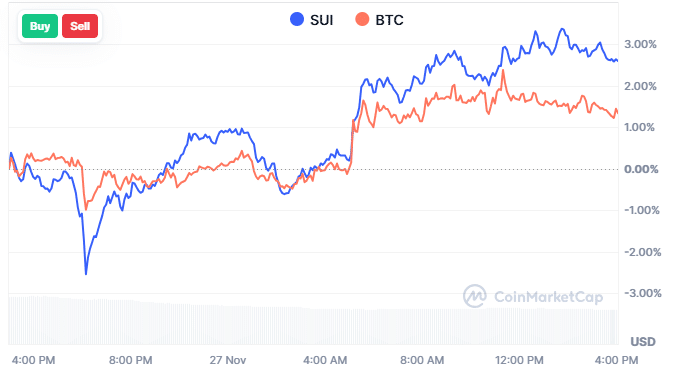
SUI outperforms on the latest price comparison during the period Nov. 27. It is currently trading on display at $0.6862, up 2.55% today. Bitcoin, on the other hand, had a relatively modest rise, about 1.3%.
Source:
Coinmarketcap
During the trading session shown, both assets were trading with a selling bias. But the loss was more pronounced for SUI, which briefly posted a -2.5% drop. Bitcoin had a smaller pullback before the recovery started for both assets.
This change was evident around 6:00 AM on November 27. Performance increased for both lines, though SUI did so at a greater pace. It had risen more than 2%, compared to Bitcoin, which had risen around 1.5%.
The split persisted all morning during trading. SUI was trending toward 3.3% until it pulled back a bit from its peak. Bitcoin remained positive but its performance was still less than SUI's.
Liquidity Conditions and Market Positioning
According to market data, its capitalization is about $2.84 billion. Its 24-hour trading volume stands at $261.49 million, down 28.51%. The decrease in turnover is a contrast to the positive price chart movement.
As of writing, there are 4.13 billion tokens in circulation. The maximum supply is capped at 10 billion in the meantime. The valuation is around $6.86 billion when fully diluted.
The liquidation heatmap over Bitcoin gives some extra background into the general market. It detects a high level of liquidation risk within the $63,000-$90,000 range. The cumulative short liquidation estimate is currently at $16 billion, close to $100,000.
In the meantime, the estimated long liquidations are still bunched together in the $47,000-$58,000 range. These figures reflect possible forced closures, not actual future trading. However, they indicate the possible impact of leveraged positions on the price of Bitcoin.
What is interesting for SUI is the relative performance, along with the Bitcoin-backed lending. More adoption could introduce more borrowing activity to its ecosystem. But the drop in trading volume is something that will need to be watched.
The immediate price question is if buyers can keep their recent edge. If the demand persists, it would give more confirmation of the latest recovery. In the meantime, lending activity will determine if the new collateral use case has significant participation.