Key Highlights Shares of Synopsys advanced following the introduction of AI-powered autonomous engineering solutions Enhanced collaboration with NVIDIA brings automated chip design and verifi
Key Highlights
- Shares of Synopsys advanced following the introduction of AI-powered autonomous engineering solutions
- Enhanced collaboration with NVIDIA brings automated chip design and verification capabilities
- New autonomous verification technology compresses multi-week processes into mere hours
- AI-driven workflows enhance verification coverage and accelerate analog design operations
- Commercial deployment of autonomous engineering solutions planned for late 2026
Shares of Synopsys (SNPS) experienced upward momentum during premarket hours following the company’s announcement of advanced autonomous engineering solutions developed alongside NVIDIA. The stock appreciated 1.49% to reach $379.05, following a relatively flat close at $373.47 in the prior session. The disclosed technology showcases AI-powered workflows designed to streamline chip verification processes, analog design operations, and engineering simulations while significantly compressing development timelines.
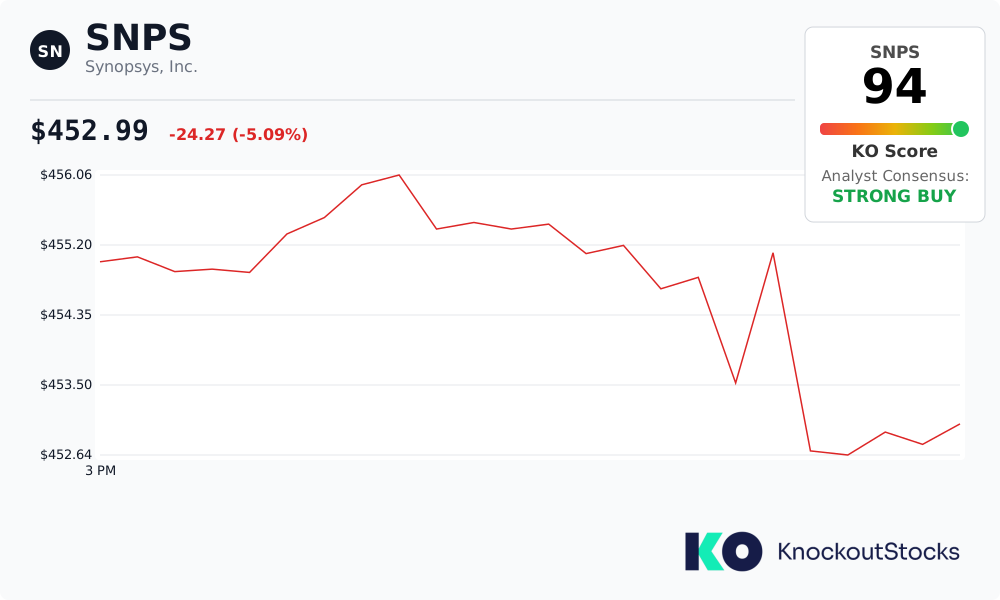
Synopsys, Inc., SNPS
Synopsys unveiled innovative agentic AI technologies created in partnership with NVIDIA to streamline engineering workflows throughout the semiconductor development lifecycle. The organizations showcased these advancements at the 2026 Design Automation Conference. This comprehensive platform merges Synopsys’ engineering solutions with NVIDIA’s advanced computing infrastructure.
These newly introduced workflows enable autonomous operations across chip design, verification, and electronic system creation through intelligent AI agents. The technology leverages NVIDIA Nemotron models alongside accelerated computing resources from NVIDIA. Additionally, the platform incorporates protected runtime functionality to support uninterrupted engineering activities.
This announcement reinforces Synopsys’ commitment to automating engineering procedures that historically demanded significant manual effort. The system executes extended engineering assignments with minimal human oversight. Consequently, development teams can accomplish sophisticated workflows with enhanced efficiency and reliability.
New AI-powered capabilities address verification, analog design, and simulation challenges
The company launched a completely autonomous design verification solution aimed at eliminating verification delays during semiconductor development. This innovation orchestrates multiple AI agents across the entire verification pipeline. The system transforms design specifications into automated execution spanning testing, debugging, and coverage evaluation.
This autonomous verification approach condenses tasks that traditionally demanded weeks into a matter of hours. Synopsys documented verification acceleration reaching up to 50 times faster for validated RTL completion. The system additionally enhances coverage metrics by up to 20% through ongoing optimization cycles.
The organization further introduced autonomous capabilities for analog and mixed-signal development processes. Engineers articulate design requirements using conversational language while AI agents handle implementation and verification tasks. According to Synopsys estimates, this workflow delivers productivity gains of up to three times for analog engineering operations.
Synopsys extended autonomous engineering functionality to computer-aided engineering platforms through automated electronics thermal analysis. This workflow autonomously manages simulation configuration, execution, and result interpretation with minimal human involvement. The technology integrates NVIDIA Agent Toolkit alongside CUDA-X libraries and Ansys Icepak applications.
The company additionally announced widespread GPU acceleration improvements throughout its engineering software suite. PrimeSim SPICE simulations demonstrate performance improvements up to 18 times faster when utilizing NVIDIA GPU technology. QuantumATK delivers acceleration of up to 50 times for semiconductor material simulations, while machine-learned force field simulations achieve performance gains approaching 200 times baseline speeds.
The organization also documented tenfold performance enhancements for Ansys Lumerical FDTD electromagnetic simulations powered by NVIDIA GPUs. Both companies are advancing CUDA-X integration across numerous engineering computational engines. Synopsys anticipates making the autonomous engineering capabilities available to customers throughout the latter half of 2026, with ongoing demonstrations scheduled at the 2026 Design Automation Conference.
The post Synopsys (SNPS) Stock Surges on AI-Powered Chip Design Partnership with NVIDIA appeared first on Blockonomi.