Key Highlights Taiwan Semiconductor’s Q2 net profit surged 77% to $22 billion, surpassing analyst expectations Quarterly revenue climbed 36% to $40.2 billion compared to the same period last
Key Highlights
- Taiwan Semiconductor’s Q2 net profit surged 77% to $22 billion, surpassing analyst expectations
- Quarterly revenue climbed 36% to $40.2 billion compared to the same period last year
- Company revealed $100 billion in additional U.S. manufacturing investments, pushing total commitment to $265 billion
- Stock declined 4.2% in premarket hours despite exceeding earnings projections
- Q2 gross margin reached 67.7%, driven by advanced chips (7nm and below) contributing 77% of wafer revenue
Taiwan Semiconductor Manufacturing (TSM) delivered exceptional second-quarter results on Thursday, yet shares tumbled during premarket hours following the chipmaker’s revelation of a dramatically expanded U.S. manufacturing footprint.
TSM American depositary receipts declined 4.2% ahead of Thursday’s opening bell.
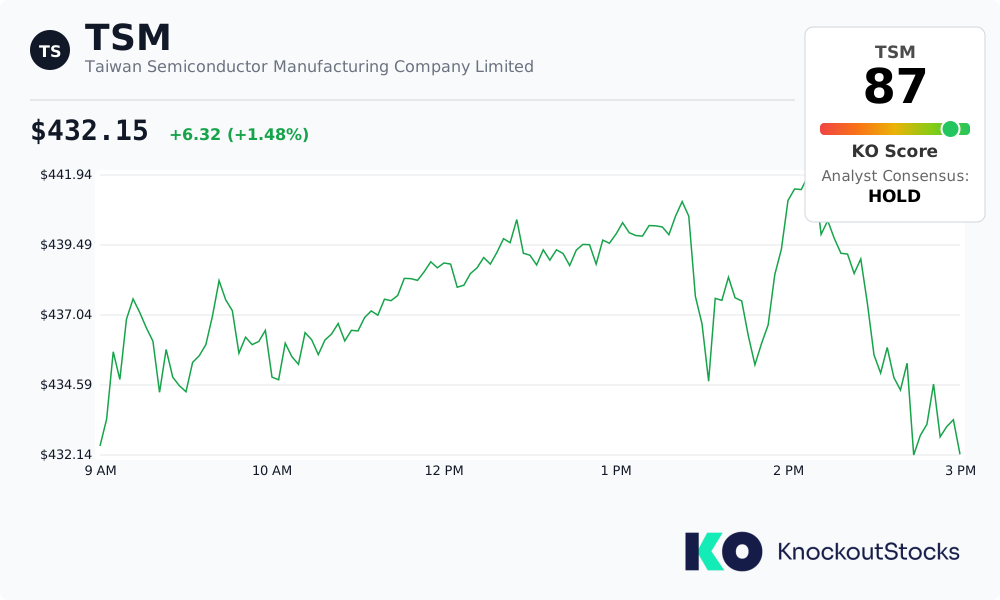 Taiwan Semiconductor Manufacturing Company Limited, TSM
The world’s leading contract chipmaker disclosed second-quarter net income of NT$706.56 billion (approximately $22 billion), representing a 77% increase from the prior-year period. The figure exceeded Wall Street’s consensus estimate of NT$626.82 billion.
Quarterly sales reached $40.2 billion, marking a 34% year-over-year improvement. Management had previously issued guidance calling for full-year revenue expansion exceeding 30%.
Cutting-edge semiconductor technologies powered the impressive performance. Production processes at 7 nanometers and smaller accounted for 77% of overall wafer revenue during the quarter. The 5nm node led contributions at 33%, while 3nm technology delivered 30%, and the newest 2nm process added 3% as manufacturing accelerates.
The company achieved a gross margin of 67.7%, benefiting from elevated capacity utilization rates. Operating margin stood at 60.3%, while net profit margin hit 55.6%.
These robust profitability metrics materialized even as TSMC absorbed increased expenses related to ramping up 2nm production, which remains in its initial phases.
Historic $265 Billion U.S. Investment Announcement
Concurrent with its earnings release, TSMC disclosed plans to deploy an extra $100 billion toward semiconductor manufacturing facilities in Arizona. This brings the company’s overall U.S. capital commitment to $265 billion, significantly higher than its previous pledge of $165 billion.
The enlarged spending plan appears to be the primary factor pressuring shares. Market participants likely seek confirmation that domestically manufactured chips can ultimately generate margins comparable to Taiwan-produced semiconductors.
TSMC serves as the foundry partner for major technology companies including Nvidia, Apple, Qualcomm, and AMD. Nvidia remains particularly critical given explosive demand for artificial intelligence chips.
Emerging Rivalry With Intel
Currently, Intel outsources approximately 30% of its wafer production to TSMC. However, Intel—bolstered by substantial U.S. government subsidies—is aggressively pursuing external clients for its foundry operations, creating direct competition with TSMC for lucrative manufacturing contracts.
Jefferies analysts had anticipated TSMC might elevate its full-year revenue growth forecast to a 30%-35% range prior to the quarterly report.
Based on TipRanks data, TSM holds a Strong Buy consensus rating supported by five analyst buy recommendations issued within the last three months. The average analyst price target of $520 suggests approximately 24% upside potential from present trading levels.
TSM ADRs have appreciated 77% during the trailing twelve-month period.
The post Taiwan Semiconductor (TSM) Stock Plunges 4% After Revealing Massive $265B U.S. Investment Plan appeared first on Blockonomi.

 Revenue: $40.2B; +33.7% YoY
 ; +77.4% YoY
 CapEx raised to $60B-$64B from $52B-$56B.