Unarguably, the bank alert is the most valuable element in every banking transaction. Figure this: you need to transfer money to a seller at a market stall to buy a pair of sneakers. You log
Unarguably, the bank alert is the most valuable element in every banking transaction. Figure this: you need to transfer money to a seller at a market stall to buy a pair of sneakers. You log in to your banking app, get their account details and transfer the cash. But even after confirming that you have been debited, the seller will not allow you to leave with the shoes if they haven’t received their own alerts.
For the text that confirms the money went where it was supposed to go. Just like every technology that works, when that message arrives, nobody thinks about it. When it does not, the aftermath is rarely charitable. Absent a swift reversal, most people go through an excrutiating journey for a refund.
With most banks, you need to receive an OTP via SMS or email to complete the banking transaction. For a few customers, however, have a hardware token to generate their own or use other biometric elements. Behind the scenes, a Lagos company has been powering the process for nine years.
Termii, founded in 2017 by Emmanuel Gbolade, Ayomide Awe, and Atinuke Idowu, provides the infrastructure that businesses use to send OTPs, transaction alerts, fraud checks, and customer messages across SMS, voice, email, and WhatsApp.Its customers include banks, fintechs, payment processors, and telecoms. The company says over 16,000 businesses use its platform, reaching around 10 million Africans every month, and its monthly message volume has grown from one million in its early years to over 400 million today.
On Thursday, Olajuwon Abayomi, Termii’s General Manager for Nigeria, shared the startup’s story with journalists, creators and other industry stakeholders at the Google office in Lagos. He described the problem as bigger than most people realise.

Industry estimates suggest between 10 and 15 per cent of users attempting OTP verification are lost to silent SMS delivery failures, messages that simply never arrive, with no error and no explanation. “Every OTP that fails is a customer who believes their money is gone,” he said.
In a country where the Central Bank recorded N25.85 billion in actual digital payment fraud losses in 2025, and attempted fraud of N37.57 billion, the difference between a verification message arriving in five seconds and not arriving is not a customer service issue.
It is the difference between a fraud attempt blocked and a fraud attempt completed. “They do not call the telecom company. They call their bank, or they close the app and never come back. We exist so that call never has to happen”, he added.
He traces the problem to some factors:
- Banks sometimes do not send requests, causing delivery failures and blocking service completion.
- Telco or internal notification service downtime also prevent message handshakes.
- Banks or apps sometimes have downtime in their notification services. The consequence is lost requests.
- SMS delivery varies by language, and telecom character encoding requirements across countries differ.
- Some customers cannot properly consume APIs. Yet, providers do not offer dedicated support engineers.
Termii’s answer has been to move from sending messages to guaranteeing them. The company describes itself today as AI-native reliability infrastructure: its systems monitor delivery routes across carriers in real time, predict where a message is likely to fail, and reroute it before the customer notices anything.
“The best compliment our product gets is silence,” Abayomi told the room. “When we do our job, nothing happens. The alert arrives, the transaction completes, and nobody thinks about us. The whole company is built for a moment the customer should never have to notice.”
Its new platform will also enhance customer engagement by customising interactions based on user location and behaviour.
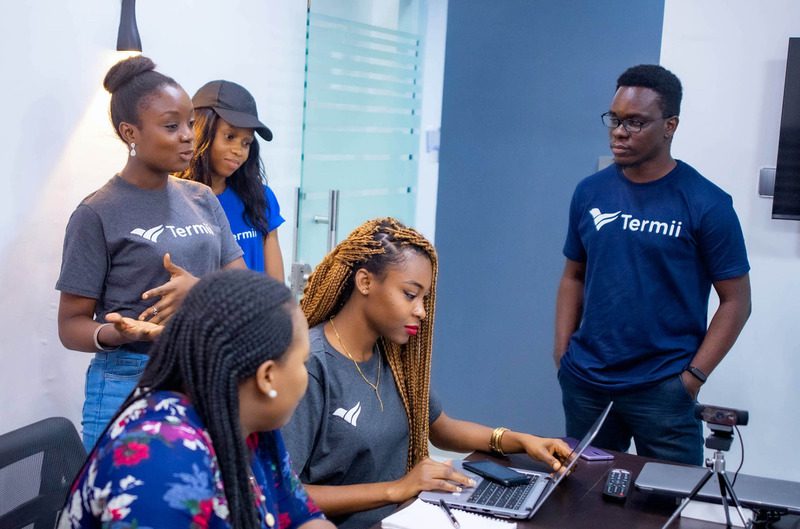
Termii OTP: Building trust is rewarding but expensive
The company’s path was not smooth, and Abayomi did not present it as one. Termii started as a young messaging startup trying to win the trust of banks and telecoms, institutions with every reason to be cautious about routing critical communications through a startup. He described years of proving reliability one client at a time, in a market where the underlying carrier infrastructure itself fails without warning.
“We were building on roads that were still being built,” he said.
“You cannot promise a bank 99.9 per cent delivery if the rails underneath you do not offer it. So we had to build the intelligence that makes unreliable rails behave reliably. That took years, and it nearly broke us more than once.”
The bet has attracted backers beyond Nigeria.
Termii went through Y Combinator in early 2020, one of the first Nigerian communications companies to do so, and has raised $5.3 million to date, including a $1.4 million seed round led by Kepple Africa Ventures and Future Africa and a later $3.65 million round.
Read here: Nigerian CaaS Startup, Termii raises $3.65M to drive expansion in Africa
It is also an alumnus of the Google for Startups Accelerator Africa and builds parts of its AI infrastructure on Google Cloud.
Asked how the company plans to grow its reach, Abayomi pointed to depth rather than geography alone. He argues that the opportunity is that most African businesses still treat customer communication as an afterthought, a cost line rather than infrastructure, even as their entire relationship with customers moves onto phones.
“Every business in Africa is becoming a digital business, whether it planned to or not,” he said.
