Five directors are working out the terms of a potential merger between Tesla and SpaceX worth $3.5 trillion. Representatives from both companies aim to reach an agreement before the year ends
Five directors are working out the terms of a potential merger between Tesla and SpaceX worth $3.5 trillion. Representatives from both companies aim to reach an agreement before the year ends. The challenge in this is coming up with a deal that makes sense financially for both parties involved.
The directors tasked with keeping Musk at arm’s length
Three Tesla directors and two from SpaceX are leading negotiations through separate special committees, the Financial Times reported on November 24.
Tesla’s representatives are board chair Robyn Denholm, Kathleen Wilson-Thompson, and Jack Hartung. Roelof Botha and Randy Glein represent SpaceX.
Morgan Stanley and Goldman Sachs serve as advisors for SpaceX, while Evercore advises Tesla. All five directors have previously worked with Musk in the past. In order to avoid future conflicts, Musk is staying away from the negotiations. SpaceX’s regulatory filings provide evidence of how a merger has not been confirmed yet.
Why the exchange ratio is the number that decides the deal
At the heart of the Tesla and SpaceX negotiations is the exchange ratio. The exchange ratio is the number of shares an acquiring company offers for each share of the company it acquires. In an all-stock merger, the ratio determines how much of the combined business each group of shareholders will own.
The difference in the two companies’ valuations complicates negotiations. Morningstar analysts Seth Goldstein and Nicolas Owens noted that SpaceX’s market value approached $2 trillion in late October, compared with Tesla’s $1.5 trillion.
SpaceX is also expected to grow much faster than the combined business. Analyst estimates compiled by TIKR project SpaceX’s revenue to grow by 272% in 2027. That figure drops to 94% if the two companies merge. Short seller Jim Chanos also warned that the merger could cut SpaceX’s projected earnings per share by nearly 40%.
How much SpaceX pays for Tesla could add to those concerns. HSBC analyst Michael Tyndall estimated Tesla’s acquisition value at $507 per share, a 33% premium to its 30-day average share price. While a higher price would benefit Tesla shareholders, it could further dilute earnings per share for existing SpaceX shareholders.
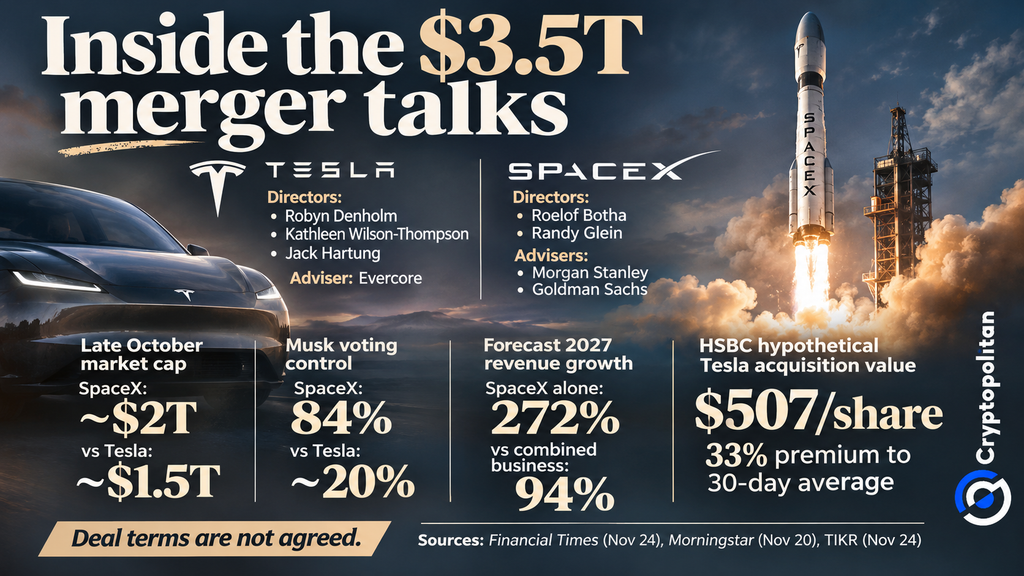
Tesla-SpaceX $3.5 trillion merger talks: Directors, valuations, voting power and growth forecasts
Votes Musk cannot simply command
Musk holds around 84% of voting rights at SpaceX, whereas he has only 20% at Tesla. Depending on the terms of the merger, he may be able to gain majority control of the merged company.
However, first he will need to get the approval of Tesla shareholders. As the FT explains, more than half of the outstanding shares of Tesla need to be in favor. Abstentions and non-votes would count as against the deal.
The former legal troubles Tesla went through regarding its acquisition of SolarCity and Musk’s pay package give board members another reason to ensure that shareholders get a good deal.
Whether a merger beats the partnerships the two already have
Tesla and SpaceX already work together on artificial intelligence (AI), chip development, and robotics. Cryptopolitan has previously reported on the rising AI costs at both companies.
Morningstar argues that joint ventures and supplier agreements could deliver many of the same benefits without a merger.
Combining the businesses also carries the risk of a conglomerate discount. The conglomerate discount is the gap that occurs when a diversified company is worth less than its businesses would be individually. That outcome, however, is not inevitable.
Regulators in four jurisdictions could still block it
Even with shareholder approval, the merger could face competition reviews in the US, China, the European Union, and the UK. Tesla’s manufacturing operations in China and SpaceX’s US defense contracts also raise national security concerns.
S&P 500 inclusion could pull passive money in
A merger could bring SpaceX into the S&P 500 sooner than expected. J.P. Morgan estimates that index-tracking funds could buy around 10% of SpaceX’s publicly tradable shares if that happens, Reuters reported on November 24.
SpaceX has yet to meet the index’s trading history and profitability requirements. A merger could pave the way for exemptions, although inclusion is not guaranteed.
If you're reading this, you’re already ahead. Stay there with our newsletter.