Tesla has started the production of its humanoid robot Optimus at its Fremont factory based in California. The announcement on October 21, 2026 stands as a significant point in its aspiration
Tesla has started the production of its humanoid robot Optimus at its Fremont factory based in California. The announcement on October 21, 2026 stands as a significant point in its aspirations for robotics. However, it was accompanied by a drop in quarterly profit by 43%.
Now, Tesla has a tough question to answer. Can it convert initial production into a profitable business in a market that has already been monopolized by Chinese rivals?
What Tesla actually started in Fremont
Tesla is making Optimus in factory space previously used to manufacture electric vehicles. In its update for the third quarter, the company referred to the robots as its very first production-grade machines. The company believes that the process of manufacturing is ready for commercialization, even though the actual hardware is still under development.
Elon Musk termed it ‘early production’ and cautioned that the ramp up could be “somewhat bumpy.” He estimated a weekly production of 20,000 robots by the end of 2027.
Getting to that goal won’t be simple. Work still needs to be conducted on Optimus by Tesla in terms of its design, safety, and AI capabilities. Moreover, the company hasn’t revealed information concerning the price of the robot as well as its delivery dates.
The 43% that frames the story
Tesla’s financial results for the 3rd quarter illustrates the cost of its expansion plans.
Net income attributable to shareholders fell to $787 million compared to $1.373 billion in the same quarter in the previous year. Meanwhile, revenue remained almost unchanged. During the period, Tesla generated revenue of $28.046 billion, in contrast to $28.095 billion obtained in the corresponding quarter of 2025.
When it comes to expenses, it’s a different situation altogether. Operating expenses increased 39% to $4.776 billion while operating income decreased 56% to $718 million. Tesla indicated that this is due to higher costs for AI research, increased stock-based compensation, and lower income from regulatory credits.
At least, for the moment, the company is still in the car business. Tesla sold 486,532 cars this quarter.
The race Tesla is trying to catch
Tesla is entering a market where competitors are already shipping thousands of robots.
Counterpoint Research recorded more than 22,000 global shipments in the first half of 2026, up nearly 300% year over year. Five Chinese manufacturers accounted for 86% of shipments.
But most robots aren’t working in factories. More than 60% went to entertainment, performances, research and data production.
Grand View Research expects the market to grow from $4.2 billion in 2026 to $40.5 billion by 2033, with annual growth of 38.2%.
As Cryptopolitan reported, former Nvidia executive Amulya Vishwanath calls robotics a “Lego era.” Essential components and safety standards are still being developed.
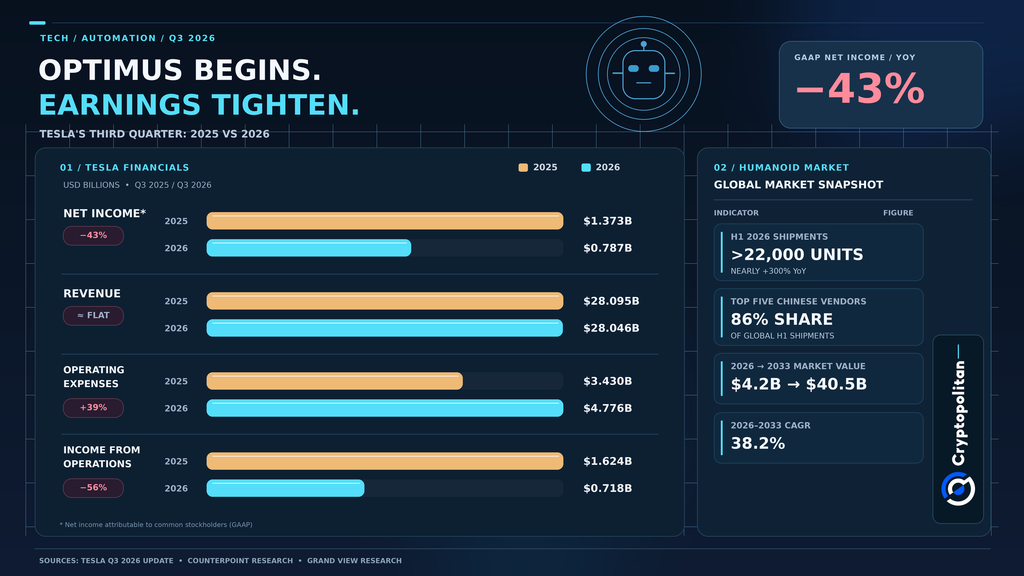
Tesla Q3 2026 vs 2025: Profit Falls 43% as Humanoid Robot Market Expands
Where suppliers and chipmakers fit
Tesla’s expansion could also benefit suppliers worldwide. McKinsey estimates that actuators account for 40%–60% of humanoid hardware costs.
Cost is another challenge. Reuters reported that the materials needed to build an Optimus Gen 2 could cost $50,000–$60,000 at low production volumes. Musk, meanwhile, is aiming for a long-term price of around $20,000.
Chinese manufacturers have an advantage in component costs, but their robots still struggle with everyday tasks.
Starting production is an important step for Tesla. Whether Optimus becomes a successful business will depend on how reliably it works, whether customers are willing to pay for it, and how much Tesla can bring down production costs.
The smartest crypto minds already read our newsletter. Want in? Join them.