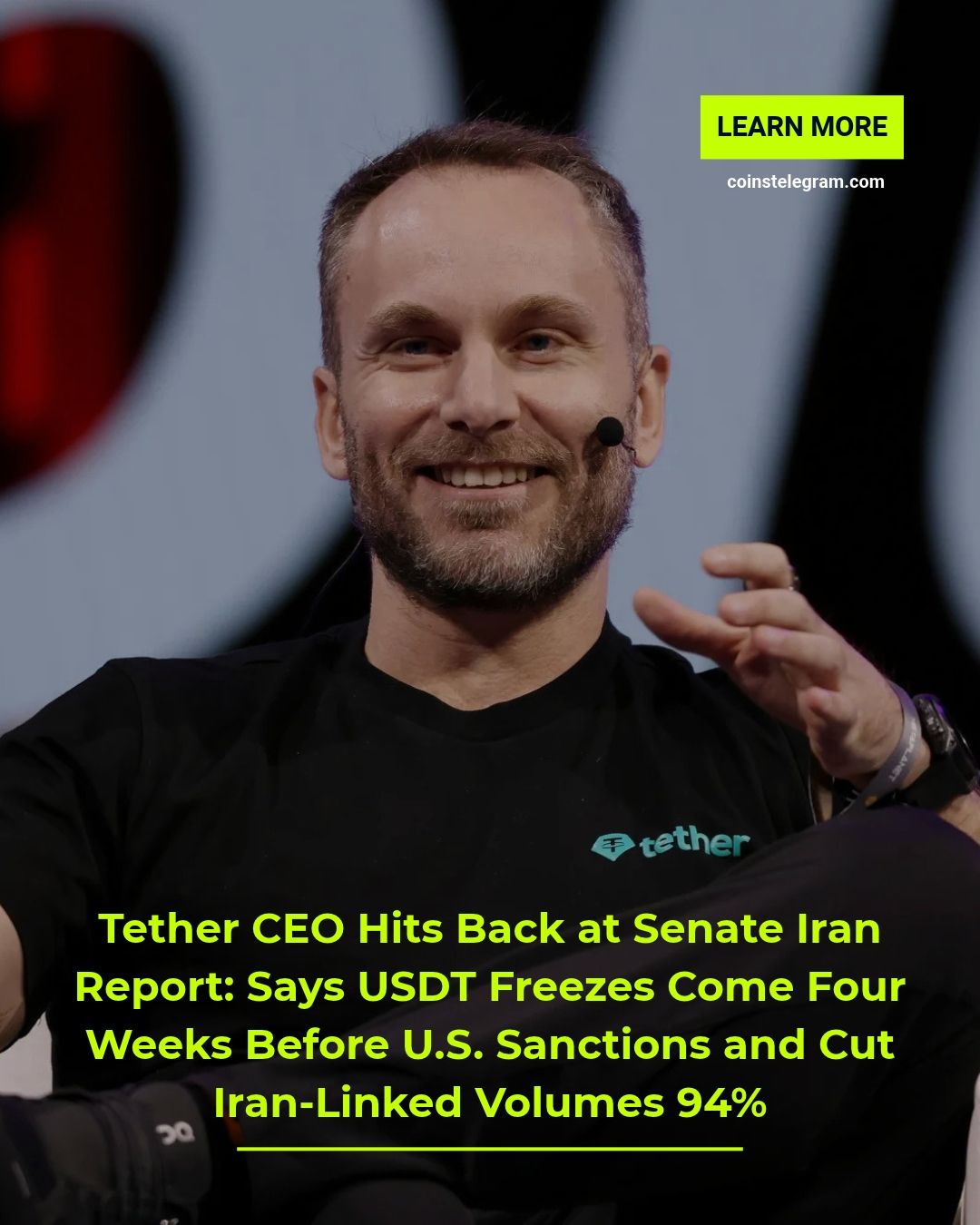
Tether CEO Paolo Ardoino has publicly challenged a Senate Democratic report that accuses the stablecoin issuer of being a lifeline for Iran’s sanctions evasion. In a post on X, Ardoino argued
Tether CEO Paolo Ardoino has publicly challenged a Senate Democratic report that accuses the stablecoin issuer of being a lifeline for Iran’s sanctions evasion.
In a post on X, Ardoino argued that Tether freezes flagged addresses weeks before official U.S. and Israeli sanctions, that it acts before blockchain analytics firms label wallets, and that its actions have cut Iran-linked stablecoin volumes by 94%. The report’s authors dispute that picture, and federal pressure on Iran-linked crypto is still growing.
What the Senate Report Found
On September 28, Democratic staff of the Senate Permanent Subcommittee on Investigations published a 28-page report titled “Tethered to Terrorism: Crypto & Iran’s Shadow Banking Network.” Senator Richard Blumenthal is the subcommittee’s top Democrat. Investigators analyzed 846 wallets that either Israel’s National Bureau for Counter Terror Financing (NBCTF) or the U.S. Treasury’s Office of Foreign Assets Control (OFAC) had sanctioned or targeted for seizure between June 2021 and August 2026, over ties to Iran and its proxies.
The headline finding: 84% of those wallets transacted exclusively or almost exclusively in USDT. Among 757 wallets tied specifically to terrorism financing, the share rose to 87%. The report also cited two Iranian oil smugglers who allegedly moved more than $603 million through USDT, and described an Iranian shadow banking network worth an estimated $20 billion in cross-border transactions over the past year.
It also pointed to a specific case: 39 addresses that Israel linked in June 2023 to a Hezbollah money launderer. According to the report, Tether froze five early but left the other 34 untouched until March 2024, and more than $34.6 million in USDT left those wallets after a seizure notice became public. The report argued that before 2024 Tether did not “comprehensively and consistently freeze” wallets designated by counter-terrorism agencies, and that “solely relying on the reactive freezing of wallets after designations will not work.”
Referral and Political Questions
Blumenthal sent the findings to Treasury Secretary Scott Bessent and Attorney General Todd Blanche, asking them to examine whether Tether violated sanctions law and anti-money-laundering rules. The report also raised questions about Tether’s ties to the U.S. government: Cantor Fitzgerald, which was run by Commerce Secretary Howard Lutnick until recently and is now controlled by his children, owns about 5% of Tether, and Blumenthal asked whether that relationship has meant looser oversight. Ardoino’s Response
Ardoino answered on X, rejecting the report’s reading of the data:
“Senator Blumenthal’s ‘analysis’ of Tether’s sanctions report misses that, since 2023, Tether froze on average 4 weeks prior to OFAC & NBCTF official sanction designation and for 99% of the times Tether froze the reported addresses before Chainalysis labelled them. Tether actions led to Iran-linked stablecoin volumes declining by 94%. The reality shows that Tether acts fast on new threats thanks to its law enforcement partnerships.”
He added that Tether has worked with authorities worldwide to freeze more than $4.9 billion in assets. On the day the report came out, Tether said it had helped freeze nearly $550 million in Iran-linked USDT during 2026, including more than $344 million across two addresses in April (tied to Iran’s Central Bank and the Revolutionary Guard, according to reporting) and over $130 million across four TRON wallets in July. In that statement, Ardoino said:
“Tether has consistently demonstrated that USDT is not a haven for sanctioned actors, terrorist organizations or criminal networks.”
The Timing Dispute
The central disagreement is when a freeze counts as early. Footnote 56 of the Senate report notes that Israeli orders sometimes became public weeks or months after they were signed. That means a wallet could have been officially designated long before anyone outside the government knew.
Ardoino’s claim of freezing four weeks before the public designation could therefore still mean freezing months after the order was signed. The report does not dispute that Tether froze funds. It argues that it did so too slowly on some wallets, and Tether’s statements do not address the wallets the subcommittee says were left unfrozen.
Washington Keeps Pushing
The Senate report arrives amid a broader crackdown. Bessent said in early October that the U.S. would “probably” seize about $1 billion in Iran-linked crypto within the week, adding that “we know where it is.” That is nearly double what Tether says it helped freeze this year. It is not the first time he has cited that number: in May he said about $1 billion had been seized, while a later Treasury statement cited a lower, earlier estimate of nearly $500 million, so the actual total remains unclear.
Separately, blockchain analytics firm Elliptic linked $507 million in USDT directly to the Central Bank of Iran, which it said was using the funds to prop up a collapsing rial. OFAC also sanctioned Iranian exchanges including Nobitex, Wallex, Bitpin, and Ramzinex in June, followed by Shelbit and Aban Tether in August.
Why It Matters
USDT is the world’s most-used stablecoin, which makes its compliance record a central question for stablecoin regulation. Tether’s argument is that fast cooperation with law enforcement works. The report’s argument is that a reactive approach leaves gaps that sanctioned networks exploit. Both sides agree on one fact: Iran-linked actors have used USDT heavily.
What Comes Next
Watch for any response from Treasury or the Justice Department to the referral, the results of the promised Iran-linked seizures, and whether Congress uses the report in stablecoin and sanctions debates. For Tether, the practical test will be how quickly it freezes new wallets after designation, and whether independent data supports its 94% claim.