KPMG has just ruled on Tether. The independent audit firm gives the highest rating “unqualified” to the issuer of USDT, confirming that its reserves exceed its liabilities by $6.814 billion a
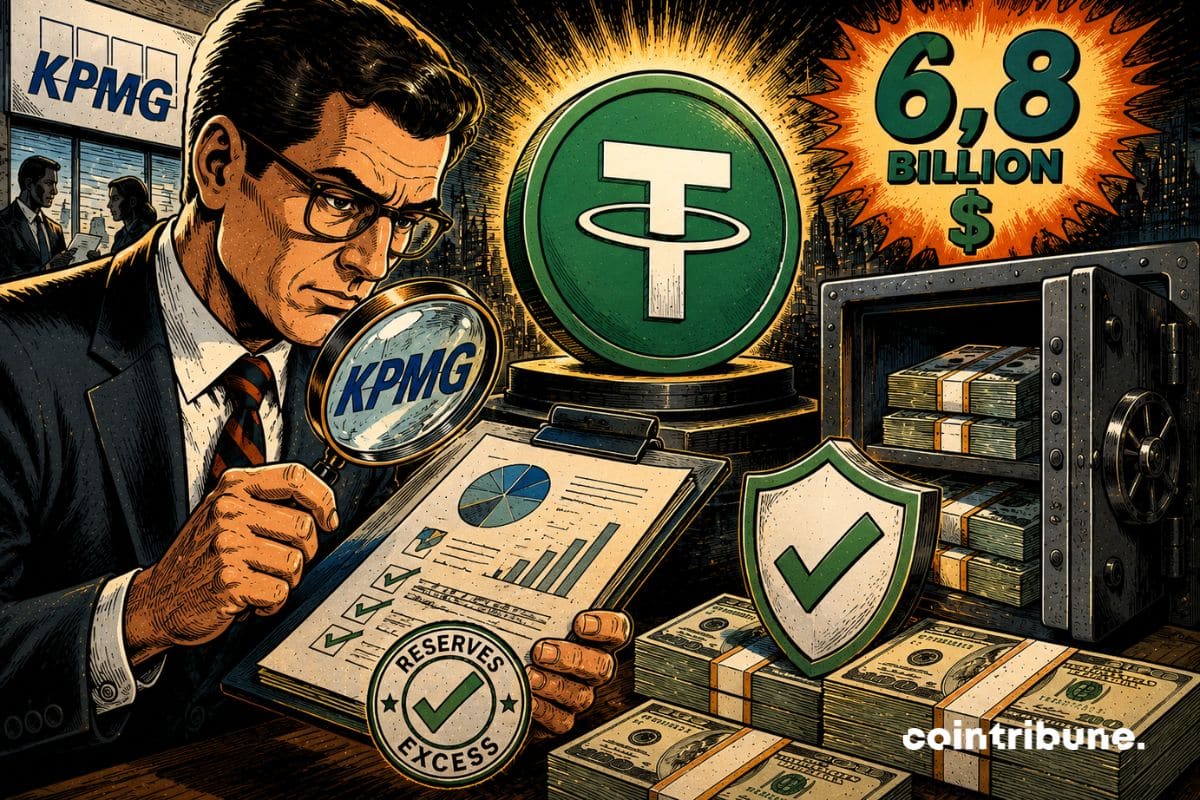
KPMG has just ruled on Tether. The independent audit firm gives the highest rating “unqualified” to the issuer of USDT, confirming that its reserves exceed its liabilities by $6.814 billion as of December 31, 2025. The world’s most used stablecoin has just undergone a real examination. Not just a simple technical check.
In brief
- KPMG certifies that Tether’s reserves exceed its obligations by $6.814 billion at the end of 2025.
- Complete balance sheet, cash flows, valuations, and physical inspection of every gold bar held by Tether.
- The audited entity is only a subsidiary, the Tether group parent company remains unaudited to date.
Stablecoin: What KPMG’s Audit Really Confirms About Tether
$6.814 billion. That’s the surplus Tether shows between its reserves and liabilities linked to its tokens in circulation, as of December 31, 2025. But the real change is not in the amount. It is in the method. Until now, Tether published quarterly attestations, a snapshot at a given time produced by a third party on a scope defined by the company itself. A full audit, however, is something else. KPMG examined:
- The balance sheet;
- The income statement;
- Cash flows;
- Ownership records;
- Valuations;
- Counterparties;
- Every gold bar held by Tether, rather than just relying on the custodian’s records.
This nuance changes everything for a stablecoin because for years, the question hovering over Tether (USDT) has always been the same: do the reserves really exist, in the announced proportions? For the first time, the answer no longer comes from Tether. It comes from a Big Four firm putting its own reputation on the line for what it certifies. It is this shift, from validated internal control to binding external audit, that justifies calling this a turning point rather than just an update in communication.
Following the KPMG Audit, Tether (USDT) Claims a Historic Turning Point
Not surprisingly, Paolo Ardoino did not hide his pleasure. The CEO of Tether called this audit the largest inaugural audit in the history of finance! A comparison difficult to verify independently, but which sets the tone of his communication… offensive, almost vindictive. The message is therefore clear. Years of criticism, doubts, accusations of lack of transparency, swept away by a document signed by an independent firm.
Ardoino also mentions the 650 million users who trust USDT daily, especially in emerging markets, for savings, commerce, and protection against local monetary instability. A huge user base, often excluded from the traditional banking system. Substantively, the argument holds because a KPMG audit is no small matter. Formally, the triumphalism deserves to be viewed with some caution. A company communicating about its own victory is never the best placed to assess its exact scope.
Your 1st cryptos with BitpandaThis link uses an affiliate program.The Factor that Makes All the Difference for USDT?
After Tether’s audit conducted by KPMG, it emerges that the audited entity is called Tether International, S.A. de C.V, a subsidiary controlled by a parent structure which is Tether Global Investments Fund, S.I.C.A.F., S.A. Cory Klippsten, CEO of Swan.com, confirms that this parent structure has only one director, Omar Rossi. He acts at the discretion of Giancarlo Devasini, a historic power figure behind Tether. And to date, no audit of this parent company is planned.
This is not an accusation of fraud. It is a scope reminder. The KPMG audit concerns a subsidiary, not the entire shareholder network of the group. An ICIJ investigation, published in early August, points in the same direction. It has documented for months the persistent opacity around the ownership structure of the stablecoin issuer Tether (USDT), a company valued at several hundred billion dollars, whose entire workings are still difficult to map.
The $6.8 billion in excess reserves of Tether (USDT) is a figure verified and signed by KPMG after its audit. But a stablecoin that weighs so heavily on the market deserves an audit commensurate with its entire structure. Not just a subsidiary.