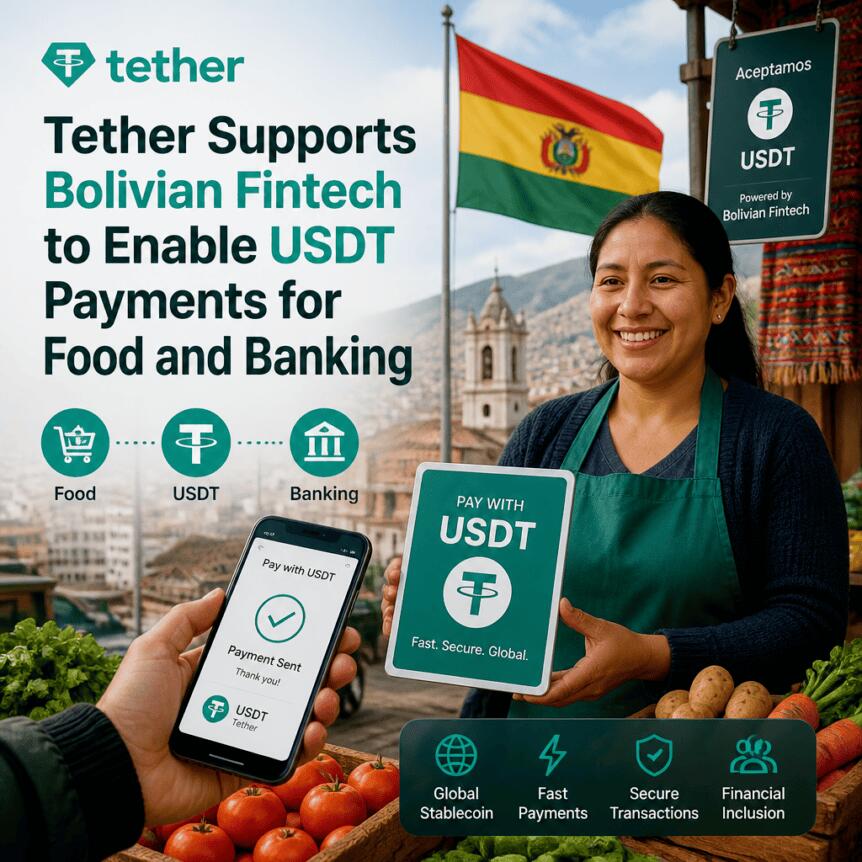
Tether is backing Bolivian fintech Peso with a pre-seed investment aimed at expanding USDT payments across Latin America, the companies said this week. In an announcement on Tether’s website,
Tether is backing Bolivian fintech Peso with a pre-seed investment aimed at expanding USDT payments across Latin America, the companies said this week. In an announcement on Tether’s website, the stablecoin issuer said the funding is intended to strengthen Peso’s payments infrastructure and its ability to route USDT transactions through banking and merchant payment systems.
The investment also arrives as local demand for dollar-linked alternatives grows in Bolivia amid a sustained shortage of US dollars and ongoing inflation pressures. Peso, for its part, is positioning USDT as a practical way for consumers and merchants to transact without relying exclusively on access to physical or banked dollars.
Key takeaways
- Tether is leading Peso’s pre-seed round to expand USDT payment infrastructure across Bolivia, Brazil, Colombia and Argentina.
- Peso’s product integrates USDT into consumer payments—so far via food delivery payments on Yango in Bolivia.
- The fintech supports payments rails that connect USDT with local currencies through banking and merchant systems.
- Bolivia’s policy discussion has increasingly centered on recognizing stablecoins like USDT for payments and financial services amid dollar shortages.
Tether’s investment targets payments infrastructure, not just token use
According to Tether, its investment will help Peso scale USDT-based payment services in multiple Latin American markets. The announcement emphasizes the practical layer of the rollout: connecting USDT with local payment ecosystems, including services that link stablecoin payments to local currency through banking and merchant payment systems.
Tether did not specify the size of its investment.
Peso integrates USDT into real-world payments in Bolivia
In Bolivia, Peso has already embedded USDT payments into Yango’s food delivery offering. That integration allows customers to pay for orders using USDT, according to the companies’ announcement.
Peso’s payments stack described by Tether includes QR payments for customers, point-of-sale (POS) capabilities for merchants, and virtual accounts tied to Bolivia’s banking system. Tether also noted that these virtual accounts are connected via ACH transfers, indicating Peso is building a bridge between stablecoin settlement and traditional banking rails.
For investors and operators, the relevance is straightforward: stablecoin payments only matter at scale if they fit into everyday consumer payment flows—such as QR checkouts and merchant POS—while still integrating with existing banking settlement. Peso’s approach, as presented by Tether, suggests an emphasis on usability and operational connectivity more than standalone wallet apps.
Bolivia’s dollar shortage is driving stablecoin adoption
Tether’s support for Peso is taking place against a backdrop of increasing local reliance on stablecoins in Bolivia. The announcement aligns with earlier reporting that stablecoins gained traction as access to dollars became harder.
Bolivia has “increasingly” turned to stablecoins since 2025 amid a prolonged US dollar shortage and high inflation, with businesses reportedly beginning to accept USDT for purchases as foreign currency access tightened. Earlier coverage from Cointelegraph noted that Bolivia’s interest in stablecoins has expanded beyond informal use, with government attention shifting toward whether and how such assets fit into the broader financial system.
In November 2025, the government announced plans to integrate cryptocurrencies and stablecoins into the financial system. That included allowing banks to offer digital asset custody and crypto-linked financial products. Later, in July 2026, Bolivia began considering a regulatory framework that would recognize USDT for payments, savings and trade alongside the boliviano and the US dollar, according to Cointelegraph coverage referenced in the Peso update.
Those steps came after Bolivia abandoned its longstanding currency peg in June, which contributed to the demand for dollar-denominated alternatives such as USDT. The same dynamic has continued to shape the commercial rationale for stablecoin payments: merchants and consumers may seek predictable value storage and settlement when local currency purchasing power and dollar access are under strain.
More USDT-linked services are emerging alongside policy discussions
The Peso investment is not the only sign of growing stablecoin-linked activity in Bolivia. Tether’s announcement points to other fintech expansion in the country, including a Tuesday update from lending platform Tala.
According to the announcement, Tala partnered with El Dorado to offer embedded credit through a digital wallet, allowing eligible customers to receive and repay loans in USDT on the Tempo blockchain. While Tether’s investment specifically targets payments infrastructure, this broader ecosystem growth highlights a pattern: multiple financial services are exploring stablecoin rails to reach users who need dollar-linked access for day-to-day transactions or credit products.
At the same time, Bolivia’s evolving regulatory discussions underline a key uncertainty for the sector: stablecoin adoption may accelerate through commercial integrations, but the durability of those models often depends on how regulators define permissions, custody rules, and operational requirements for banks and fintechs.
As Tether and Peso scale USDT payment capabilities across Latin America, market participants will likely watch two things closely: whether Bolivia’s proposed stablecoin framework moves from consideration to formal implementation, and how quickly payment providers can expand merchant coverage beyond early use cases like delivery payments.
This article was originally published as Tether Supports Bolivian Fintech to Enable USDT Payments for Food and Banking on Crypto Breaking News – your trusted source for crypto news, Bitcoin news, and blockchain updates.