Key Takeaways The Magnificent Seven ETF surged 2.3% midweek and climbed over 7% throughout July following June’s 9% decline Apple reached an all-time peak with a 4% gain, while Alphabet, Amaz
Key Takeaways
- The Magnificent Seven ETF surged 2.3% midweek and climbed over 7% throughout July following June’s 9% decline
- Apple reached an all-time peak with a 4% gain, while Alphabet, Amazon, Meta, and Microsoft posted approximately 3% increases
- Chip stocks beyond Nvidia have hemorrhaged approximately $1.8 trillion in July, plunging into bear market conditions
- A staggering $3.2 trillion has shifted between Mag 7 and semiconductor stocks, resulting in a stagnant S&P 500
- Upcoming Big Tech quarterly results represent the critical catalyst that may finally push markets beyond their two-month consolidation zone
Equity markets have been trapped in consolidation mode for more than sixty days. An enormous $3.2 trillion shift of capital between technology giants and semiconductor companies has prevented the S&P 500 from establishing any meaningful directional momentum.
The Roundhill Magnificent Seven ETF registered a 2.3% advance on Wednesday. The fund has now accumulated gains exceeding 7% during July, recovering from June’s 9% selloff — marking the second-worst monthly performance in the fund’s history.
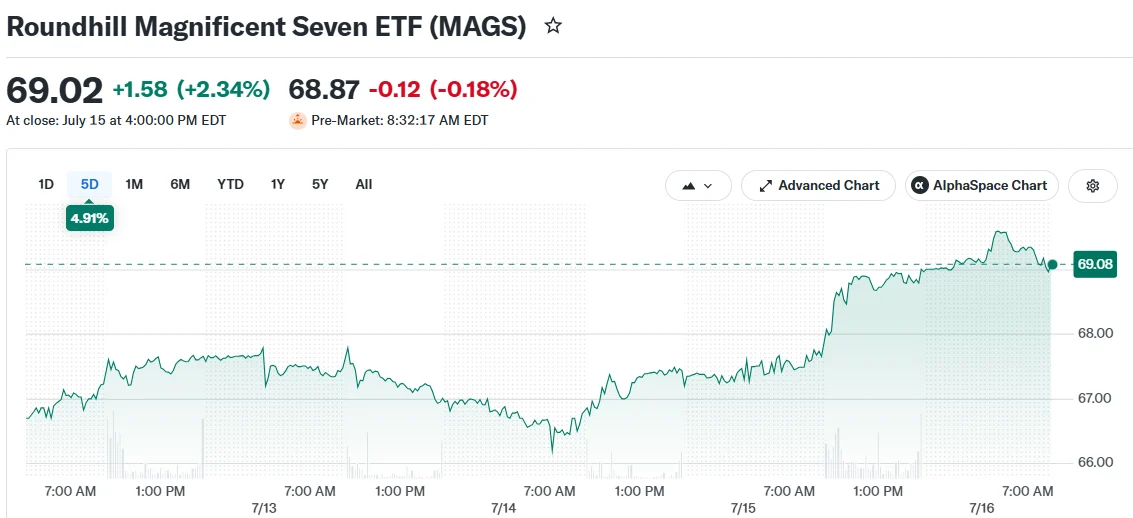 Roundhill Magnificent Seven ETF (MAGS)
Apple spearheaded the advance, posting a 4% increase to establish a fresh record. Alphabet, Amazon, Meta, and Microsoft each delivered roughly 3% gains during the same trading session.
Semiconductor Sector Faces Severe Pressure
As mega-cap technology companies have ascended, chip manufacturers have experienced brutal declines. The PHLX Semiconductor Index has plummeted 13% during July.
Stocks excluding Nvidia have witnessed nearly $1.8 trillion in market capitalization evaporate this month. Memory chip producers have suffered the most devastating losses, with Micron, Samsung, and SK Hynix leading the sector’s descent into bear market territory.
Semiconductor ETFs are currently processing over $40 billion in daily trading volume. This represents a dramatic surge from just $9 billion one year ago, based on Strategas data.
Strategas ETF strategist Todd Sohn drew parallels between the semiconductor rush and the ARKK frenzy of 2020. He noted both episodes featured elevated volumes and inflows before ultimately losing momentum.
Semiconductors have expanded to represent nearly 18% of the S&P 500, which Sohn characterized as an exceptionally rare concentration level.
Software Companies Demonstrate Resilience
Software equities have demonstrated far greater stability than their chip counterparts. Forty-four out of 51 software stocks in the Yahoo Finance industry basket are posting gains in July, with a median advance approaching 6%.
Meanwhile, only a small fraction of 62 semiconductor stocks are trading higher this month. The median chip stock has declined nearly 20%.
IBM’s recent sharp decline revealed that corporate IT spending remains constrained. Nevertheless, the software sector as a whole has maintained resilience relative to semiconductors.
The five most stable Mag 7 constituents — Apple, Amazon, Alphabet, Meta, and Microsoft — have essentially transformed into defensive positions. Market participants rotate capital into these names during periods of semiconductor weakness.
Another dynamic is emerging. Should memory chip pricing soften, Big Tech companies can sustain aggressive AI infrastructure investments while reducing input costs.
The offsetting gains and losses throughout these sectors have essentially neutralized each other. The S&P 500 has oscillated between identical support and resistance boundaries since early May.
The Nasdaq Composite has traced a comparable pattern. The Dow has registered minimal movement in July despite robust performances from select components.
Big Tech earnings season is approaching. These financial disclosures could serve as the catalyst that finally propels the market beyond its narrow trading range in one direction or the other.
The post The $3.2 Trillion Market Rotation: Why Big Tech Thrives as Semiconductors Tumble appeared first on Blockonomi.