676 million dollars. That is the amount that would have transited between Shelbit, a Dubai-based platform suspected of laundering Iranian funds, and Binance. Online betting, Tehran’s central
676 million dollars. That is the amount that would have transited between Shelbit, a Dubai-based platform suspected of laundering Iranian funds, and Binance. Online betting, Tehran’s central bank, suspicions of links with the Guardians of the Revolution: the crypto exchange giant finds itself, again, in hot water.
In brief
- Shelbit, an unregulated crypto platform in Dubai, transferred at least 676 million dollars to Binance, including 540 million after its own sanction by VARA.
- This platform connected a network of Iranian online betting sites, Tehran’s central bank, and wallets linked to the Guardians of the Revolution.
- VARA investigates money laundering and sanctions evasion, while OFAC closely monitors Binance, already convicted in 2023.
676 Million Dollars: What the Reuters Investigation Reveals About Shelbit
The case is serious enough to raise concerns up to the halls of OFAC. According to a Reuters investigation, the Shelbit platform — unregulated, based in Dubai and led by Iranian expatriate Siavash Kayvanpour — would have processed at least 4 billion dollars since May 2024. Its role: to serve as a discreet hub between a network of over 2,000 Persian-language betting sites, the Iranian central bank, and crypto wallets that Israel associates with the Islamic Revolutionary Guard Corps (IRGC). Of this financial flow, 676 million dollars would have ended up on Binance.
A detail that stings: about 540 million moved after the Dubai regulator VARA sanctioned Shelbit, in January 2025, for unlicensed activity. In other words, money kept flowing even while the crypto platform was officially under scrutiny by authorities. Reuters remains cautious: it is impossible to establish with certainty whether the IRGC directly managed the operation. But the mere fact that these flows reached Binance is enough to reignite a question that has stuck to the exchange for years: does its compliance really hold up, or does it always react retroactively?
Binance and USDT: the Real Achilles’ Heel of Crypto Compliance
This Shelbit case is not an isolated accident; it fits a well-known pattern among blockchain researchers: sanctioned networks favor stablecoins, with USDT leading, because of their liquidity and stability. Unlike bitcoin, whose volatility complicates large-scale laundering, Tether’s token allows massive amounts to flow without price shocks before final conversion on major platforms like Binance.
Your 1st cryptos with BitpandaThis link uses an affiliate program.It is no coincidence that Binance has been burdened with this issue since its 2023 agreement with US justice: guilty plea, record fine of 4.3 billion dollars, and admission that the platform facilitated nearly 900 million dollars in exchanges between US and Iranian users. Faced with Reuters, the crypto exchange now claims that “the compliance program worked as it should” once accounts linked to Shelbit were identified: accounts frozen and reported to authorities.
The problem is timing. Compliance that only acts after an external researcher’s alert — in this case Rich Sanders, who says he warned Binance as early as October 2025 — looks less like a detection system and more like after-sales service. And as long as USDT remains the favored highway for sanctioned networks, exchanges listing it will remain, whether they like it or not, on the front line.
What Binance and Shelbit Risk Facing VARA and OFAC
On the Dubai side, the tone has changed. The VARA regulator, which had already sanctioned Shelbit in January 2025, issued on July 24, 2026, an official notice stating that the platform continued to operate without a license, without KYC checks, and without commercial authorization. Notably, VARA does not just make a vague accusation; it links these failures to three specific texts:
- Federal Decree-Law No. 10 of 2025 on combating money laundering and terrorist financing;
- Cabinet Resolution No. 111 of 2022 on virtual assets;
- Dubai Law No. 4 of 2022. A legal anchor that weighs heavily on the scale.
As a result, the crypto regulator states it has engaged the necessary enforcement measures, imposed financial penalties on Shelbit, and ordered the immediate cessation of all unlicensed activities in Dubai. The notice itself specifies that it is published for informational purposes, without constituting legal or professional advice. A cautionary tone that does not diminish the gravity of the case.
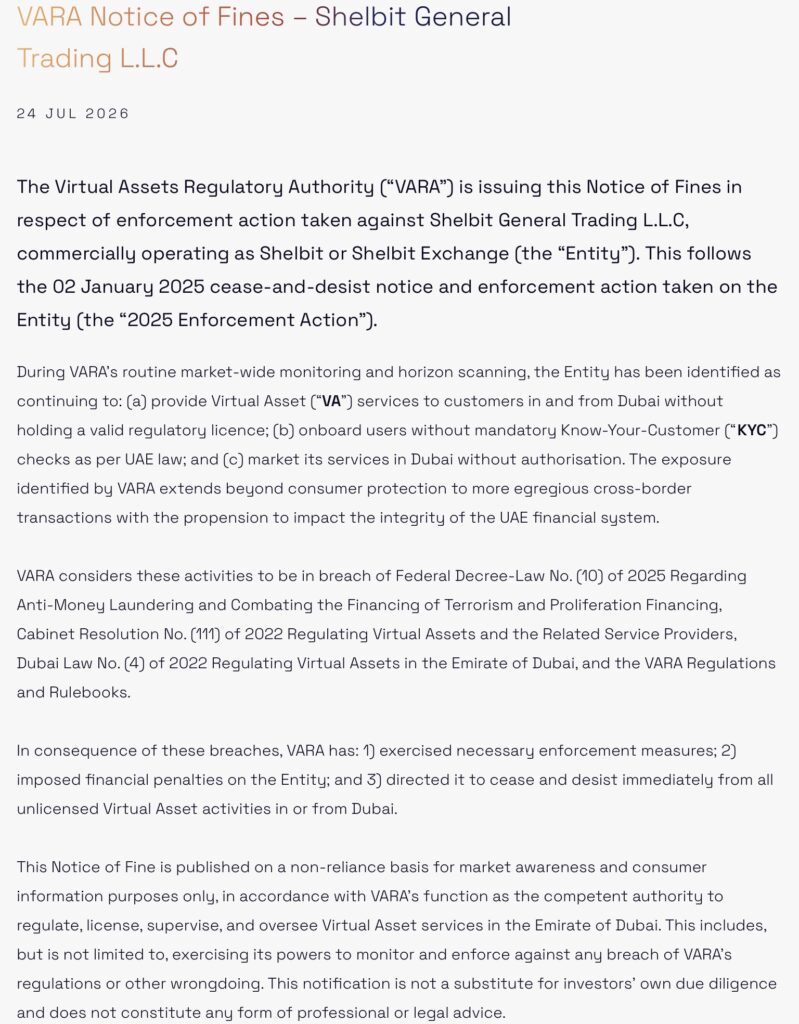 VARA finds that Shelbit continues to operate without a license and sanctions it.
On the US side, OFAC says it takes the allegations very seriously. For Binance, already convicted in 2023, the challenge goes beyond simple crisis communication: a new procedure would maintain the image of a platform that is always running after scandals rather than anticipating them.
Binance assures it acted as it should once the alert was raised. But is reacting afterwards really compliance? Between the VARA investigation and the stated vigilance of the US Treasury, Changpeng Zhao’s crypto exchange must prove that its monitoring is not limited to press releases. The debate is only beginning.