Sometimes the “boring” businesses become the best investments. Not because they tell the best story but because customers keep paying them to solve essential problems, year after year. Waste
Sometimes the “boring” businesses become the best investments.
Not because they tell the best story but because customers keep paying them to solve essential problems, year after year. Waste Management built a business around collecting trash. Rollins, the company behind Orkin, built one around pest control. Both illustrate how unglamorous, recurring services can reward patient investors over time. The lesson isn’t buy anything boring. It’s to look for essential services, repeat demand and economics that improve as the business scales.
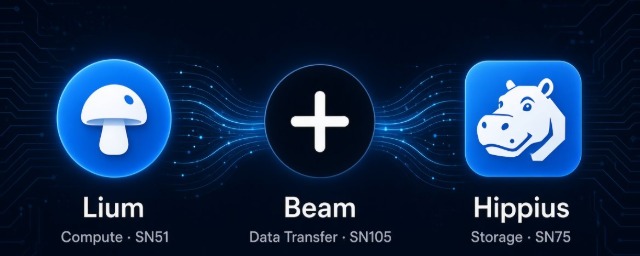
That’s the lens I’d apply to AI infrastructure subnets on $TAO
Everyone sees the chatbot. Fewer people pay attention to the infrastructure underneath it: supplying compute, moving data and storing it.
Three examples worth watching on $TAO
1. Lium
@Lium_io
$SN51
Supplying the compute
Lium operates in GPU compute. Published estimates have placed it among Bittensor’s larger customer revenue generating subnets, although estimated annualized revenue is not the same as audited revenue or profit.
The upside thesis: if demand for AI compute keeps expanding, providers that deliver reliable GPU capacity at competitive prices could build substantial businesses.
For Lium, the opportunity is turning that demand into repeat customers, strong utilization and sustainable margins not simply collecting emissions.
2. Beam
@b1m_ai
Subnet 105
Programmable bandwidth
Beam is building programmable bandwidth on $TAO
A network that lets applications coordinate bandwidth across cloud storage, P2P networks and AI infrastructure. Data transfer is one use case; the broader idea is to make bandwidth a resource that software can access and orchestrate.
The upside thesis: AI needs more than compute and storage. It needs connectivity between the two.
If Beam can make bandwidth reliably available and easy to integrate into applications, it could become a useful infrastructure layer for distributed AI systems. The opportunity isn’t simply moving more data. It’s turning programmable connectivity into a service customers repeatedly pay to use.
3. Hippius
@Hippius_cloud
$SN75
Storing the data
Hippius provides decentralized cloud storage with an S3 compatible interface, allowing developers to use familiar storage tools. Its offering includes persistent storage for AI agents’ files, memory and outputs.
The upside thesis: as AI applications generate and retain more information, storage could become an increasingly valuable recurring service.
If Hippius can win customers on reliability, pricing and ease of integration and retain them, it could build a durable storage business. S3 compatibility gives it a way to fit into existing workflows rather than requiring developers to start from scratch.
The common thread
Compute. Data transfer. Storage.
Not necessarily the most exciting parts of AI but potentially infrastructure that customers keep paying to use.
That’s where the “boring business” analogy becomes interesting.
But these are early, speculative bets not established compounders. A useful service does not automatically make its alpha token a good investment. Reporting on Bittensor has highlighted how emissions can subsidize services, making it important to distinguish sustainable customer demand from incentive supported activity.
The questions that matter:
Are paying customers returning?
Do revenues translate into sustainable margins?
Does commercial success create value for alpha holders?
Does the entry valuation leave room for execution risk?
The upside could be substantial if these businesses execute. It isn’t guaranteed just because AI is growing. The next great investment might not be the AI application everyone talks about. It might be the infrastructure that customers or agents keep paying to use. Time and patience can reward improving economics. They cannot replace them.