Crypto casinos often feel simpler than traditional online casinos. A player opens the site, creates an account, deposits crypto, and starts playing within minutes. From the outside, that spee
Crypto casinos often feel simpler than traditional online casinos.
A player opens the site, creates an account, deposits crypto, and starts playing within minutes. From the outside, that speed looks like freedom. No bank delay. No card decline. No slow payment screen. No long onboarding process.
However, the fastest part of a crypto casino is rarely the most important part.
The real test usually appears later: when the player withdraws.
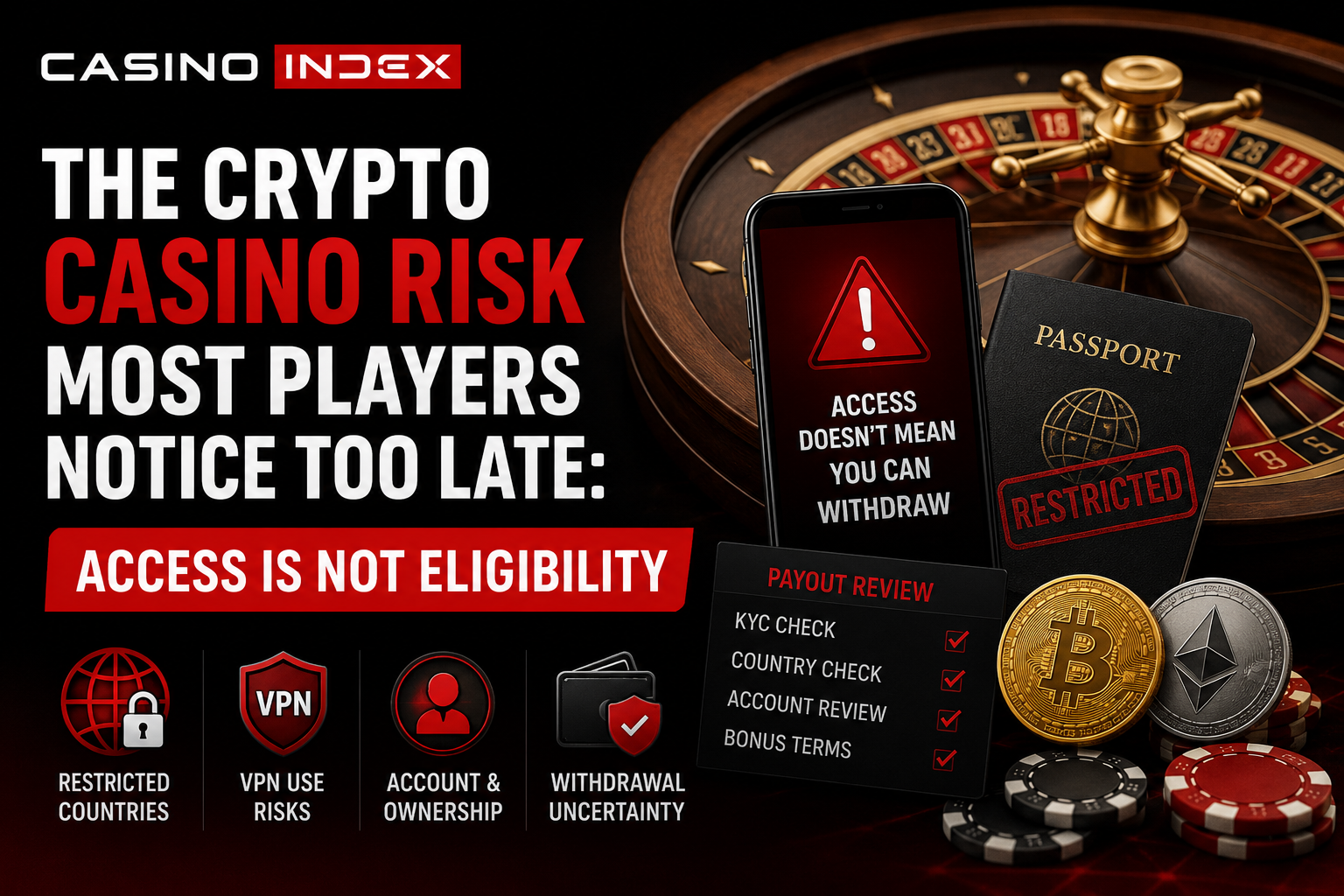
That is when country rules, VPN use, wallet ownership, duplicate account checks, KYC requests, bonus terms, and operator transparency can suddenly matter much more than the original deposit experience.
This is the risk many players notice too late.
A casino website loading does not always mean the player is fully eligible to play, win, and withdraw.
Why “the site works” is not enough
Many players assume that if a casino accepts their registration and deposit, the account must be safe.
That assumption can be dangerous.
A crypto casino may allow a user to open the homepage from almost anywhere. It may allow account creation with limited checks. It may accept crypto deposits quickly. Yet the same casino may still restrict certain countries, block specific providers, limit withdrawals, or request documents before paying out.
In practice, access and eligibility are different things.
Access means the site loads.
Eligibility means the player is allowed to use the casino under its terms, location rules, payment rules, and verification standards.
That difference matters most in offshore or crypto-first gambling sites. These casinos often operate across many regions, use multiple licenses, rely on third-party game providers, and apply risk checks at the withdrawal stage rather than during signup.
For players, this creates a simple problem: the casino may feel low-friction before deposit but become strict after a win.
VPN use can create payout risk
VPNs are one of the most common risk points in crypto gambling.
Some users use VPNs for privacy. Others use them because certain sites, games, or payment options are not available in their country. The problem is that casino terms often treat location masking as a serious issue.
A player may be able to access the homepage with a VPN. They may even be able to deposit and play. However, if the casino later reviews the account and finds inconsistent location data, the result can be delayed withdrawals, extra verification, locked balances, or even voided winnings.
This does not mean every VPN user is trying to cheat.
But from the casino’s side, VPN use can look like restricted-country access, multi-accounting, bonus abuse, or identity mismatch.
The safest approach is simple: do not assume VPN access means permission. Players should check location rules before depositing, not after requesting a withdrawal.
CasinoIndex explains this wider issue in its guide to VPN use at online casinos and when it can trigger account problems.
Restricted countries are not always obvious
Country restrictions are another area where crypto casinos can be confusing.
Some casinos publish a restricted-country list clearly. Others hide it inside long terms. Some apply restrictions by game provider rather than the whole casino. That means a player may be able to access the casino but not certain live dealer games, slot providers, bonus offers, or payment methods.
This is especially important for crypto users because deposits can feel instant and final.
If a player deposits first and reads country rules later, they may already be exposed to unnecessary risk.
The strongest casinos make country eligibility clear before deposit. Weaker casinos may rely on broad terms that give them room to reject or delay payouts later.
A player should check:
- whether their country is restricted
- whether specific game providers are blocked
- whether VPN use is prohibited
- whether withdrawals require address verification
- whether crypto payments are allowed from their region
- whether bonus terms apply differently by country
The key point is not whether a player can open the site.
The key point is whether the player can withdraw without eligibility issues.
A deeper breakdown is available in CasinoIndex’s guide to restricted countries and geoblocking at online casinos.
Casino ownership matters more after something goes wrong
Ownership is another underrated trust signal.
Many casino players look at bonuses, game libraries, crypto options, or visual design. Fewer players check who actually owns the casino, which company operates it, whether sister brands exist, and how complaints are handled across the operator group.
That can become important later.
If a player has a withdrawal issue, self-exclusion issue, duplicate account claim, or verification dispute, the operator behind the brand matters more than the homepage design.
Some casinos are independent brands. Others are part of larger operator groups. Some are white-label casinos using shared infrastructure. In those cases, risk may not sit with one brand alone. Sister brands can share ownership, support systems, licensing structures, payment processors, or fraud controls.
This matters because a problem at one brand may affect another.
For example, a player might self-exclude at one casino but later open an account at a related brand. Another player might create accounts across sister sites without realizing they share the same operator. A household may have multiple users on different brands that are actually connected.
When terms are unclear, legitimate players can still get flagged.
That is why ownership transparency is not just a corporate detail. It is a player-protection issue.
Duplicate accounts and household risk are real
Crypto casinos often attract players who expect privacy and fast access.
However, account risk still exists.
Casinos may flag accounts when they see shared devices, shared IP addresses, similar KYC details, repeated wallet patterns, same household usage, or similar bonus behavior. Sometimes this catches abuse. Other times it creates problems for legitimate families, roommates, or shared-device users.
The risk becomes higher when bonuses are involved.
If two people in the same household claim similar promotions, use the same device, or deposit from related wallets, the casino may investigate. The account may be paused until the casino understands whether the activity is legitimate.
Players can reduce this risk by keeping account details accurate, avoiding bonus stacking, using their own payment methods, and not creating multiple accounts to claim extra offers.
The main rule is simple: crypto does not erase identity risk.
Even no-KYC or low-KYC casinos can still review wallet behavior, device signals, IP patterns, gameplay history, and withdrawal activity.
The withdrawal stage reveals the real casino
Deposits show how easy a casino is to start using.
Withdrawals show how trustworthy the casino really is.
A strong crypto casino should explain its withdrawal limits, KYC triggers, payment ownership rules, pending periods, and review process before the player wins. A weaker casino may stay vague until money is already locked inside the account.
Common payout-stage checks include:
- identity verification
- address confirmation
- payment ownership
- wallet checks
- source-of-funds questions
- country eligibility review
- bonus rule review
- duplicate account checks
- gameplay pattern review
Not every check is unfair.
Casinos do need fraud controls, licensing compliance, and payment security. However, the process should be clear, proportionate, and consistent. Players should not discover the real rules only after a large win.
What players should check before depositing
The safest crypto casino decision starts before the first deposit.
Players should check the terms, not just the lobby. They should also confirm country access, avoid VPN conflicts, use accurate personal details, keep payment methods consistent, and test a small withdrawal before holding a large balance.
A practical pre-deposit checklist looks like this:
- Can I legally and clearly use this casino from my country?
- Does the casino ban VPN use?
- Are my preferred games available after login?
- Are bonuses restricted by game, country, or payment method?
- Are withdrawal limits clear?
- Can the casino request KYC before payout?
- Does the account name match the payment method or wallet setup?
- Is the operator or ownership structure transparent?
- Are complaint patterns mostly about normal checks or serious payout problems?
This takes a few minutes.
However, those few minutes can prevent the most common problems: blocked withdrawals, bonus disputes, location issues, duplicate-account flags, and verification delays.
Final thought
Crypto casinos are not automatically safer because deposits are faster.
Fast deposits can hide slow risk.
The real question is not whether a casino lets a player in quickly. The real question is whether the casino still behaves fairly when the player wants to leave with money.
Access is easy to test.
Eligibility, payout rules, ownership transparency, and withdrawal behavior require more attention.
That is where serious players should focus before depositing.