Today, Elon Musk is associated with rockets, electric vehicles, artificial intelligence, and some of the world's most valuable companies. But in 2008, none of that was guaranteed. SpaceX had suffered repeated failures, Tesla was running out of cash, and the global financial syste
History has a habit of compressing uncertainty.
Looking backward, major success stories often appear inevitable. Once a company becomes dominant, once a founder becomes famous, once an industry is transformed, people begin constructing narratives that make the outcome seem obvious from the beginning. The failures become footnotes. The doubts disappear. The risks are forgotten.
But history rarely feels inevitable while it is being lived.
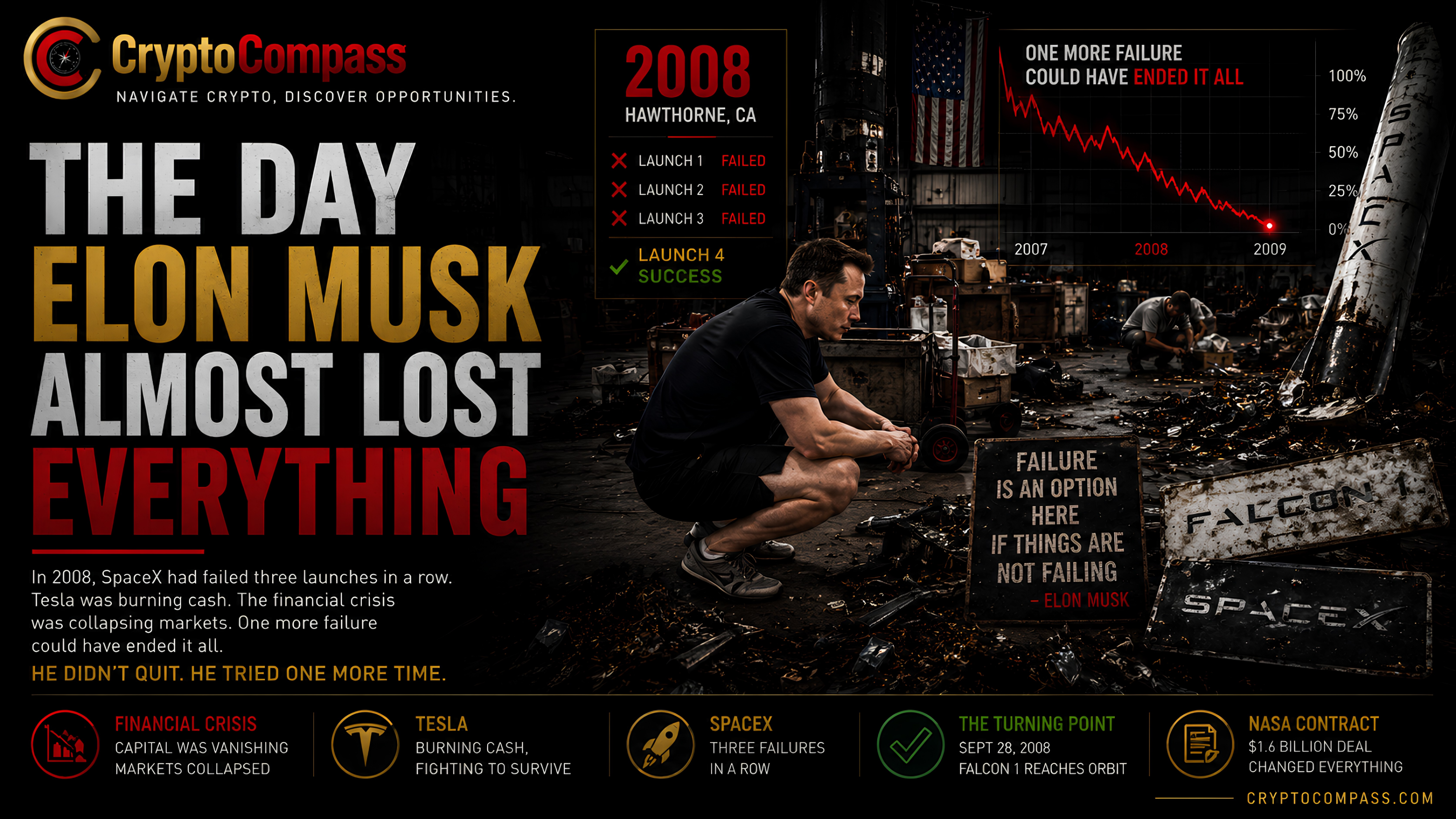
The photograph above captures one of those moments.
There are no cheering crowds. No triumphant headlines. No billion-dollar valuations. No celebrations.
Instead, there is silence.
A warehouse floor covered with twisted metal. Burned components. Broken machinery. Pieces of a rocket that was supposed to work but did not.
In the foreground sits Elon Musk.
Not as the world's richest man.
Not as the owner of a global satellite network.
Not as the founder of a company launching astronauts into orbit.
Simply as a founder staring at the consequences of failure.
The year was 2008.
And everything was beginning to fall apart.
SpaceX had already suffered three consecutive launch failures. Each mission represented years of engineering work and millions of dollars in capital. Each explosion destroyed hardware, delayed progress, damaged credibility, and intensified skepticism from both investors and industry veterans.
The aerospace sector was not known for welcoming newcomers.
For decades, access to space had largely been controlled by governments and defense contractors with enormous budgets, decades of experience, and extensive political connections. The idea that a startup founded by a former internet entrepreneur could compete in that environment seemed unrealistic to many observers.
SpaceX was attempting something few people believed was possible.
More importantly, it was attempting it with limited resources.
Every failure carried consequences.
Every delay increased pressure.
Every launch became a referendum on whether the company deserved to exist.
Yet SpaceX was only half the story.
At the very same time, Tesla was facing a crisis of its own.
The company had not yet become the dominant electric vehicle manufacturer it is today. Production challenges were mounting. Costs were rising. Investors were becoming nervous. The Roadster program had encountered significant delays and financial difficulties.
Then the global financial system began to unravel.
Lehman Brothers collapsed.
Credit markets froze.
Banks failed.
The 2008 financial crisis spread across the world.
Access to capital became dramatically more difficult for nearly every business, particularly young companies that had not yet demonstrated sustainable profitability.
For Tesla and SpaceX, the timing could hardly have been worse.
Both businesses required substantial investment.
Both businesses were consuming cash rapidly.
Both businesses depended on a future that had not yet arrived.
And both businesses were being financed, in large part, by the same individual.
Musk later described this period as one of the most painful moments of his life.
He had invested much of the fortune earned from PayPal into ventures that many considered reckless. As conditions deteriorated, he faced increasingly difficult choices about where to allocate remaining resources. Money moved from one company to another in an effort to keep both alive.
The margin for error disappeared.
There was no unlimited funding source.
There was no guarantee of rescue.
There was only time.
And time was running out.
From the outside, critics believed the outcome was becoming obvious.
SpaceX looked like an expensive experiment.
Tesla looked like an ambitious automotive startup struggling against overwhelming odds.
Many analysts assumed at least one company would fail.
Some believed both would.
The image of Musk sitting among rocket debris reflected that reality.
Today, the photograph is often interpreted as a symbol of perseverance.
At the time, however, it looked like evidence.
Evidence that the skeptics might be right.
Evidence that the project was failing.
Evidence that the dream was ending.
What happened next would ultimately define the future of both companies.
Following the third failed launch, SpaceX engineers returned to work.
They reviewed telemetry.
They analyzed hardware.
They traced failures component by component.
The company could not afford endless experimentation. Resources were limited. Another unsuccessful launch might be fatal.
Everything focused on the fourth attempt.
The mission would become one of the most important launches in modern business history.
On September 28, 2008, Falcon 1 lifted off once again.
This time, it worked.
For the first time, a privately developed liquid-fueled rocket successfully reached orbit.
The achievement immediately altered perceptions of the company.
What had previously been dismissed as an unrealistic ambition suddenly became a proven capability.
SpaceX had demonstrated that private industry could accomplish something historically dominated by governments.
The significance extended beyond engineering.
Success created credibility.
Credibility attracted contracts.
Contracts created survival.
Soon afterward, NASA awarded SpaceX a contract worth approximately $1.6 billion under the Commercial Resupply Services program.
That agreement changed everything.
The contract provided stability.
The stability enabled growth.
The growth created momentum.
And momentum became one of the most important advantages in the company's history.
Tesla experienced its own lifeline around the same period, securing critical financing that allowed operations to continue.
Neither company had fully escaped danger.
But both had survived.
Sometimes survival is enough.
Looking back nearly two decades later, the scale of that turning point is difficult to overstate.
SpaceX transformed launch economics through reusable rockets.
The company developed Starlink, creating one of the world's largest satellite networks.
It became a critical supplier for NASA and a central player in the future of space exploration.
Tesla accelerated the global adoption of electric vehicles and forced traditional automakers to rethink long-term strategy.
Entire industries changed direction.
Hundreds of billions of dollars in value were created.
New technologies emerged.
New markets formed.
Yet all of those outcomes remained invisible when this photograph was taken.
That is perhaps the most important lesson hidden within the image.
Success often appears linear after the fact.
Reality is rarely linear.
Progress is usually messy.
Innovation is usually uncertain.
Breakthroughs often emerge from periods when failure appears more likely than success.
The entrepreneurs celebrated today are frequently the same individuals who were doubted yesterday.
The companies dominating headlines today are often the same companies that once struggled simply to survive another quarter.
This photograph captures a moment before the story became obvious.
Before the victories.
Before the valuations.
Before the headlines.
Before history decided how the narrative would be remembered.
It captures uncertainty in its purest form.
And uncertainty is where every significant achievement begins.
CryptoCompass View
Investors often study outcomes.
Founders live through probabilities.
When looking at SpaceX today, it is tempting to focus on the extraordinary scale of its success. But scale was never guaranteed. In 2008, SpaceX was not a dominant aerospace company. It was a startup with repeated failures, limited resources, and a rapidly shrinking margin for error.
The photograph reminds us that transformative companies are not built during moments of certainty. They are built during moments when success remains highly improbable and the decision to continue requires conviction rather than confidence.
The wreckage on the floor represented failure.
What it did not reveal was that the next launch would change the future of an industry.
History remembers the success.
This image captures the moment just before it happened.
By CryptoCompass