The latest Ledger theft is a hardware-wallet attack in the most literal sense. Ledger says genuine devices were purchased, physically opened, fitted with hidden electronics and placed back in
The latest Ledger theft is a hardware-wallet attack in the most literal sense.
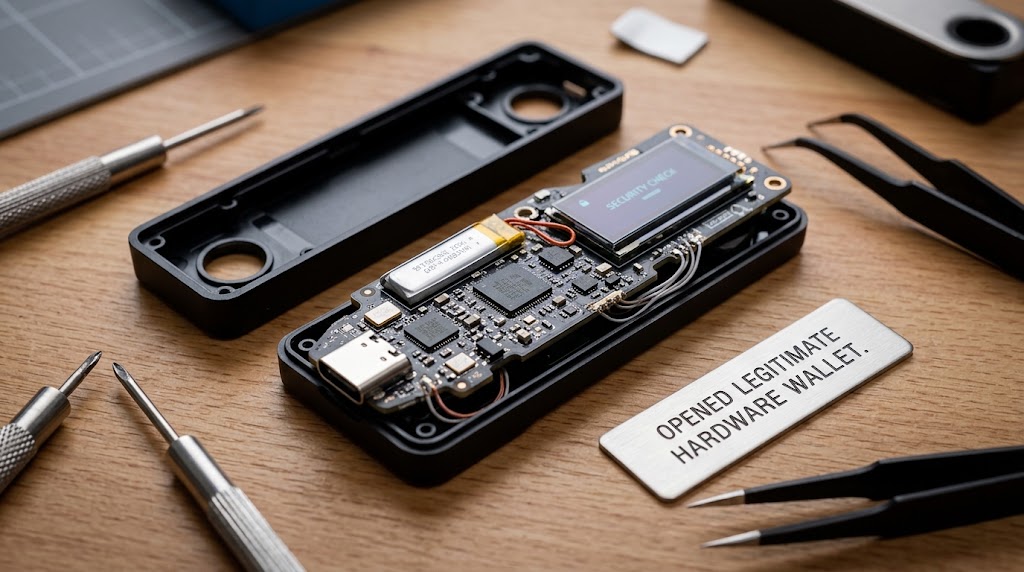
Ledger says genuine devices were purchased, physically opened, fitted with hidden electronics and placed back into distribution through resellers in Southeast Asia.
The implant did not break Ledger's Secure Element, operating system or transaction-signing logic.
It watched the screen during setup, captured the 24-word recovery phrase and transmitted the words over a cellular connection using an eSIM.
Independent investigators have estimated losses in the tens of millions of dollars, with several reports placing the suspected total above $86 million. Ledger has not confirmed a final loss amount or victim count.
The security lesson is uncomfortable because the cryptography can work exactly as designed while the user still loses everything.
A hardware wallet is built around the assumption that the recovery phrase remains secret.
The Secure Element can protect keys generated from that phrase. Transaction signing can remain isolated. Firmware can verify what the device is being asked to sign.
None of those controls help if a hidden component records the recovery phrase when it first appears on the device's screen.
Anyone who possesses the phrase can recreate the wallet elsewhere. The attacker does not need the original device again and does not need to bypass transaction confirmation.
Ledger is drawing a careful boundary around the incident.
The company says the affected devices were modified after leaving Ledger's control and that its own chip, operating system, servers and direct inventory were not compromised.
Ledger therefore describes the incident as a localized attack on the distribution channel rather than a systemic compromise of its manufacturing supply chain.
That wording matters technically, but from the user's perspective the practical issue is broader: authenticity has to survive every handoff between factory and buyer.
A secure device received through an insecure distribution path can become an insecure device.
Optimisus covered another major hardware-wallet failure earlier this year.
In that case, a Coldcard firmware build generated weak recovery seeds that remained vulnerable even after the firmware was updated.
The two incidents fail in opposite places.
Coldcard's problem was internal seed generation: the device created a mathematically weak secret. Ledger's reported implant attack targeted a genuine strong secret at the moment it was displayed.
Both produce the same end state. The attacker learns enough information to recreate the wallet without defeating the blockchain.
Hardware-wallet advice often treats the purchase channel as a footnote.
This incident turns it into part of the threat model.
Ledger asked authorized resellers and distributors in Southeast Asia and Hong Kong to suspend sales while it investigated. The company also inspected inventory and devices from other markets.
Users should therefore treat provenance as part of device security: buy through official or clearly verified channels, inspect packaging and device condition, follow manufacturer authenticity checks and never trust a recovery phrase that arrived pre-written or pre-generated.
If a device has already been initialized and there is credible reason to suspect tampering, moving funds requires a newly generated recovery phrase on trusted hardware. Resetting the same compromised setup is not enough.
Hardware wallets have historically concentrated on protecting private-key material from extraction and keeping transaction signing isolated.
The Ledger implant shows another target: the path between the secure system and the human.
If malware or hardware can observe what the secure device displays, a recovery phrase can leak without the secure chip ever surrendering the private key directly.
That pushes future wallet design toward stronger tamper detection around screens, enclosures and input/output pathways, not only around the secure element itself.
The slogan 'not your keys, not your coins' is directionally correct and operationally incomplete.
Self-custody removes the exchange or custodian from the ownership chain. It replaces that counterparty risk with dependence on device design, software, entropy, distribution, backup practices and the user's own operational security.
Optimisus has made the same point in its coverage of European rules that distinguish regulated custody from self-hosted wallets. Control of the key changes the legal and technical relationship, but somebody still has to protect the process that creates and stores the key.
The Ledger implant is a reminder that security starts before the first transaction is signed.
It starts when the box reaches the buyer.
This is not financial advice.