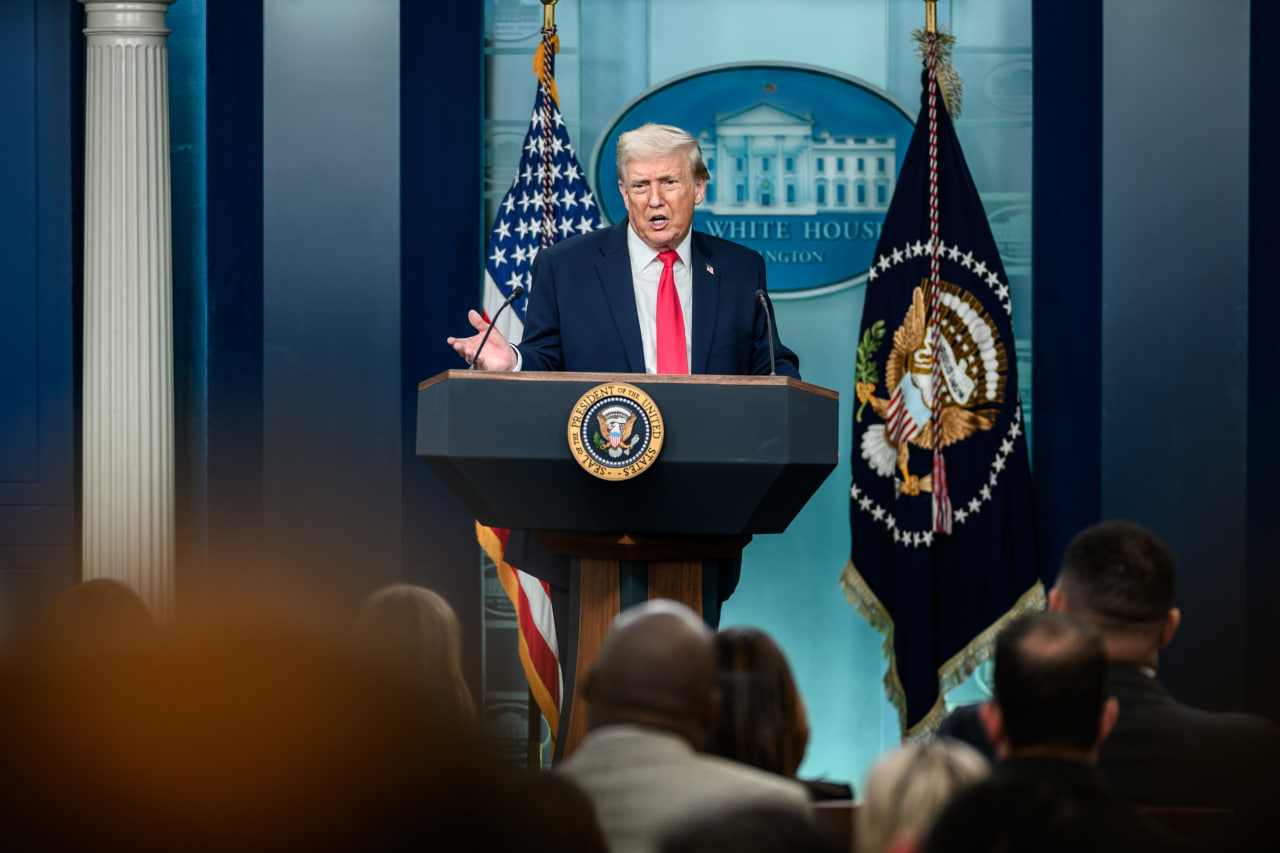
The White House and Senate Republicans agreed to apply crypto ethics rules to Trump, with enforcement resting solely with the DOJ. Acting Attorney General Todd Blanche, Trump’s former persona
- The White House and Senate Republicans agreed to apply crypto ethics rules to Trump, with enforcement resting solely with the DOJ.
- Acting Attorney General Todd Blanche, Trump’s former personal defense lawyer, would be the one investigating any violations.
- The actual bill text isn’t public yet. What’s circulating is characterization from sources, not statute.
- Bitcoin rallied on the news, but Thune still needs 7 to 8 Democratic votes he doesn’t currently have.
Somebody had to decide who polices Donald Trump’s crypto holdings once the CLARITY Act becomes law. After months of deadlock, the White House and a bipartisan group of senators settled on an answer: the Department of Justice, currently led by acting Attorney General Todd Blanche, who spent years as Trump’s own defense attorney before joining the administration.
Fox Business host Eleanor Terrett broke the story, reporting that she was hearing from multiple industry sources that the White House had signed off on an ethics package for the bill. Wu Blockchain corroborated the report within hours, and Senator Kevin Cramer later confirmed it. The agreement applies ethics restrictions to the president the same way it applies to any federal official, while stripping out a mechanism that would have let state attorneys general sue the DOJ if it failed to act.
Picture a whistleblower alleging that a new token utility was structured to directly inflate the president’s own equity stake. Trump’s 2025 financial disclosure, filed July 1, put his crypto-linked income at $1.4 billion, most of it tied to World Liberty Financial and a scattering of meme coins. Under the DOJ-only model now on the table, that whistleblower has exactly one door to knock on, and it’s a door answering to Trump’s former lawyer. Critics argue a politically aligned attorney general could simply let the complaint sit indefinitely. Under the state AG mechanism Democrats originally wanted, New York’s or California’s attorney general could have bypassed federal gridlock entirely, issuing subpoenas and suing under state consumer-protection or conflict-of-interest statutes. That’s the gap the June compromise tried to close.
Why June’s near-deal actually died
A bipartisan group that included Kirsten Gillibrand, Ruben Gallego, Bernie Moreno and Cynthia Lummis had reached tentative agreement in June on letting state AGs sue the DOJ over non-enforcement. The White House pulled out during a closed-door session, worried that Democratic attorneys general in states like New York or California would use the mechanism for targeted litigation rather than genuine ethics enforcement.
Trump met personally with Moreno and Lummis on July 16, along with White House crypto adviser Patrick Witt. Chief of Staff Susie Wiles and Witt have both framed the resulting language as a real concession from the executive branch. Witt reportedly postponed mandatory Georgia Army National Guard training specifically to shepherd the bill through this stretch. That alone tells you how the White House is prioritizing the next two weeks.
Strip away the politics and CLARITY Act itself is fairly conventional market-structure legislation, oversight of digital commodities to the CFTC, narrower jurisdiction over investment contracts to the SEC. Industry lawyers have wanted that division for years. None of that was ever the sticking point in these negotiations. The ethics clause got grafted on separately, built entirely around one person’s finances, which is why it’s the part still unresolved while the rest of the bill has had bipartisan Banking Committee support since May.
Markets, meanwhile, are not waiting for the fine print. Bitcoin hit a one-month high of $66,500 on the news, up 1.9%, and spot Bitcoin ETFs logged a fifth straight day of net inflows.
ScenarioPath to passage
Polymarket oddsBipartisan compromiseRepublicans allow limited, late-stage state intervention, pulling in moderate Democrats43%Gridlock to recessDemocrats block floor consideration over bill-text transparency35%Lame-duck postponementBill shelved until after the 2026 midterms22%
The Senate floor hasn’t caught up to what markets are pricing in.
The industry doesn’t care who enforces this, it just wants a bill
Kristin Smith, president of the Solana Policy Institute, has pushed for immediate floor consideration regardless of how the ethics fight resolves. Her position is blunt: a uniform federal framework is worth whatever political trade-offs come attached to it, ethics language included. That view runs through most of the crypto lobby right now. After years of operating under SEC enforcement actions instead of clear statute, the industry wants certainty more than it wants a particular version of accountability.
Banks are split. The American Bankers Association has welcomed the bill’s bankruptcy protections, which would let institutions custody digital assets without the kind of punitive capital treatment that currently discourages them from touching crypto at all. But the same association keeps flagging a separate concern that has nothing to do with Trump’s finances: language in the bill that could let crypto platforms offer yields resembling bank deposits without the anti-money-laundering safeguards traditional banks operate under. None of that industry pressure moves the ethics question forward. It just adds weight to the argument that something needs to pass before the recess, whether or not the enforcement language holds up under scrutiny.
The vote count Blanche can’t fix
Republicans hold 53 seats, effectively 52 with Mitch McConnell hospitalized. Clearing the 60-vote filibuster threshold means Majority Leader John Thune needs 7 to 8 Democratic votes that, right now, simply do not exist. Senators Chris Murphy, Chris Van Hollen and Jeff Merkley already held a joint press conference rejecting the merged text outright. Murphy didn’t mince words, calling the arrangement a bill that “essentially legalizes Donald Trump’s crypto corruption scheme.”
Moderate Democrats facing tight 2026 midterm races are still under pressure from well-funded crypto lobbying groups to break ranks anyway. That’s the only real variable left in this equation. TD Cowen’s Washington Research Group warns that without immediate bipartisan momentum, the bill risks sliding past the August recess and into 2027. Astraea Law puts a viable enactment window around August 2026, but only if the final text peels off enough moderate Democrats to matter.
None of that changes what happens if Blanche’s DOJ decides, six months from now, not to open an investigation nobody outside Washington ever hears about.
The post The Man Policing Trump’s Crypto Ethics Used to Be His Lawyer appeared first on ETHNews.