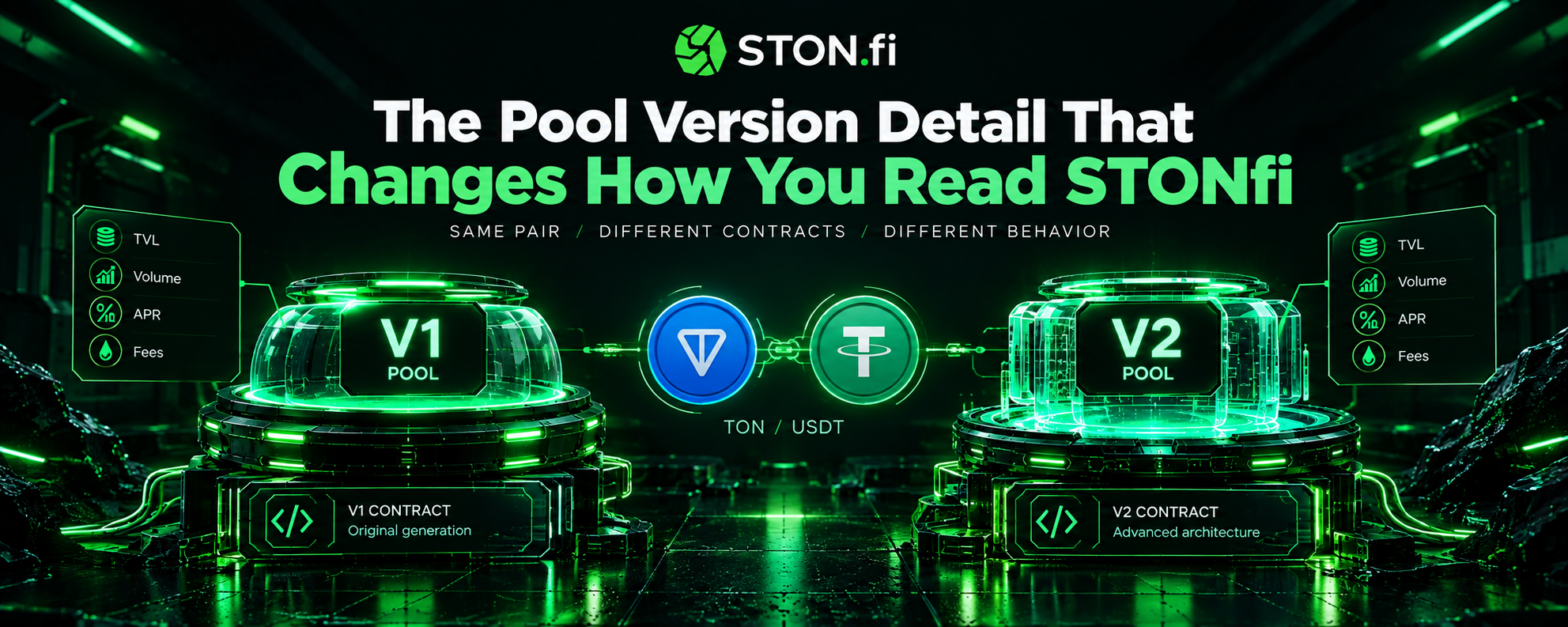
When looking at a STONfi pool, it is easy to focus on the numbers first. TVL. Volume. Fees. APR. But there is another detail that comes before all of them: the pool version. STONfi currently
When looking at a STONfi pool, it is easy to focus on the numbers first.
TVL. Volume. Fees. APR.
But there is another detail that comes before all of them: the pool version.
STONfi currently supports V1 and V2, and they are not simply two labels for the same implementation. They represent different generations of the DEX's smart-contract architecture.
That means two pools containing the same token pair can still operate under different contract logic.
So before comparing their numbers, it helps to understand what you are actually comparing.
Think of the version as identifying the underlying system running the pool.
STONfi's documentation describes V1 as the original implementation, while V2 is the newer implementation with additional liquidity-management features and a vault system for fee collection.
The difference is therefore deeper than the interface.
A simple way to think about it is:
Same token pair
↓
Different pool version
↓
Different contract implementation
↓
Potentially different pool behavior
The token pair might look identical on the surface, but the infrastructure underneath does not have to be.
That is why the version label deserves more attention than it usually gets.
V2 introduces capabilities that are not part of the original V1 implementation.
According to STONfi's documentation, V2 includes:
Single-sided liquidity provision
A vault system for fee collection
Optimized gas consumption
Automatic LP token burns
V1, meanwhile, represents the original AMM implementation.
This gives V2 a different set of capabilities rather than simply making it a renamed version of V1.
So when you see V2, the useful question is not simply:
"Is this newer?"
A better question is:
"What does this version change about the pool I am looking at?"
Suppose you search for a token pair and find two pools.
Both contain the same assets.
One is V1.
The other is V2.
It would be tempting to combine their TVL and volume mentally and treat them as one market.
That can hide an important distinction.
Each pool has its own liquidity and activity.
For example:
POOL A
Version: V1
TVL: $800K
Volume: $120K
POOL B
Version: V2
TVL: $2.4M
Volume: $900K
Those numbers describe two separate pools.
The correct comparison is not:
V1 + V2 = one bigger pool
It is:
V1 pool → evaluate its own conditions
V2 pool → evaluate its own conditions
The version is part of the context behind the numbers.

For a trader, pool selection can affect the execution environment.
Liquidity depth and trading activity are properties of the individual pool. If liquidity is distributed between multiple pools for the same pair, the conditions in one pool do not automatically describe the others.
So instead of asking only:
"How much liquidity does this pair have?"
look at:
"How much liquidity does this specific pool have?"
Then check its version and other relevant pool details.
This gives you a more accurate picture of where the trade is actually being executed.
For liquidity providers, the version is directly connected to the contract implementation handling the position.
STONfi states that its pools are immutable, meaning the deployed pool contracts cannot simply be rewritten after deployment.
That makes the version more than temporary metadata.
If you are comparing pools, you should know which contract generation you are interacting with before looking at the return figures.
And this is where another common mistake appears.
People often compare APR first.
But APR is an outcome of current pool conditions.
The version helps explain the structure producing those conditions.
Imagine two pools:
Pool A
V1
TVL: $1M
Volume: $150K
APR: 8%
Pool B
V2
TVL: $1M
Volume: $500K
APR: 15%
The higher APR alone does not tell you why the difference exists.
You still need to consider:
The point is not that one version automatically produces better results.
It is that the numbers need structural context before they can be compared properly.
When I look at a pool now, I would go in this order:
1. Identify the pair
Know exactly which assets the pool contains.
2. Check the version
V1 and V2 should not be treated as interchangeable implementations.
3. Check the pool structure
Understand what type of pool and liquidity model you are looking at.
4. Check TVL and volume
These tell you about the pool's current size and activity.
5. Check fees and APR
Only after the previous information is clear do these numbers have proper context.
This takes only a few extra seconds, but it can prevent a misleading comparison.

The arrival of V2 does not mean V1 should automatically be treated as irrelevant.
STONfi's documentation describes V1 as still supported for backward compatibility, while V2 is the latest version.
That means version checking remains relevant when looking through existing pools.
You are not necessarily choosing between "old" and "new."
You are identifying which implementation a particular pool uses.
The useful takeaway is not simply:
V2 exists.
It is this:
Pool metrics only make sense when you know what is producing them.
TVL tells you about liquidity.
Volume tells you about activity.
Fees tell you about the pool's fee configuration.
APR reflects recent conditions.
And the version tells you which generation of contract infrastructure you are dealing with.
Leaving that last piece out can make two different pools look more comparable than they really are.
The version label on a STONfi pool may be small, but it carries useful context.
V1 and V2 are different contract generations, with V2 introducing additional capabilities such as single-sided liquidity and a vault system.
So the next time you compare pools for the same pair, don't jump straight to TVL or APR.
Start with the version.
Then look at the mechanics.
Then compare the numbers.
That order gives you a much clearer picture of what the pool actually represents.