The Second Half of 2026: Five Forces That Could Shape Crypto Markets
Bitcoin investors are watching ETFs, traders are watching charts, and Crypto Twitter is chasing the next narrative. Yet the biggest drivers of the market may come from macroeconomics, liquidity, and global capital flows.
A
AnonymousCryptoCompass newsroom
June 8, 2026
7 min read
OPINION
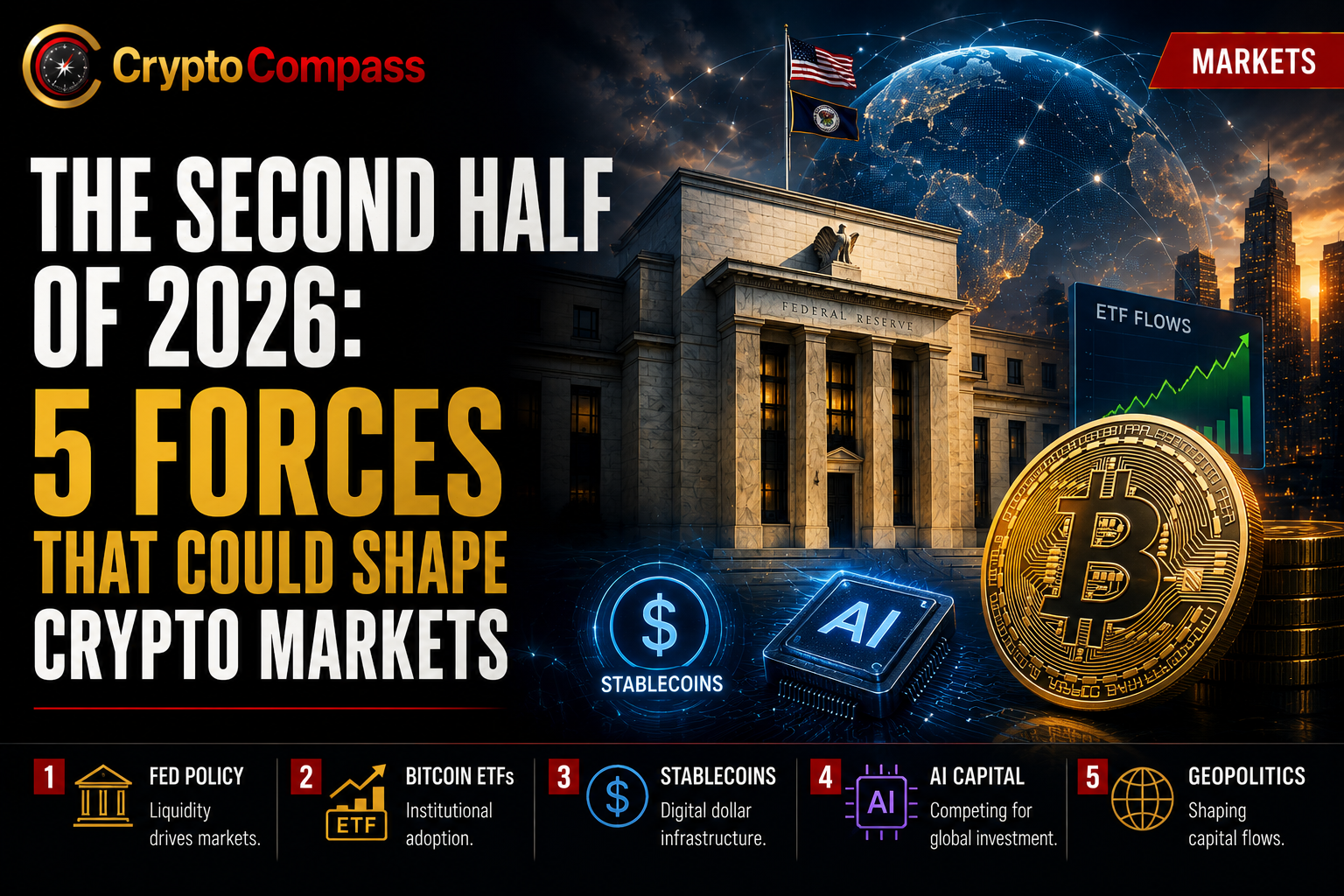
CryptoCompass editorial visual for markets coverage.
The Second Half of 2026: Five Forces That Could Shape Crypto Markets
Crypto Is No Longer Trading in Isolation
For much of its history, crypto existed in its own universe.
Market participants focused on token launches.
Exchange listings.
Protocol upgrades.
Mining activity.
Today, that reality has changed.
Bitcoin ETFs have connected digital assets to traditional finance.
Institutional investors now participate in the market.
Pension funds, hedge funds, family offices, and asset managers increasingly influence price action.
As a result, crypto no longer trades independently.
It trades as part of the global financial system.
Understanding the second half of 2026 requires looking beyond crypto itself.
Force #1: The Federal Reserve and Global Liquidity
Federal Reserve policy decisions continue to influence global liquidity conditions, risk appetite, and capital allocation across financial markets. No institution has greater influence over global liquidity than the Federal Reserve.
Interest rates affect:
Capital availability
Risk appetite
Credit conditions
Investment flows
For years, crypto investors focused almost exclusively on blockchain developments.
Today, many professional investors spend more time analyzing Federal Reserve policy than individual token launches.
The reason is simple.
Liquidity drives markets.
If financial conditions ease, risk assets often benefit.
If conditions tighten, speculative assets frequently face pressure.
The relationship is not perfect.
But over time, liquidity remains one of the strongest forces influencing capital allocation.
Force #2: The Rise of Bitcoin ETFs
Bitcoin ETFs have strengthened the connection between digital assets and traditional financial markets, attracting institutional participation. Bitcoin ETFs have fundamentally changed market structure.
For the first time, large institutions can gain Bitcoin exposure through familiar investment vehicles.
This matters because institutional capital behaves differently.
It is larger.
More patient.
More systematic.
The long-term significance of ETFs may not be short-term price appreciation.
It may be the gradual integration of Bitcoin into mainstream portfolio construction.
The market is still learning what that transition looks like.
Force #3: Stablecoins Are Quietly Becoming Financial Infrastructure
Many investors still view stablecoins as a crypto niche.
That perception may be outdated.
Stablecoins increasingly function as digital dollars.
They facilitate payments.
Trading.
Cross-border settlements.
On-chain financial activity.
The growth of stablecoins could become one of the most important stories in financial technology.
Unlike many speculative narratives, stablecoins solve real-world problems.
And institutions are beginning to notice.
Force #4: Artificial Intelligence Is Competing for Capital
One of the most overlooked themes in crypto is competition.
Not competition between blockchains.
Competition between investment opportunities.
Artificial intelligence has become one of the strongest magnets for global capital.
Technology companies are investing hundreds of billions of dollars into infrastructure.
Data centers.
Semiconductors.
Energy systems.
Private markets.
Every dollar flowing into AI is a dollar not automatically flowing elsewhere.
Crypto no longer competes only with itself.
It competes with every major growth narrative in global markets.
Force #5: Geopolitical Uncertainty
Investors face a world that appears increasingly fragmented.
Trade disputes.
Supply chain realignments.
Regional conflicts.
Energy security concerns.
Currency diversification efforts.
These developments influence capital flows across markets.
Historically, periods of uncertainty have often increased interest in alternative stores of value.
Gold has benefited.
Bitcoin hopes to benefit as well.
Whether it succeeds remains one of the most important questions facing the asset class.
The Most Important Trend Nobody Talks About
Perhaps the biggest change in crypto is psychological.
The market is becoming more mature.
Five years ago, investors asked:
"Which coin will go up next?"
Today, larger investors increasingly ask:
"How does crypto fit into a diversified portfolio?"
That shift may prove more important than any individual narrative.
Looking Ahead
The second half of 2026 is unlikely to be defined by a single event.
No ETF approval.
No token launch.
No viral trend.
Instead, the market will likely be shaped by the interaction of liquidity, institutional adoption, stablecoin growth, artificial intelligence investment, and global geopolitics.
Investors who focus exclusively on headlines may miss the bigger picture.
The future of crypto increasingly depends on forces far beyond crypto itself.
CryptoCompass View
The next phase of crypto may look very different from the last.
Markets are maturing.
Institutions are arriving.
Capital is becoming more selective.
The winners may not be those chasing the loudest narrative.
They may be those best positioned to understand where global capital is heading next.
Navigate Markets. Discover Opportunities.
Frequently Asked Questions
What is the biggest risk for crypto in the second half of 2026?
A sharp deterioration in global liquidity conditions remains one of the most significant risks.
Why are ETFs important?
They provide institutional access and integrate Bitcoin into traditional portfolio frameworks.
How does AI affect crypto?
AI competes for investment capital, talent, infrastructure, and investor attention.
Why are stablecoins important?
Stablecoins increasingly function as digital financial infrastructure rather than speculative assets.
What should investors monitor most closely?
Federal Reserve policy, ETF flows, stablecoin growth, AI investment trends, and geopolitical developments.
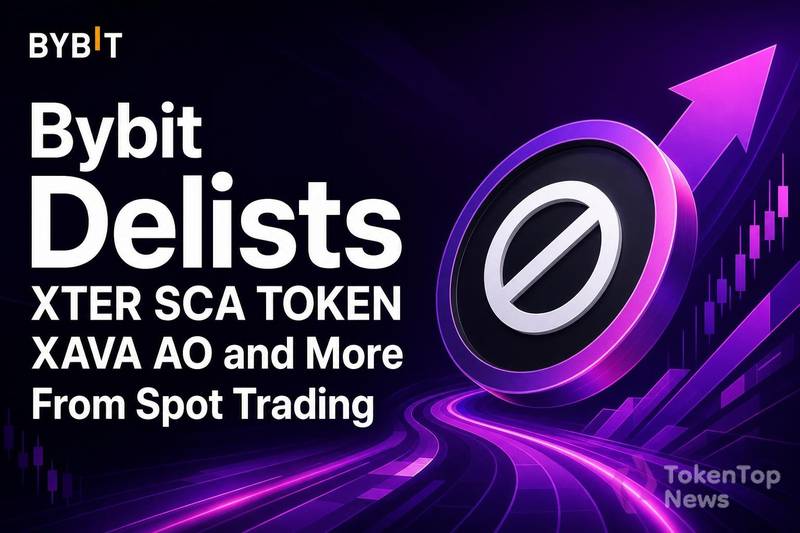
Bybit is delisting XTER, SCA, TOKEN, HPOS10I, PUMPBTC, AFC, INTER, XAVA and AO from spot trading, removing all nine tokens from the exchange's spot market in a single update to its trading pa
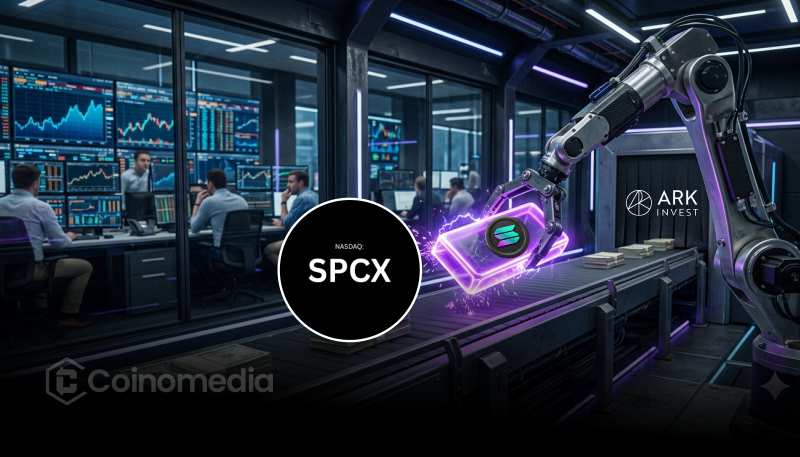
Ark Invest bought 124,543 SPCX shares worth $14.1 million. The firm also purchased 4,799 SOLQ shares valued at about $30,000. Ark reduced its Robinhood (HOOD) position by selling 12,119 share
Key Insights CRCL stock gained about 2% after Circle announced the IBM patent acquisition. Circle acquired nearly 1,000 issued patents across over 680 patent families. The portfolio supports