The top crypto exchange aggregators in 2026 are: 1inch, CoW Protocol, Velora, Odos, Uniswap X, Jupiter, LI.FI, SimpleSwap, ChangeNOW, and StealthEX. That list spans two fundamentally differen
The top crypto exchange aggregators in 2026 are: 1inch, CoW Protocol, Velora, Odos, Uniswap X, Jupiter, LI.FI, SimpleSwap, ChangeNOW, and StealthEX. That list spans two fundamentally different models – decentralized routing protocols that route your trade across on-chain liquidity, and centralized swap services that quietly route you through whichever counterparty pays them the most. The difference matters because it determines who captures the value in every trade you execute.
Quick comparison
RankNameTypeChain coverageMEV protectionKey 2026 development11inchDEX aggregator15+ chainsFusion+ modeCross-chain intent orders live2CoW ProtocolDEX aggregatorEthereum + GnosisBatch auction surplus sharingUsers receive better-than-quoted fills3VeloraDEX aggregator10+ chainsDelta featureInstitutional API adoption growing4OdosDEX aggregator10+ chainsMulti-path routingv2 outperforms 1inch on multi-hop routes5Uniswap XDEX aggregatorEthereum + L2sIntent-based routingLive on mainnet; filler competition model6JupiterDEX aggregatorSolanaRoute splittingDominant Solana swap interface7LI.FICross-chain aggregator30+ chainsBridge + swap combinedAggregator-of-aggregators model8SimpleSwapCEX aggregator900+ tokensNoneNo-KYC swap; regulatory grey zone9ChangeNOWCEX aggregator850+ tokensNoneNo-KYC; FATF Travel Rule exposure10StealthEXCEX aggregator1400+ tokensNoneLargest token breadth; non-custodial claims
How we ranked these aggregators
Routing quality provides the baseline – specifically, whether the aggregator consistently returns better prices than going directly to a single exchange. We then layered in:
- MEV protection – whether the protocol architecture prevents front-running and sandwich attacks, or simply outsources that risk to market makers
- Chain coverage – how many networks and which bridges are supported, and whether cross-chain routing introduces additional smart contract risk
- Fee transparency – whether aggregator fees are disclosed on-screen or embedded invisibly in quoted rates
- Regulatory exposure – whether the service operates with KYC, without KYC, and in which jurisdictions regulators have signaled enforcement interest
- Security record – whether the protocol or service has suffered a material exploit, and how it responded
We reviewed 1inch’s official documentation, CoW Protocol’s Whitepaper, Velora’s developer documentation, and Odos v2 documentation. For centralized swap aggregators, we reviewed public statements and, where relevant, publicly documented security incidents. We did not execute live trades on any platform.
The top 10 crypto exchange aggregators in 2026
1. 1inch
1inch is the largest DEX aggregator by cumulative volume – it crossed $300 billion in total swaps routed across its supported chains by mid-2026. Its reach spans over 15 networks including Ethereum, BNB Chain, Arbitrum, Optimism, Polygon, Avalanche, and more. No other DEX aggregator comes close on network breadth.
The 2025-2026 development that changed 1inch’s competitive position is Fusion+ – a cross-chain intent order system where users sign an intent to swap and resolvers (professional market makers) compete to fill it at the best available rate. The user never sends a transaction directly. The resolver does. That model eliminates front-running because the resolver cannot extract MEV from a transaction they themselves are submitting in competition with other resolvers.
1inch shows the current supported chains and the Fusion+ mode toggle in the interface.
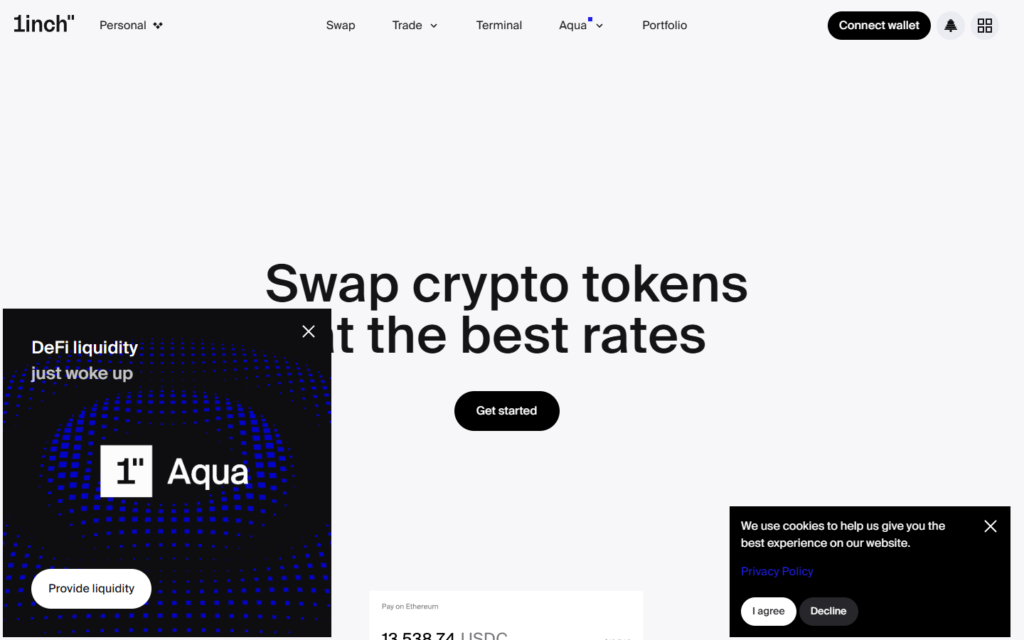 1inch app, July 2026 – Fusion+ mode toggle and supported chains confirmed on the live interface.
 The resolver network has grown to over 80 active resolvers as of the Fusion+ v2 launch.
The critique of 1inch’s model is that resolver competition is only as strong as the resolver set. If resolver concentration increases – a risk in any permissioned professional market – then the competitive pressure that makes Fusion+ work begins to degrade.
Best for: Multi-chain traders who need the widest routing coverage and intent-based MEV protection.
2. CoW Protocol
CoW Protocol built its routing model around a concept called coincidence of wants – if two users want to swap in opposite directions simultaneously, the protocol matches them directly, cutting out liquidity pool fees entirely. Trades that cannot be matched peer-to-peer are filled through batch auctions where solvers (CoW’s equivalent of resolvers) compete to route the remaining order flow.
The result that distinguishes CoW from every other aggregator on this list: users routinely receive better-than-quoted prices. CoW introduced surplus sharing in 2025, where any execution surplus – the difference between the quoted rate and the actual fill rate – is returned to the user rather than captured by the protocol or solver. That mechanism turns the aggregator from a fee-extraction layer into something closer to an advocate for the user’s outcome.
CoW Protocol publishes its batch auction surplus statistics on-chain.
 CoW Protocol homepage, July 2026 – Batch auction model and surplus sharing mechanism confirmed.
 The data is verifiable – every batch is a transaction on Ethereum with solver competition documented in the calldata.
CoW’s current limitation is chain coverage. It operates primarily on Ethereum and Gnosis Chain. Traders on BNB Chain, Solana, or Layer 2 networks outside Ethereum’s ecosystem cannot access CoW’s routing.
Best for: Ethereum-based traders who want the strongest available MEV protection and are willing to accept longer settlement times in exchange for better execution quality.
3. Velora
Velora occupies the institutional lane of DEX aggregation. Its Delta feature – a request-for-quote system where professional market makers provide firm quotes before the user signs a transaction – appeals to desks and protocols that need predictable execution rather than best-effort routing.
The API adoption angle is significant. Velora is embedded in multiple wallets and DeFi protocols as the backend routing layer, meaning its actual routing volume is substantially higher than what is visible through the Velora interface alone. The interface is a small portion of the footprint.
Velora discloses its partner integrations and the Delta feature documentation directly on the developer portal.
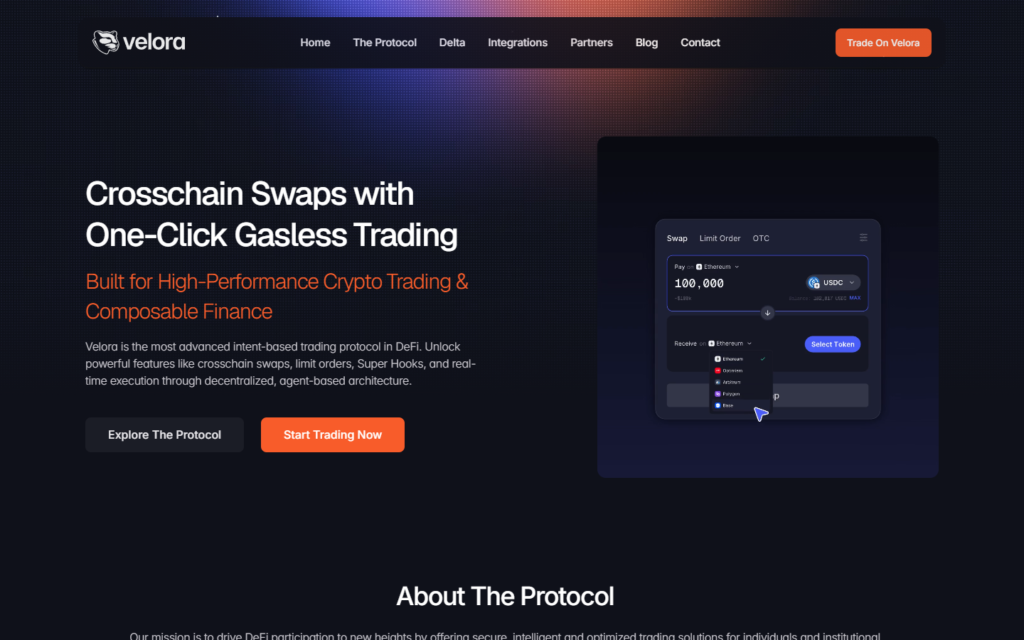 Velora homepage, July 2026 – Delta feature and partner integration documentation confirmed.
The critique of Velora is that the Delta model, which relies on market maker quotes, means Velora’s routing quality depends on the quality and competitiveness of its market maker relationships – a dependency that is harder for users to independently verify than on-chain routing competition.
Best for: Protocol integrators and institutional traders who need a request-for-quote API with predictable execution.
4. Odos
Odos launched its v2 routing engine in 2025 and published benchmarking data showing it outperforms 1inch on multi-hop routes – trades that require passing through more than one liquidity pool to reach the destination token. Multi-hop optimization matters most for long-tail token pairs and for large trades where single-pool slippage is the binding constraint.
The multi-path architecture of Odos v2 splits orders across multiple simultaneous routes and optimizes the path selection using a custom pathfinding algorithm. The practical effect is measurable in the benchmarks: on routes requiring three or more hops, Odos v2 returns better quoted prices than 1inch’s standard routing in a majority of tested pairs.
Odos displays the routing path for each swap, showing which pools and chains are used. The transparency is useful – users can see exactly where their trade is being routed.
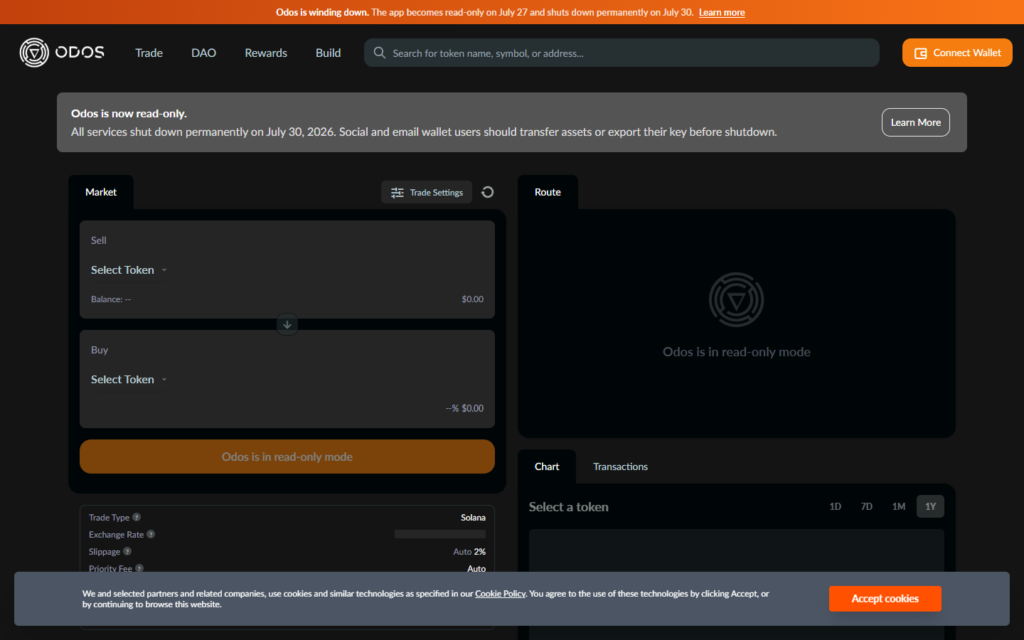 Odos app, July 2026 – Multi-path routing display and v2 optimization confirmed.
Odos is smaller than 1inch by cumulative volume and resolver/solver set. The question for traders is whether better routing quality on complex paths is worth using a protocol with a smaller security track record.
Best for: Traders executing complex multi-hop swaps on Ethereum and L2s who want best-execution routing over brand familiarity.
5. Uniswap X
Uniswap X is Uniswap’s answer to the intent-based aggregator model. Rather than routing trades through Uniswap’s own liquidity pools by default, Uniswap X routes through a filler network – third-party market makers who compete to fill signed user intents. Uniswap pools are the fallback, not the first option.
The architecture shift is material. Uniswap is explicitly acknowledging that its own pools are not always the best source of liquidity, and building a meta-routing layer on top. For users, the practical benefit is MEV protection through the same mechanism as 1inch Fusion+ – the filler, not the user, submits the on-chain transaction.
Uniswap X is live on Ethereum mainnet and expanding to Layer 2 networks.
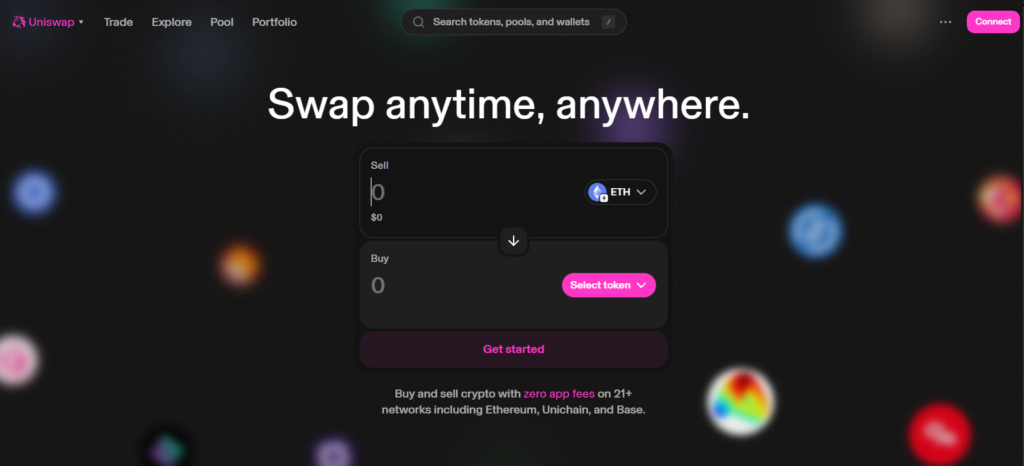 Uniswap X interface, July 2026 – Intent-based routing live on Ethereum mainnet confirmed.
 The filler set is currently smaller than 1inch’s resolver set, which means less competitive pressure on fill quality.
Best for: Uniswap-native traders who want intent-based MEV protection without leaving the Uniswap interface.
6. Jupiter
Jupiter is not competing with 1inch in the same market. It is Solana’s dominant swap aggregator – the routing layer that aggregates liquidity across Raydium, Orca, Meteora, and every other major Solana DEX. For Solana-native traders, Jupiter is not one option among many; it is the default interface for on-chain trading.
Jupiter’s Route Map feature allows users to see the exact routing path across pools, and its liquidity coverage on Solana is effectively complete. Any token with meaningful on-chain Solana liquidity can be swapped through Jupiter.
Jupiter has expanded to offer limit orders, DCA (dollar-cost averaging) automation, and a portfolio view.
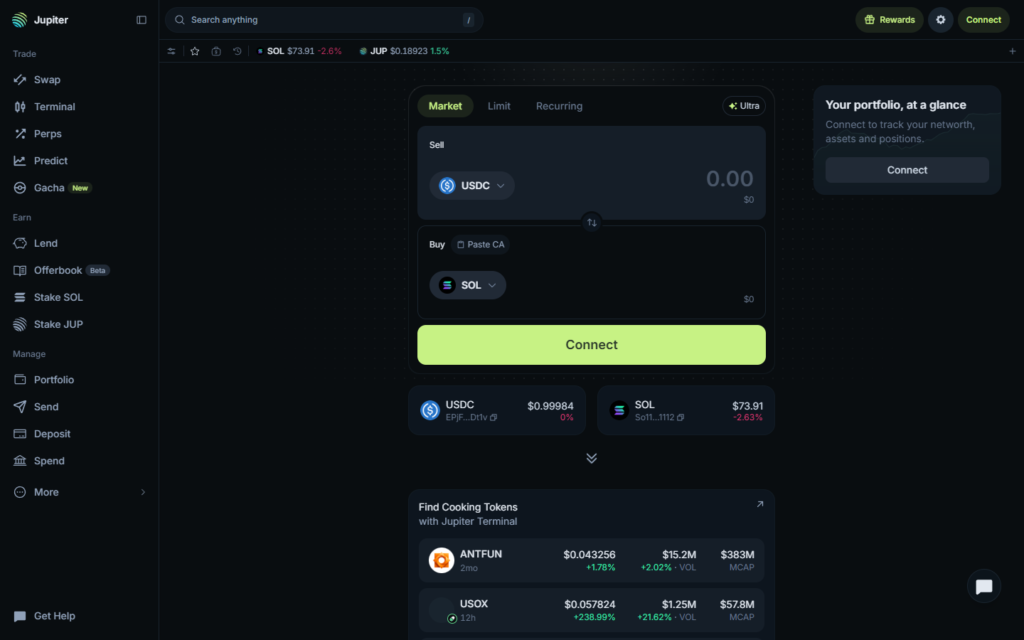 Jupiter app, July 2026 – Solana aggregator interface and expanded limit order features confirmed.
 The aggregator has become a broader trading interface rather than a pure swap tool.
Jupiter’s limitation is simple: it does not operate outside Solana. For Ethereum-based traders, it is irrelevant. For Solana-native traders, it is essential.
Best for: Solana-native traders. Not relevant for Ethereum or EVM-chain trading.
7. LI.FI
LI.FI is an aggregator-of-aggregators – it combines DEX aggregation across chains with bridge aggregation, letting users route a single trade across multiple chains in one transaction. A user wanting to move from USDC on Ethereum to a token on Arbitrum to a position on Base can execute that as a single intent through LI.FI.
The protocol aggregates over 30 chains and dozens of bridges, including Stargate, Hop, Across, and Connext. It selects the optimal bridge-plus-swap path based on user parameters (speed vs. cost vs. security).
LI.FI documents its supported chains and bridge partners.
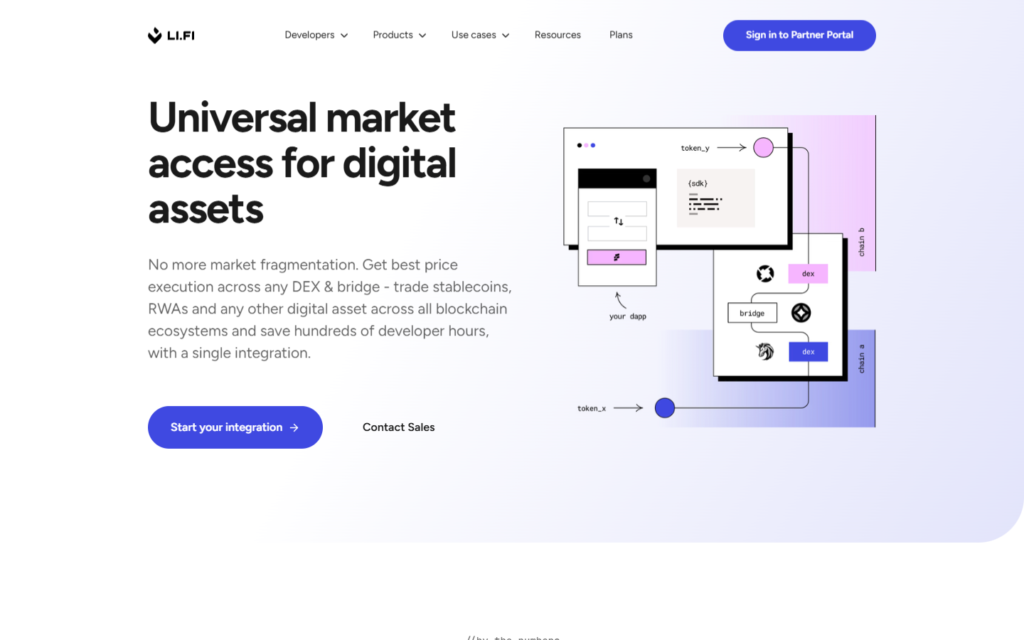
![LI.FI homepage showing cross-chain aggregator and bridge routing interface]() LI.FI homepage, July 2026 – Cross-chain aggregator and 30+ chain bridge support confirmed.
LI.FI homepage, July 2026 – Cross-chain aggregator and 30+ chain bridge support confirmed. The developer API is widely embedded – LI.FI routing appears inside MetaMask, Jumper Exchange, and multiple other interfaces.
The risk that LI.FI’s model concentrates is smart contract risk across multiple layers. A bridge exploit or DEX aggregator vulnerability anywhere in the route could affect LI.FI transactions. The protocol has bug bounty programs and audits, but the attack surface is larger than single-chain aggregators.
Best for: Cross-chain traders who need a single interface for multi-chain routing, and protocol developers embedding cross-chain swap functionality.
8. SimpleSwap
SimpleSwap operates as a centralized swap aggregator – it routes trades through its own liquidity partnerships and charges a margin on the spread. It does not require KYC for most swap volumes, which is its primary draw. The user enters a destination address, selects tokens, and receives the swap without creating an account.
The no-KYC model operates in a regulatory grey zone. FATF Travel Rule guidance, which requires originator and beneficiary information for crypto transfers, applies in theory to crypto asset service providers in most FATF-member jurisdictions. Whether centralized swap aggregators operating without KYC qualify as CASPs under those rules is a question that regulators in the EU and UK have not fully resolved as of July 2026.
SimpleSwap discloses its fee structure as a percentage built into the exchange rate.
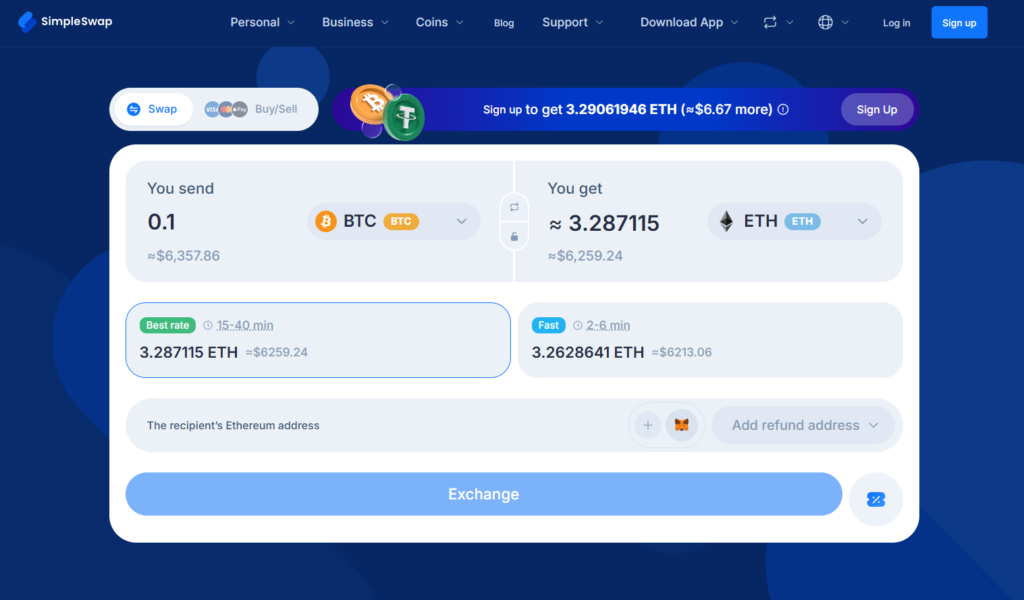 SimpleSwap homepage, July 2026 – No-account swap interface and fee structure confirmed.
 The exact margin is not displayed numerically; users compare quoted rates against reference prices to infer it.
Best for: Users who prioritize no-account access and understand they are paying a spread premium for that convenience.
9. ChangeNOW
ChangeNOW operates on essentially the same model as SimpleSwap – no-KYC swap routing through centralized liquidity partnerships, with fees embedded in quoted rates. Its distinguishing feature is a fixed-rate swap option that locks the exchange rate for a short window, protecting users from volatility between quote and settlement.
The regulatory exposure for ChangeNOW is the same as for SimpleSwap. Both services have appeared in discussions about FATF Travel Rule compliance, and both have adjusted their terms of service language over 2025 in ways that suggest awareness of incoming regulatory scrutiny.
ChangeNOW documents its fixed-rate and float-rate swap options.
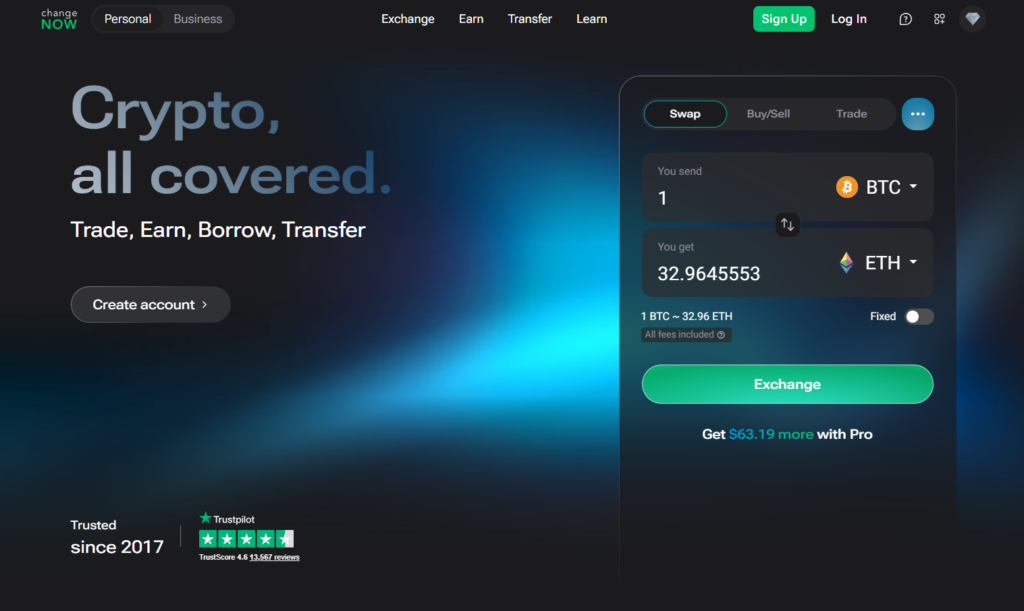 ChangeNOW homepage, July 2026 – Fixed-rate and float-rate swap options confirmed.
 The fixed-rate option typically carries a higher implied fee because the service is bearing rate risk during the settlement window.
Best for: Users who need rate certainty for a swap and prefer fixed-rate execution over best-effort routing.
10. StealthEX
StealthEX claims the largest token breadth of any swap aggregator on this list – over 1,400 supported tokens as of mid-2026. It operates as a non-custodial service, meaning it does not hold user funds during the swap; it routes through third-party exchanges and liquidity providers.
The non-custodial claim is technically accurate but partially misleading. StealthEX does not hold funds, but it does control routing – and it routes through counterparties it selects, with fees embedded in the spread. Users have no visibility into which liquidity providers are used for any given swap.
StealthEX publishes its supported token list and fee structure in FAQ format.
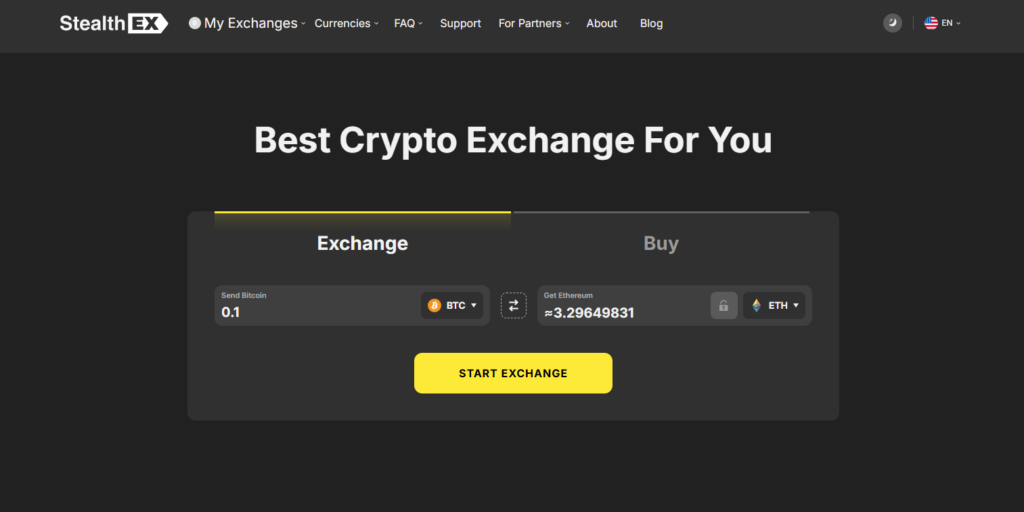 StealthEX homepage, July 2026 – Token breadth and non-custodial swap interface confirmed.
 The FAQ acknowledges that partner exchanges may apply additional processing fees that are reflected in the quoted rate.
Best for: Users who need access to obscure or newly listed tokens that are not available on the larger DEX aggregators.
The FixedFloat exploit: what centralized swap aggregators hide
FixedFloat, a no-KYC centralized swap aggregator similar in model to SimpleSwap and ChangeNOW, lost approximately $26 million in March 2024. Attackers drained the service’s hot wallet. The exact mechanism – whether address poisoning, compromised key management, or an insider – was never definitively established in public disclosures.
FixedFloat’s response followed the standard centralized exchange playbook: a brief suspension, a public statement attributing the breach to “serious vulnerabilities,” and a reopening without detailed post-mortem. No on-chain forensic reconstruction was published.
The incident is documented in The Biggest Crypto Hacks of 2026 as part of the broader pattern of centralized swap aggregator security failures. The structural risk is that services operating without user accounts and without regulatory KYC requirements also tend to operate with less public accountability for security incidents. When a user loses funds in an exploit, there is no account to file a claim against, no regulator to escalate to, and no legal relationship that establishes what the service owed the user.
The FixedFloat case did not stop SimpleSwap, ChangeNOW, or StealthEX from growing. But it is the clearest available case study of what no-KYC swap aggregator failure looks like in practice.
What aggregator dominance means for traders in 2026
The DEX aggregator market has consolidated around a specific architectural argument: intent-based routing, where users sign an intent and specialists compete to fill it, protects users better than direct on-chain routing. 1inch Fusion+, Uniswap X, and CoW Protocol’s solver model all represent variations of this argument.
The counterargument is that intent-based routing replaces on-chain MEV extraction with off-chain counterparty concentration. The resolver or solver that fills your trade has information advantages over you – they know your size, your deadline, and your acceptable range. Whether their competitive incentives fully neutralize that information advantage is not empirically settled.
For traders evaluating aggregators in 2026, the practical framework is:
- Ethereum-native traders who want the strongest MEV protection: CoW Protocol or 1inch Fusion+
- Multi-chain traders who need breadth: 1inch or LI.FI
- Solana traders: Jupiter, without meaningful competition
- Users who need no-KYC access: SimpleSwap or ChangeNOW, with full awareness of the regulatory grey zone and the FixedFloat precedent
- Long-tail token access: StealthEX, with awareness that fee transparency is limited
What this review verified and what it did not
ClaimStatus1inch cumulative volume exceeds $300BBased on publicly reported protocol statistics; not independently verified against on-chain dataCoW Protocol returns surplus to usersDocumented in CoW Protocol whitepaper and on-chain batch data; methodology reviewedOdos v2 outperforms 1inch on multi-hop routesBased on Odos-published benchmarking; independent third-party benchmarks not reviewedFixedFloat $26M exploit, March 2024Publicly documented; on-chain forensic attribution not independently verifiedSimpleSwap and ChangeNOW operate without KYCVerified against current service terms as of July 2026StealthEX supports 1,400+ tokensBased on StealthEX published token list; not independently countedUniswap X live on Ethereum mainnetConfirmed via Uniswap public announcement and interface verification
Frequently asked questions
What is a crypto exchange aggregator?
A crypto exchange aggregator routes your swap across multiple liquidity sources – exchanges, pools, or market makers – to find the best available price. Instead of trading directly on one exchange and accepting whatever rate it offers, an aggregator compares rates across many sources simultaneously.
Is a DEX aggregator the same as a crypto swap service?
No. A DEX aggregator (like 1inch or CoW Protocol) routes through decentralized on-chain liquidity. A centralized swap service (like SimpleSwap or ChangeNOW) routes through its own liquidity partnerships and operates more like a traditional exchange, with counterparty risk concentrated in the service operator.
Do crypto exchange aggregators charge fees?
Yes, but in different ways. DEX aggregators typically charge a small protocol fee on top of the underlying pool fees, and some embed a spread in the quoted rate. Centralized swap aggregators almost always embed their fee in the quoted rate rather than displaying it as a line item. The quoted rate should be compared against a reference price (CoinGecko or CoinMarketCap) to infer the actual fee.
What is MEV, and why does it matter for aggregators?
MEV stands for maximal extractable value – the profit that can be extracted by reordering, inserting, or censoring transactions within a block. In practice, MEV extraction often means front-running or sandwich attacks, where a bot sees your pending trade and executes trades around it to profit at your expense. Aggregators that use intent-based routing (1inch Fusion+, CoW Protocol, Uniswap X) protect against this by having specialists submit the on-chain transaction on your behalf, eliminating the window where your pending transaction is visible and exploitable.
Are no-KYC swap aggregators legal?
The legality of no-KYC swap services depends on jurisdiction and interpretation. FATF Travel Rule guidance requires many crypto service providers to collect and transmit user identification for transactions above threshold amounts. Whether centralized swap aggregators like SimpleSwap and ChangeNOW qualify as regulated entities under those rules varies by jurisdiction. As of July 2026, this remains an unresolved regulatory question in most markets.
Which crypto exchange aggregator has the best price?
Price quality depends on the trade. For Ethereum-based swaps, CoW Protocol and 1inch Fusion+ consistently test well for MEV protection and execution quality. For multi-hop routes, Odos v2’s benchmarks show competitive results. For Solana, Jupiter has no meaningful competition. For tokens not available on DEX aggregators, centralized swap services offer broader access at the cost of less fee transparency.
What happened to FixedFloat?
FixedFloat, a no-KYC centralized swap aggregator, lost approximately $26 million in a hot wallet exploit in March 2024. The attacker identity and exact method were never publicly confirmed. FixedFloat resumed operations after the exploit without publishing a detailed post-mortem. The incident illustrates the accountability gap in no-KYC, no-account swap services when security failures occur.
Who controls crypto exchange aggregator routing in 2026?
The open question that this market has not answered is whether the intent-based routing model – where resolvers and solvers compete to fill user orders – genuinely distributes routing power or merely replaces on-chain MEV extraction with off-chain resolver concentration. If resolver networks consolidate around a small number of professional market makers, the aggregator layer could become a new form of order flow capture rather than a protective layer for users. Regulators have not yet engaged with this specific question.
The article The Top Crypto Exchange Aggregators in 2026 first featured on theccpress.com.