TLDR The Trade Desk stock fell 19.64% after hours following weaker Q2 financial results. Quarterly revenue rose only 3% as earnings and operating margins declined sharply. Adjusted EBITDA dro
TLDR
- The Trade Desk stock fell 19.64% after hours following weaker Q2 financial results.
- Quarterly revenue rose only 3% as earnings and operating margins declined sharply.
- Adjusted EBITDA dropped to $241 million while overall profitability weakened.
- Third-quarter guidance pointed to continued pressure on growth and profit margins.
- Strong customer retention and major partnerships failed to ease market concerns.
The Trade Desk (TTD) stock sank after weak growth and a softer third-quarter outlook hit confidence. Shares closed 6.80% lower at $17.67, then fell another 19.64% after hours to $14.20. The drop reflected slower growth, weaker earnings, and near-term execution concerns.
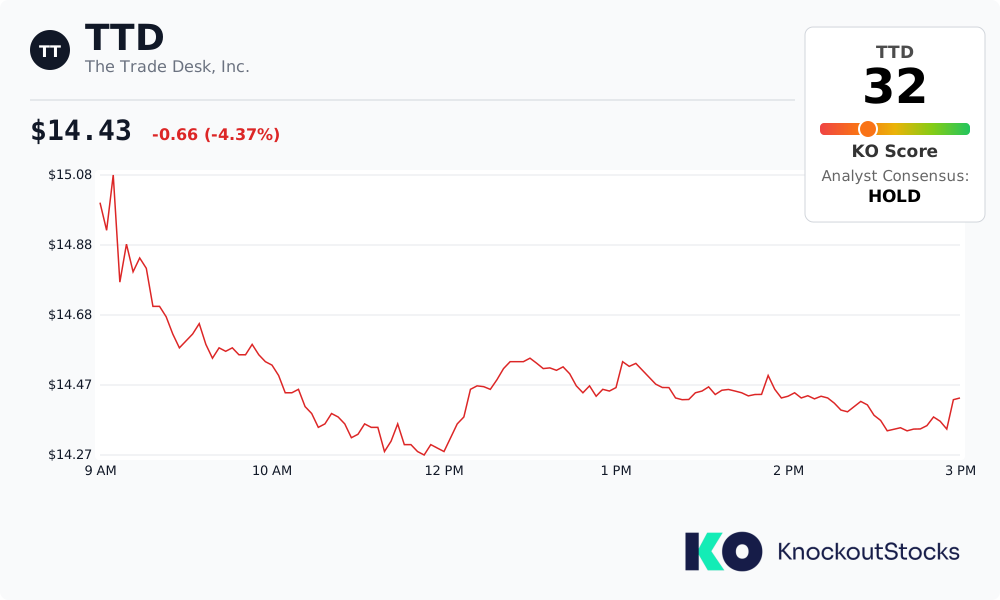
The Trade Desk, Inc., TTD
The Trade Desk Q2 Revenue Growth Slows
The Trade Desk reported second-quarter revenue of $715 million, up 3% from $694 million last year. That pace slowed sharply from 19% growth during the same quarter of 2025. Six-month revenue rose 7% to $1.40 billion, compared with 22% growth one year earlier.
Net income fell to $64 million from $90 million, while the net income margin dropped to 9%. GAAP diluted earnings reached $0.14 per share, down from $0.18 a year earlier. Meanwhile, six-month net income declined to $104 million from $141 million.
Adjusted EBITDA decreased to $241 million from $271 million, while the margin narrowed to 34%. Non-GAAP net income fell to $158 million, compared with $203 million one year earlier. Non-GAAP diluted earnings also dropped to $0.34 from $0.41 per share.
Weak Guidance Deepens TTD Stock Selloff
The company expects third-quarter revenue of at least $650 million and adjusted EBITDA near $160 million. That forecast signaled continued pressure after weaker growth and lower profitability. It also suggested limited operating leverage while costs remain elevated.
The company withheld GAAP net income guidance because several future charges remain difficult to estimate. Stock-based compensation could change significantly because share-price movements directly affect the expense. Therefore, reported earnings could vary more widely than the adjusted outlook.
The Trade Desk spent about $78 million on share repurchases during the second quarter. It retained $269 million under its authorized buyback program at June’s end. However, the repurchases provided little support as weak results drove the after-hours plunge.
Partnerships Support The Trade Desk’s Expansion
Customer retention stayed above 95%, continuing a record lasting over ten years. The company also expanded partnerships with Dentsu, Databricks, Adobe, Booking.com, Marriott, Uber, and United Airlines. These agreements support data use, measurement, and advertising across the open internet.
Netflix joined the company’s inventory marketplace and widened access to its premium streaming advertising environment. Samsung Ads also opened home-screen inventory to programmatic platforms, including The Trade Desk. Both additions strengthened the company’s connected television offering during the quarter.
The Trade Desk operates a major advertising platform across global digital media markets. However, slower growth now tests its ability to turn partnerships and platform upgrades into stronger revenue. Management has changed several senior roles while focusing on execution, product improvements, and commercial discipline.
The post The Trade Desk (TTD) Stock: Plunges 19% After Weak Q2 Results appeared first on Blockonomi.
