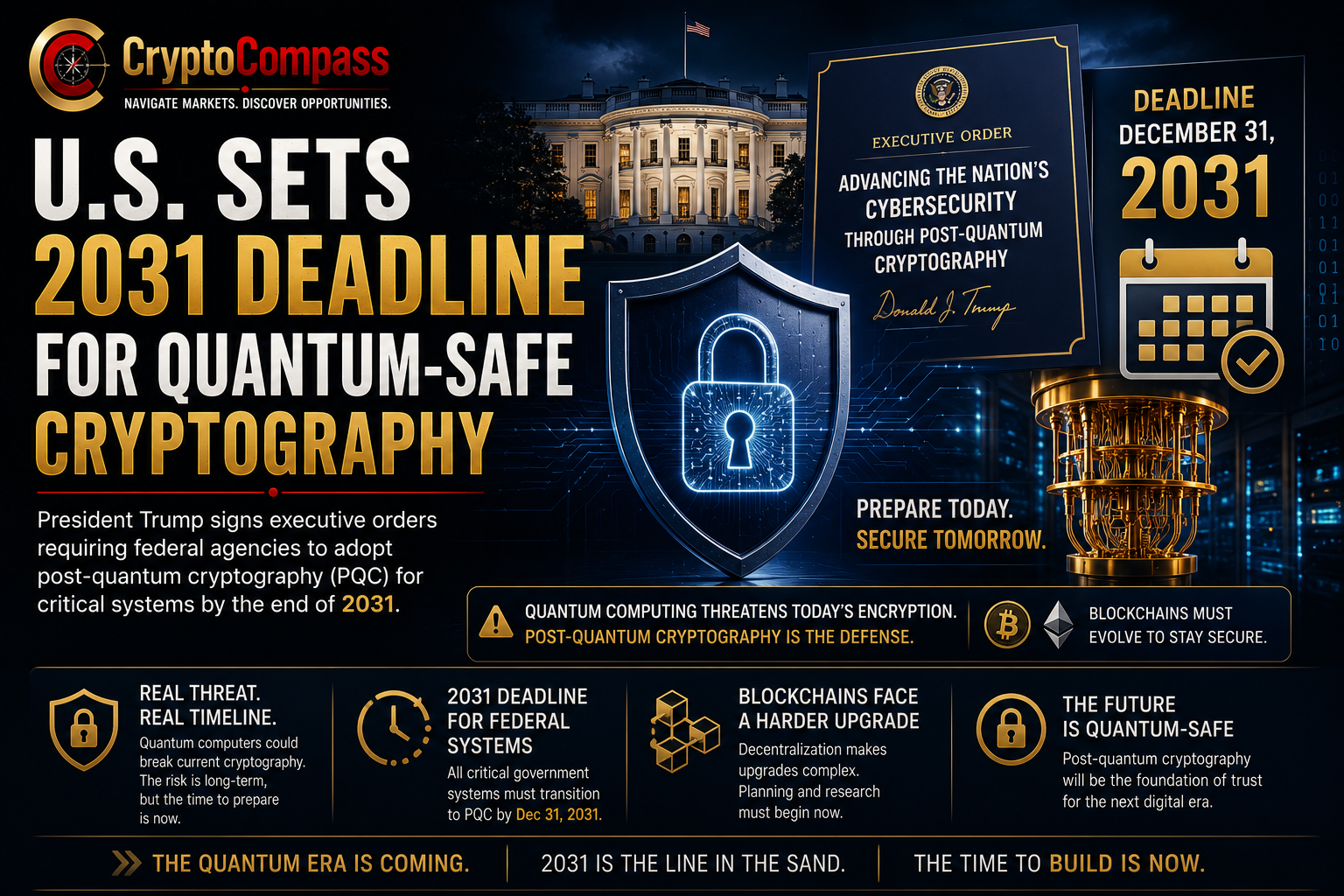
The Trump administration has ordered federal agencies to begin transitioning critical systems to post-quantum cryptography by the end of 2031. While the move is aimed at protecting government infrastructure, it sends a broader message to the technology industry: the quantum threa
For years, quantum computing has existed in an uncomfortable category.
Too important to ignore.
Too distant to prioritize.
Most discussions about quantum computers sounded like science fiction.
Powerful machines capable of solving mathematical problems beyond the reach of today's computers.
A future technology.
A future problem.
The U.S. government no longer appears willing to treat it that way.
President Donald Trump has signed executive orders directing federal agencies to migrate critical systems toward post-quantum cryptography (PQC) before the end of 2031.
The message is clear.
The world's largest government believes the quantum threat is significant enough to justify action today.
And if governments are preparing now, blockchain networks may need to do the same.
Why Quantum Computing Matters
Modern digital security relies on a simple assumption.
Certain mathematical problems are extremely difficult to solve.
Public-key cryptography depends on that assumption.
So do banking systems.
Government networks.
Military communications.
Internet infrastructure.
And most blockchain networks.
Bitcoin, Ethereum, and countless other digital assets ultimately rely on cryptographic systems that were designed for a world without practical quantum computers.
The concern is that sufficiently advanced quantum machines could eventually break some of these assumptions.
Not tomorrow.
Perhaps not even this decade.
But eventually.
And security systems cannot wait until the threat arrives.
They must prepare beforehand.
The Threat Is Not Just Future Theft
One of the most misunderstood aspects of quantum risk is timing.
Many assume organizations can simply upgrade their systems once quantum computers become powerful enough.
Unfortunately, it may not be that simple.
Security researchers have long warned about a strategy known as:
"Harvest Now, Decrypt Later."
Attackers can collect encrypted data today and store it for years.
Once quantum computers become capable enough, that data could potentially be decrypted retroactively.
Information considered secure today may not remain secure forever.
That reality is one reason governments are accelerating preparations long before practical quantum computers arrive.
Why Blockchain Faces A Unique Challenge
Traditional institutions can upgrade centralized systems.
Blockchains cannot.
Or at least not easily.
Bitcoin cannot simply issue a software update and force every participant to comply overnight.
Ethereum cannot instantly replace cryptographic standards across thousands of applications.
Public blockchain networks must coordinate upgrades across miners, validators, developers, exchanges, wallets, and users.
The larger the network becomes, the harder that process gets.
Ironically, decentralization creates resilience.
But it can also slow adaptation.
Bitcoin's Quantum Question
For Bitcoin, the challenge is particularly sensitive.
Many wallet addresses eventually reveal public keys when funds are spent.
Under certain future scenarios, sufficiently advanced quantum computers could theoretically derive private keys from exposed public keys.
Researchers continue debating the timeline.
Some argue the threat remains decades away.
Others believe preparations should begin much sooner.
What remains undisputed is that Bitcoin will eventually need a post-quantum migration strategy if quantum computing continues advancing.
The question is not whether.
It is when.
Ethereum And The Broader Ecosystem
Ethereum faces similar concerns.
But it may also possess advantages.
The network has demonstrated a greater willingness to evolve through protocol upgrades.
Account abstraction, smart contract flexibility, and active developer communities may provide more pathways toward future cryptographic transitions.
Still, the scale of the challenge remains enormous.
Every wallet.
Every smart contract.
Every DeFi protocol.
Every Layer 2 network.
Every bridge.
Every application.
All depend on cryptographic assumptions that could eventually require revision.
The Government Signal Matters
The significance of the White House directive extends beyond cybersecurity.
Governments rarely mobilize resources around threats they consider irrelevant.
By establishing a 2031 migration target, Washington is effectively acknowledging that post-quantum readiness is now a strategic priority.
That creates pressure across the technology sector.
Banks will prepare.
Cloud providers will prepare.
Defense contractors will prepare.
Critical infrastructure operators will prepare.
Blockchain networks are unlikely to remain outside that conversation.
A New Technology Race
For years, blockchain developers competed on speed.
Scalability.
User experience.
Transaction costs.
The next decade may introduce a new competitive category.
Quantum readiness.
Networks that successfully transition toward post-quantum security could gain a significant advantage in trust, institutional adoption, and long-term resilience.
Those that delay may eventually face difficult and disruptive migrations.
CryptoCompass View
The most important takeaway from the Trump administration's directive is not that quantum computers are about to break Bitcoin.
They are not.
The more important takeaway is that governments have started planning as if the threat is real.
That changes the conversation.
For years, post-quantum cryptography was a research topic.
Today, it is becoming public policy.
Tomorrow, it may become a requirement.
The blockchain industry was built on cryptography.
Its future may depend on how successfully it evolves that cryptography for the quantum age.
The countdown to 2031 is not just a deadline for government agencies.
It may become one of the most important timelines in the history of digital assets.
—
By Suttermill
CryptoCompass Editorial Desk