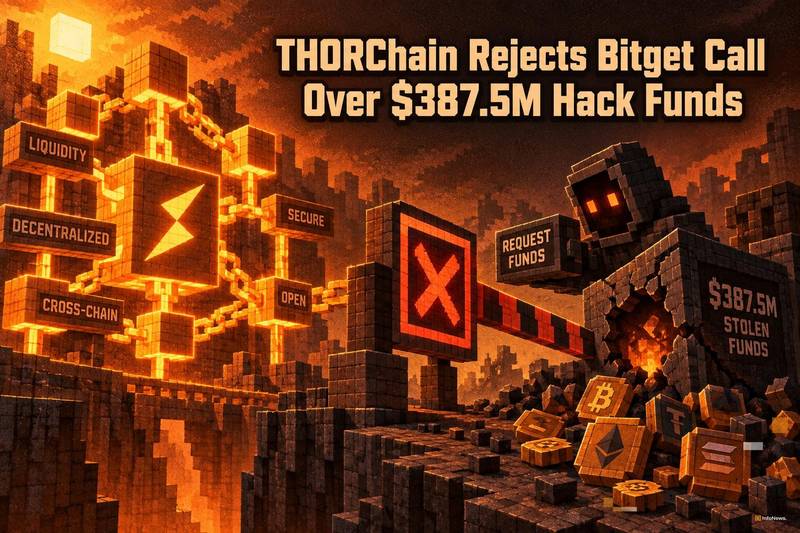
THORChain has declined a request from crypto exchange Bitget to freeze funds reportedly linked to a $387.5 million hack, drawing attention to the recurring tension between decentralized proto
THORChain has declined a request from crypto exchange Bitget to freeze funds reportedly linked to a $387.5 million hack, drawing attention to the recurring tension between decentralized protocol design and coordinated incident response in digital asset markets.
THORChain Rejects Bitget's Request to Block Funds
Bitget called on THORChain, the decentralized cross-chain liquidity protocol, to block funds the exchange identified as linked to the hack. THORChain declined. The dispute reflects a fault line that surfaces repeatedly in crypto security: centralized exchanges seeking intervention from permissionless infrastructure that, by design, does not discriminate between transactions. For related coverage, see Bitcoin Spot ETFs Draw $2.39B in Weekly Net Inflows.
THORChain allows users to swap native assets across blockchains without wrapped tokens or custodians. Its architecture makes unilateral fund freezing structurally at odds with the protocol's core properties. A prior network incident that led to an emergency measure is documented in coverage of THORChain's emergency chain halt following an earlier exploit, illustrating how the protocol has previously responded to security stress. For related coverage, see SEC Crypto Task Force: Much of Agenda Fits Existing Authority.
Whether THORChain declined through a formal on-chain governance vote or through its node operator set has not been confirmed by independently verifiable sources at time of publication.
What the $387.5 Million Hack Link Means
The funds at issue are described as linked to a hack totaling $387.5 million. That figure represents the stated scale of the incident; the research available does not confirm the exploited protocol's identity, the hack's date, or the precise on-chain path the funds followed into THORChain. The movement of those funds toward Bitcoin via THORChain has been separately reported.
Careful attribution is warranted: describing the funds as "linked" to the hack reflects the framing of the original allegation, not a confirmed forensic finding. On-chain attribution in cross-chain environments requires specific transaction hashes traced through a block explorer; that verification has not been independently completed here. Separately, Bitget disclosed that the underlying vulnerability was remediated and BTC withdrawals resumed following the incident.
For Bitcoin's network, large-scale hacks routed through cross-chain protocols frequently terminate in BTC, either through THORChain's native BTC swap pools or over-the-counter channels, placing Bitcoin's transparent UTXO ledger at the end of an otherwise opaque cross-chain trail.
What to Know
- THORChain rejected Bitget's call to block funds the exchange identified as linked to the hack, consistent with the protocol's permissionless, non-custodial architecture.
- The funds are linked in reporting to a $387.5 million hack; the specific origin chain, exploited protocol, and transaction path remain unconfirmed in independently verifiable on-chain sources at time of publication.
Disclaimer: This article is for informational purposes only and does not constitute financial or investment advice. Cryptocurrency and digital asset markets carry significant risk. Always do your own research before making decisions.
Bitcoininfonews first published the article titled THORChain Rejects Bitget Call Over $387.5M Hack Funds.