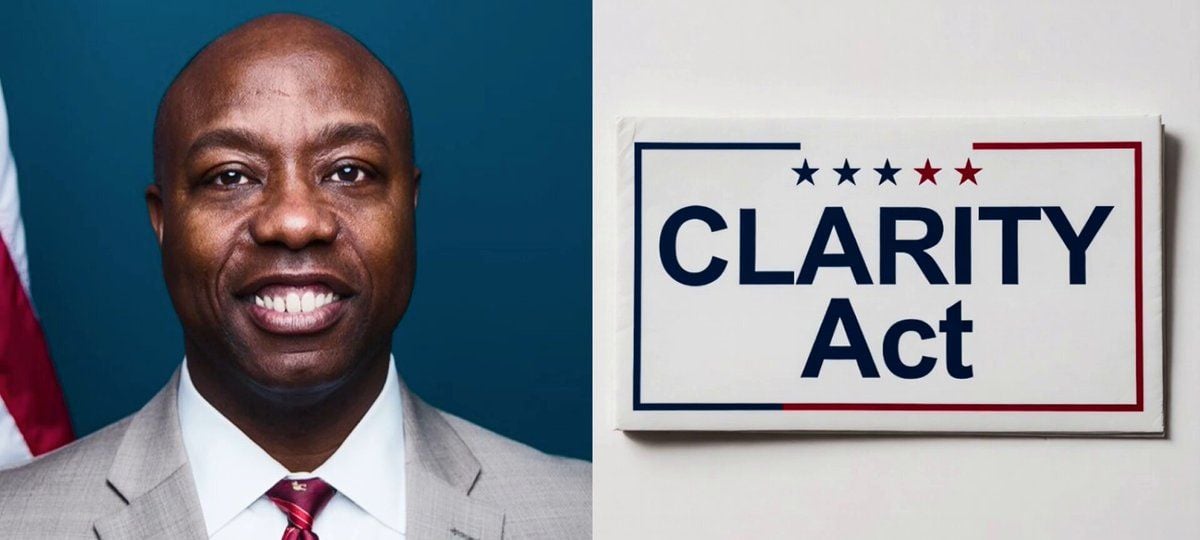
Senator Tim Scott (R-S.C.), chairman of the Senate Banking Committee, is pushing hard for the Digital Asset Market Clarity Act, arguing the United States must act now to protect consumers and
Senator Tim Scott (R-S.C.), chairman of the Senate Banking Committee, is pushing hard for the Digital Asset Market Clarity Act, arguing the United States must act now to protect consumers and remain competitive in the fast-moving digital asset space.
"We can either lead the next era of innovation or be left watching it happen elsewhere," Scott said. He added that blockchains and digital assets are here to stay, framing the legislation as a necessity rather than an option.
What the CLARITY Act Does
The CLARITY Act, short for the Digital Asset Market Clarity Act of 2025, is Washington's most serious attempt yet to answer the long-standing question of who actually regulates crypto.The bill draws a hard line between SEC and CFTC authority over digital assets, with digital commodities falling under CFTC jurisdiction.Stablecoins receive a separate third category with joint SEC and CFTC oversight.
The bill also provides regulatory clarity for spot trading, custody operations, DeFi protocols, and developers who do not hold customer assets. For Scott, that clarity serves a dual purpose. "This bill reflects serious, good-faith work across the committee and delivers the certainty, safeguards, and accountability Americans deserve," he said in a statement. "It puts consumers first, combats illicit finance, cracks down on criminals and foreign adversaries and keeps the future of finance here in the United States."
Where the Bill Stands
The Digital Asset Market Clarity Act cleared the House in July 2025 with a 294-134 bipartisan vote, but Senate delays over stablecoin regulation, DeFi provisions, and ethics language burned nearly a year of momentum.After a couple of hours of partisan debate, the Senate Banking Committee secured a 15-9 bipartisan approval, advancing the bill to its next steps.
The bill has been championed by numerous crypto companies, including Coinbase, Circle and Ripple, which want to see a degree of regulation and oversight of their industry to help encourage investors.The White House has also pushed for the bill, at times becoming active in negotiations between banks and crypto groups.
Opposition remains, however. Law enforcement groups say the legislation does not do enough to prevent illicit financial transactions through digital assets, while major labor groups, including the AFL-CIO, have warned that efforts to legitimize crypto could jeopardize financial stability and, in turn, retirement and pension accounts.The two Democrats who voted for the bill in committee indicated their votes did not guarantee support on the Senate floor without further progress on outstanding issues, particularly an ethics provision addressing government officials' ties to the crypto industry.
Any Senate floor vote needs to happen before August 2026, when campaigning begins in earnest and the Senate's calendar effectively closes for controversial votes.
Sources:CNBC: Crypto industry scores win as Clarity Act clears Senate hurdleCoinDesk: Clarity Act clears U.S. Senate committeeFortune: The crypto industry's Clarity Act hits a critical juncture