Why Do Crypto Prices Fall Before Token Unlocks? Prices often slide before token unlocks because traders expect new supply and sell or hedge early. How far they fall depends on unlock size, li
Why Do Crypto Prices Fall Before Token Unlocks?
Prices often slide before token unlocks because traders expect new supply and sell or hedge early. How far they fall depends on unlock size, liquidity, and who receives the tokens.
Token unlock news moves traders long before any coin actually changes hands. A token unlock is the date when restricted coins become transferable, and each one adds to the circulating supply.
This guide explains how unlocks work, what research says about the price effect, and where the evidence is mixed. Information here was checked on November 16, 2026.
What Are Token Unlocks in Crypto?
Projects lock part of their supply at launch, so founders, investors, and the team can’t sell right away. The vesting schedule sets when each group’s tokens become transferable.
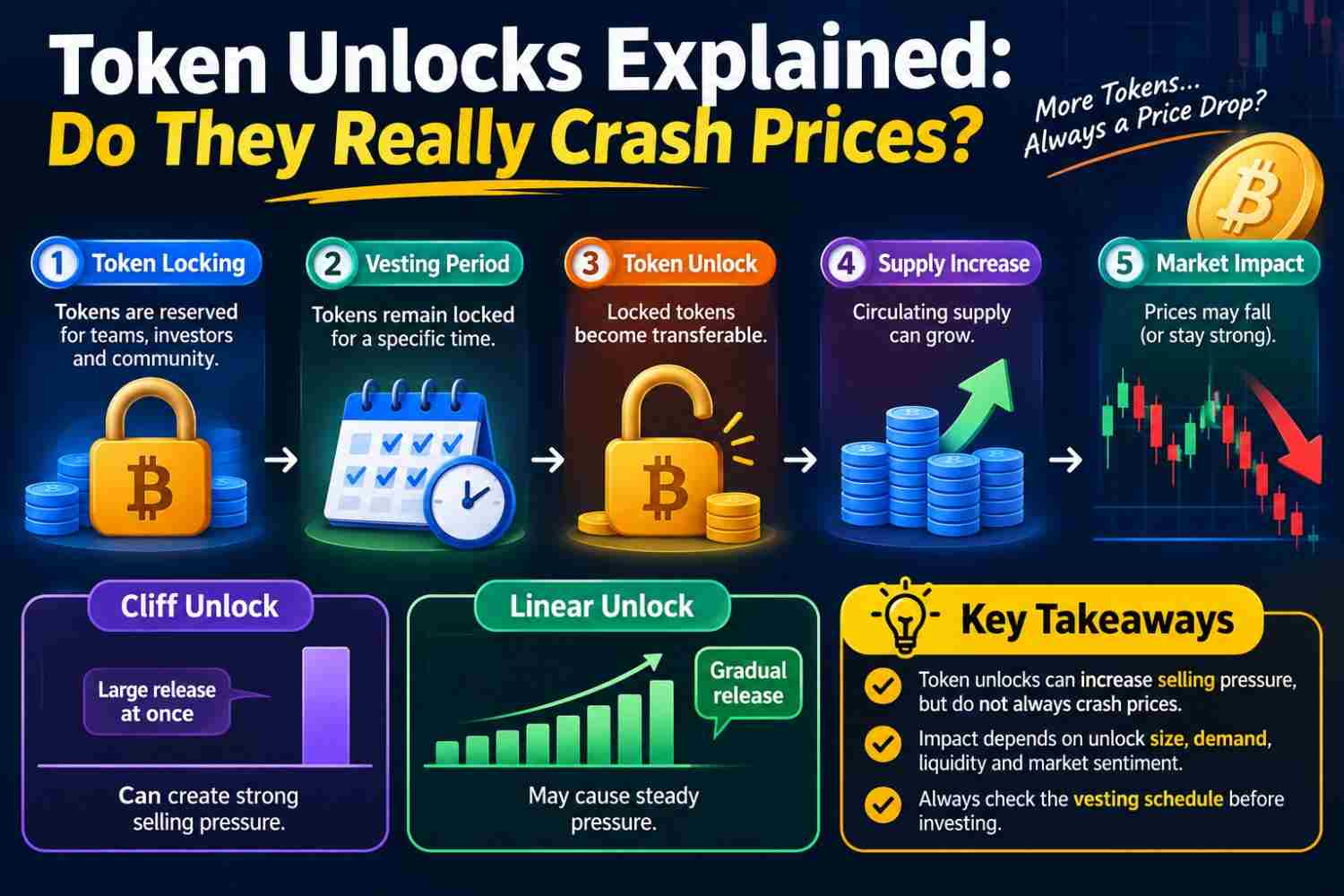
Locked coins stay outside the circulating supply until their date arrives. Fully diluted valuation, or FDV, counts every coin including locked ones, while market cap counts only circulating coins, so an unlock moves the supply that market cap sees.
Token emissions, such as staking rewards, are different because they release coins continuously instead of on set dates.
How Does a Crypto Token Unlock Work Step by Step?
Most vesting schedules follow similar steps, though terms differ from project to project.
Allocation: the project divides tokens among founders, investors, the team, the community, and a treasury.
Vesting period: each group’s tokens stay locked for a fixed time.
Cliff: A waiting stretch passes before the first release.
Linear vesting: equal portions come out each day, week, or month.
Release: unlocked coins turn transferable and can reach exchanges.
A token vesting schedule calculator or a simple example shows the scale. If a token has 100 million circulating coins and a project unlocks 10 million more, supply rises to 110 million, a 10% jump.
The unlock ratio equals unlocked tokens divided by circulating supply, and the unlock-to-volume ratio divides the unlock’s value by daily trading volume. Both are screening tools, not forecasts.
Why Do Unlocks Put Pressure on Crypto Prices?
More supply needs more buyers to hold the price steady. Early investors may sit on large unrealized gains and sell, hedge, or trade over the counter, which means a big deal can happen away from public order books.
Retail traders often sell early to avoid dilution, and institutions may hedge with futures, so weakness can start before the date. Low trading volume makes large sell orders harder to absorb, and a large release into a thin order book can move the price fast. Token unlock price impact also changes by project, so identical release sizes can produce different charts.
Known supply overhang matters here. When a large unlock sits on the calendar, sellers can short or hedge weeks ahead, and buyers may wait for a lower entry, so the pressure arrives early instead of on release day.
Do Token Unlocks Really Crash Crypto Prices?
Keyrock’s study of more than 16,000 unlock events reported negative price pressure in about 90% of them, with weakness often starting around 30 days earlier. Team unlocks showed the worst drops, while ecosystem development unlocks were among the milder cases. Those are averages from one dataset, not forecasts for a single token.
Other research adds nuance.Tokenomist’s 236-event study reported a one-month pre-event median near -14.7% against Bitcoin, yet it calls its findings correlational and says drops cluster in early-stage, thin-float tokens and arrive mostly before the unlock. A market-wide move can mimic an unlock effect.
Also, unlocked doesn’t mean sold. Coins may sit in wallets, move to exchanges, or trade over the counter, so exchange inflows give a better clue than the calendar alone.
Cliff Unlocks vs. Linear Unlocks: Which Is More Risky?
Feature
Cliff Unlock
Linear Unlock
Release pattern
Large release at once
Gradual release
Supply impact
Sudden increase
Incremental increase
Market reaction
Sharp volatility possible
More spread out pressure
Risk
Sudden selling pressure
Continuous selling pressure
Cliff releases carry the sharper short-term risk, since one big batch lands on a single date. Linear schedules seem gentler, yet they can weigh on the price for months if insiders sell each release.
How to Track Token Unlock News and Dates Before Trading?
A token unlock calendar lists dates, and a token unlock dashboard adds amounts and recipients. Tokenomist covers cliff and linear schedules and showed about $560.82M in scheduled releases for the week when checked on November 16, 2026, a figure that moves with token prices and schedule updates.
CryptoRank adds a watchlist with alerts, andDefiLlama offers an unlock calendar with post-unlock price impact data. Five details matter most:
Unlock date and time
Tokens scheduled and the share of circulating supply
Allocation by group, such as team or investors
Trading volume and liquidity
Price reaction to earlier unlocks
Biggest Warning Signs Before a Token Unlock Event
Several signals around token unlocks together raise the risk. A release that equals a large share of circulating supply matters most, and the danger grows when early investors hold large unrealized gains.
Low trading volume makes large sell orders harder to absorb, and a bearish market adds fear. Releases that land close together can stack pressure, while weak demand leaves little to absorb the extra coins.
Insider token allocation also matters, since team coins showed worse drops than ecosystem grants in one large study. One flag alone rarely decides the outcome, but three or four at once deserve attention.
How Can Traders Prepare for Major Unlock Events?
Preparation starts with the vesting schedule, since dates and amounts are usually public. Comparing the release size with circulating supply and daily volume shows how big the change is. Exchange inflows can hint that holders are moving coins to sell.
Sentiment and market-wide trends deserve a check too, because an unlock rarely acts alone. Position size, stop levels, and patience matter more than reacting to token unlock news after the market has priced it in. Unlock dates are screening tools, not trading signals.
Conclusion: Do Token Unlocks Always Crash Prices?
Token unlocks can raise selling pressure, but they don’t automatically cause a crash. Research is mixed: one large dataset shows frequent weakness before unlocks, while another study finds the effect conditional and mostly visible before the unlock.
Size against liquidity, recipient type, and the wider market decide most outcomes. Checking the vesting schedule, circulating supply, and holders involved works better than reacting to any headline.
Disclaimer
This article is for informational purposes only and isn’t financial advice. Crypto is volatile and high risk, so readers should research each project and consult a licensed advisor before acting. Cited statistics come from outside studies and aren’t predictions.