Tokenization Is Quietly Becoming The Next Internet
When the internet first emerged in the early 1990s, few people believed it would eventually reshape commerce, banking, entertainment and global communication.
A
AnonymousCryptoCompass newsroom
July 10, 2026
5 min read
ANALYSIS
CryptoCompass editorial visual for markets coverage.
Tokenization Is Quietly Becoming The Next Internet
When the internet first emerged in the early 1990s, few people believed it would eventually reshape commerce, banking, entertainment and global communication.
Most dismissed it as a niche technology.
Three decades later, the internet has become the foundation of the global economy.
Today, another technological shift is following a remarkably similar path.
It is called tokenization.
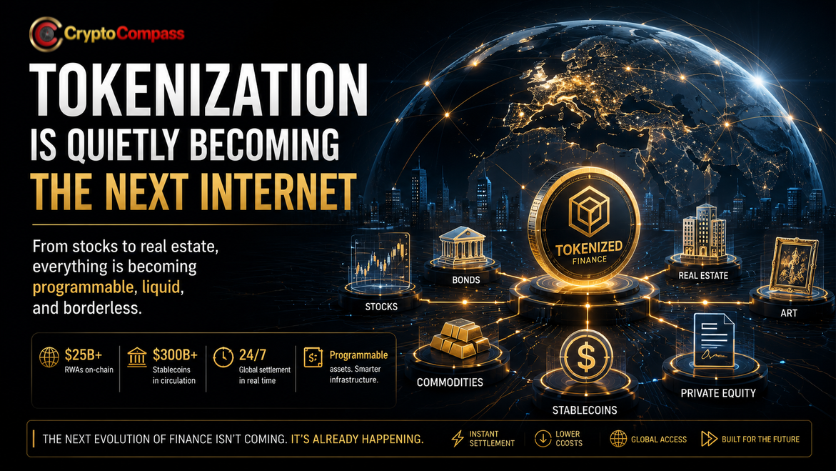
Unlike cryptocurrencies, tokenization is not primarily about creating new digital assets. It is about transforming existing financial assets into programmable digital instruments that can move instantly across blockchain networks.
Stocks.
Government bonds.
Money market funds.
Real estate.
Private equity.
Commodities.
Even bank deposits.
Everything is gradually becoming tokenizable.
The most important story in digital finance may no longer be Bitcoin.
It may be the infrastructure quietly replacing how traditional finance operates.
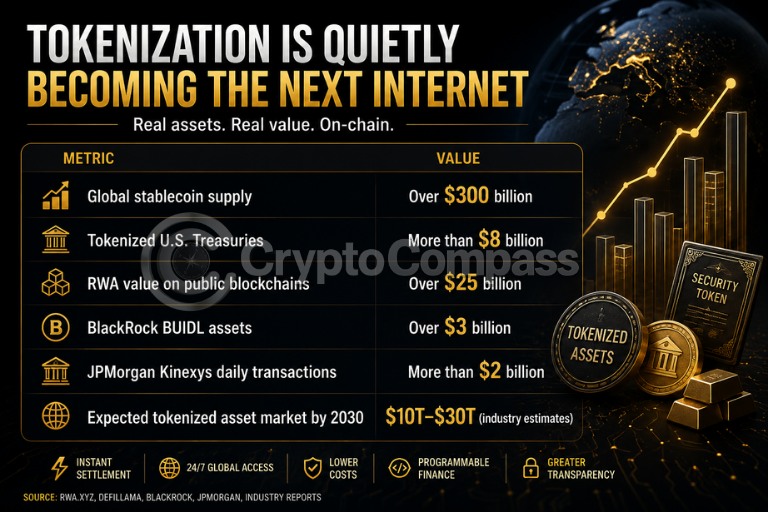
By The Numbers
The numbers remain small compared with global financial markets.
That is precisely why many analysts believe tokenization is still in its earliest stage.
Crypto Was The First Chapter. Tokenization Is The Second.
The first generation of blockchain focused on creating entirely new financial systems.
Bitcoin introduced decentralized money.
Ethereum introduced programmable smart contracts.
Thousands of cryptocurrencies followed.
The next generation is taking a different approach.
Instead of replacing traditional finance, blockchain is increasingly being used to upgrade it.
Rather than asking investors to abandon conventional assets, tokenization allows existing assets to move more efficiently.
In many ways, blockchain is becoming an invisible settlement layer.
Users may never know they are interacting with distributed ledger technology.
They will simply experience faster settlement, lower costs and continuous market access.
Why Every Major Financial Institution Is Paying Attention
Five years ago, tokenization was largely discussed within crypto circles.
Today, it has become a strategic priority across global finance.
BlackRock launched the BUIDL tokenized money market fund.
Franklin Templeton operates one of the world's first tokenized government money funds.
JPMorgan has expanded its blockchain-based payment infrastructure through Kinexys, processing billions of dollars in institutional transactions.
UBS, Citi, HSBC, Standard Chartered, BNY and DTCC are all actively exploring tokenized assets and blockchain settlement.
This is not a coincidence.
The world's largest financial institutions rarely compete over experimental technologies.
They compete over infrastructure.
Why Tokenization Matters
Traditional financial markets were designed decades before the internet.
Settlement often takes one or two business days.
Transactions involve multiple intermediaries.
Reconciliation requires separate databases maintained by different institutions.
Cross-border transfers remain expensive.
Tokenization addresses many of these inefficiencies.
A tokenized asset can be transferred almost instantly.
Ownership records update automatically.
Smart contracts automate compliance.
Settlement occurs continuously rather than within limited market hours.
Assets become programmable.
That represents a structural improvement rather than a speculative innovation.
Stablecoins Proved The Model
Stablecoins quietly solved one of finance's biggest problems.
They demonstrated that blockchain could move dollars globally within minutes.
Today, hundreds of billions of dollars circulate through stablecoins every month.
Businesses increasingly use them for treasury management.
Trading firms rely on them for liquidity.
Payment providers are integrating them into cross-border settlement.
Governments that once viewed stablecoins with skepticism are now building regulatory frameworks around them.
Stablecoins became the first successful tokenized financial product.
Tokenized securities may become the second.
Europe Wants To Build The Rules
The European Union has already introduced MiCA, the world's first comprehensive crypto regulatory framework.
Now regulators are reviewing how existing rules should evolve as tokenization expands across financial markets.
The discussion is no longer limited to cryptocurrencies.
It increasingly includes tokenized deposits, digital securities, real-world assets and institutional settlement systems.
Rather than asking whether tokenization will happen, policymakers are beginning to ask how it should be regulated.
That shift is significant.
History suggests markets mature only after legal infrastructure develops alongside technological innovation.
The United States Is Moving Too
Europe is not alone.
In the United States, lawmakers continue working toward clearer legislation for digital assets while regulators increasingly distinguish between speculative cryptocurrencies and blockchain-based financial infrastructure.
Major asset managers have embraced tokenized money market funds.
Banks are experimenting with tokenized deposits.
Exchanges are exploring tokenized securities.
The competition is no longer about which country supports crypto.
It is about which jurisdiction becomes the preferred home for tokenized capital markets.
Why Wall Street Sees A Multi-Trillion-Dollar Opportunity
The global financial system is enormous.
Global bond markets exceed $140 trillion.
Global equity markets are worth well over $120 trillion.
Real estate exceeds $350 trillion.
Private markets continue expanding rapidly.
Tokenization does not need to replace these markets.
Capturing even a small percentage would create one of the largest digital asset ecosystems ever built.
Industry forecasts estimating $10 trillion to $30 trillion in tokenized assets by 2030 may sound ambitious.
Yet they represent only a fraction of existing financial assets worldwide.
The Internet Comparison
The internet transformed how information moves.
Tokenization could transform how value moves.
Email replaced letters.
Streaming replaced DVDs.
Cloud computing replaced physical servers.
Tokenization may replace paper-based ownership records and fragmented settlement systems.
Just as internet users rarely think about TCP/IP today, future investors may never think about blockchain.
They will simply own digital assets that settle instantly.
Infrastructure often becomes most valuable when it becomes invisible.
The Risks Remain
Tokenization is not guaranteed to succeed.
Several challenges remain unresolved.
Regulatory fragmentation continues across jurisdictions.
Interoperability between blockchain networks remains limited.
Cybersecurity standards must improve.
Institutions still require scalable custody solutions.
Legal recognition of digital ownership varies globally.
Technology alone cannot solve these issues.
Policy, regulation and industry standards will determine how quickly tokenization expands.
Why Crypto Investors Should Care
For years, crypto investors focused primarily on tokens.
The next decade may reward those who understand infrastructure.
The companies building custody, settlement, compliance, identity and tokenization platforms could become as important as the assets themselves.
Blockchain may gradually shift from being an investment theme to becoming financial plumbing.
When infrastructure succeeds, it often attracts less attention.
But it creates far greater long-term value.
CryptoCompass View
Bitcoin introduced the idea that money could exist natively on the internet.
Ethereum proved that financial agreements could become programmable.
Tokenization is attempting something even larger.
It seeks to digitize the ownership of nearly every financial asset in existence.
The internet transformed communication by making information borderless.
Tokenization aims to do the same for capital.
If that vision succeeds, future generations may view today's financial infrastructure the same way we now view fax machines and paper stock certificates.
The biggest transformation in finance may not come from creating new assets.
It may come from rebuilding the systems that move existing ones.
BitcoinWorld Mexican Peso: Gains Against US Dollar Seen Limited, Commerzbank Warns Analysts at Commerzbank have issued a cautious outlook for the Mexican Peso, suggesting that recent gains ag
BitcoinWorld Robinhood Chain DEX Daily Volume Surges Past Hyperliquid in DeFi Milestone In a notable development within the decentralized finance (DeFi) sector, the 24-hour trading volume on
BitcoinWorld Gold Prices Stall as Geopolitical Risks and Hawkish Fed Signals Collide Gold prices are struggling to find a clear direction this week, caught between rising geopolitical tension