Tokenized gold has seen a surge in trading this year as physical bullion reached record levels, but most of the “on-chain” gold supply still isn’t being actively used inside DeFi. A new repor
Tokenized gold has seen a surge in trading this year as physical bullion reached record levels, but most of the “on-chain” gold supply still isn’t being actively used inside DeFi. A new report by RedStone points to a clear bottleneck: only a small portion of tokenized gold is showing up as collateral in major lending protocols such as Aave v3 and Morpho.
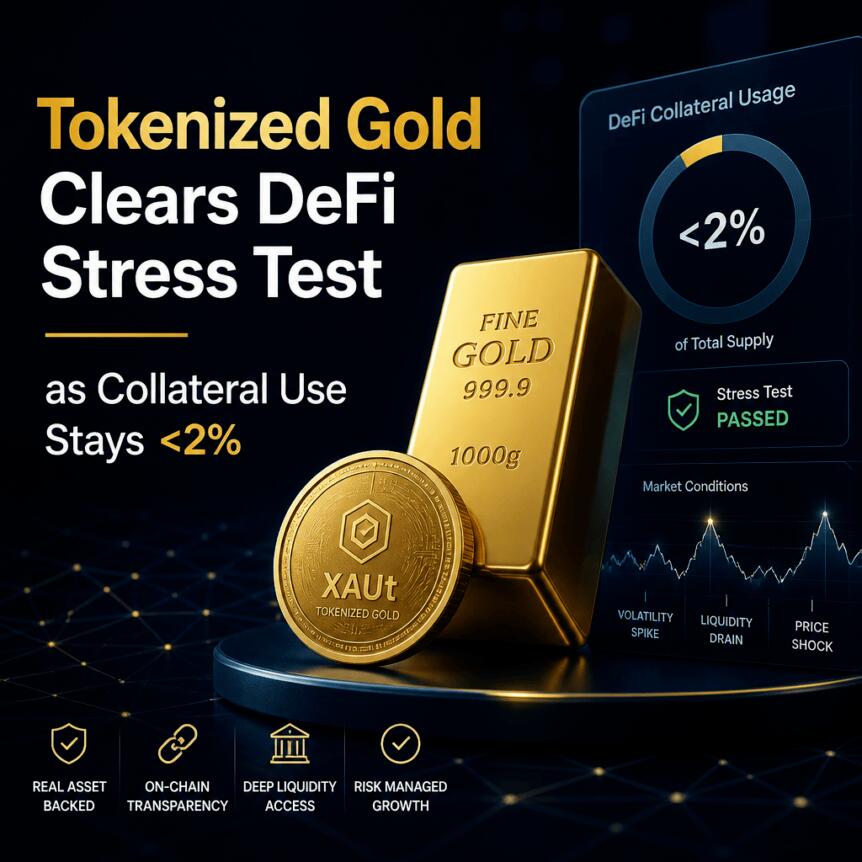
RedStone reports that tokenized gold spot trading volume hit $90.7 billion in the first quarter, during a period when gold futures rallied to above $5,600 per troy ounce. Yet only about $63 million worth of Tether Gold (XAUT) and PAX Gold (PAXG) is currently posted as collateral on Aave v3 and Morpho—roughly 1.5% of the combined $4.2 billion market capitalization of those tokens.
Key takeaways
- Tokenized gold trading is already large, with $90.7 billion in spot volume in Q1, but on-chain DeFi usage remains limited.
- Only about $63 million of XAUT and PAXG is deployed as collateral on Aave v3 and Morpho—around 1.5% of the tokens’ combined value.
- RedStone highlights resilience under stress: Aave processed its largest cluster of XAUT liquidations without disruption on March 23.
- Gold’s drawdown—futures down more than 26% since January—has reduced demand for non-yielding assets, even as tokenized gold remains actively traded.
- The main remaining challenge for tokenized gold is not performance in DeFi, but scaling collateral adoption across protocols.
Trading is surging, but DeFi collateral is lagging
The contrast between trading activity and collateral deployment is at the center of RedStone’s assessment. Despite strong market interest in tokenized bullion, the share actually put to work in lending markets is small.
According to the report, $63 million of XAUT and PAXG combined is being used as collateral on Aave v3 and Morpho, while the tokens collectively represent $4.2 billion in market capitalization. That means a large majority of tokenized gold is moving in spot markets without translating into deeper composability—at least within the two lending venues RedStone analyzed.
RedStone frames this as an adoption gap rather than a liquidity or reliability issue. In other words, the question is less “can tokenized gold operate in DeFi?” and more “why isn’t more of it being used as DeFi collateral?”
March’s liquidation test showed it can hold up
One reason tokenized gold continues to attract attention is that it has already faced a real stress scenario in DeFi. RedStone notes that on March 23, Aave handled its largest cluster of XAUT liquidations without disruption during a sharp downturn in gold.
The liquidation wave followed a painful move in the underlying commodity. RedStone ties the event to a period where gold fell 10% over the previous week—described by JPMorgan precious metals strategist Greg Shearer as an “extremely brutal flush.”
Earlier that week, gold’s broader sell-off reflected macro pressure: expectations for higher US interest rates reduced the appeal of non-yielding assets like precious metals. Cointelegraph previously reported that gold’s digital rally mirrored rising stress around the US dollar and interest-rate expectations, underscoring how quickly the commodity complex can shift.
From an investor or DeFi participant’s perspective, this matters because collateral reliability is foundational. If tokenized bullion fails to function during volatility, protocols would face operational risk and potentially forced deleveraging. RedStone’s takeaway is that, at least in that test, the system held.
Gold’s macro headwinds haven’t vanished
Even with a strong start to the year, gold has continued to face rate-driven headwinds. RedStone notes that gold futures have declined by more than 26% since peaking in January.
The decline aligns with the broader logic that higher expected US rates can make it harder for non-yielding assets to compete. That dynamic helps explain why the commodity market can generate both volatility and skepticism—even as tokenized versions of the asset continue to draw trading interest.
For tokenized gold, the implication is straightforward: DeFi collateral won’t exist in a vacuum. When gold moves aggressively, the tokenized form must be liquid enough and operationally stable. RedStone’s March example is a reminder that performance during stress may be improving, but it doesn’t guarantee automatic growth in collateral usage.
Why collateral adoption remains the bottleneck
RedStone’s report emphasizes that tokenized gold’s next hurdle is broader DeFi adoption. Proven resilience helps, but scaling requires more than technical compatibility. It also depends on incentives, protocol support, and user demand for borrowing and leverage against tokenized RWA collateral.
The tokenized real-world assets (RWA) market has been expanding beyond gold. RedStone points to a growing ecosystem that includes areas such as private credit and tokenized US Treasurys paired with equities. Token Terminal previously reported that the sector topped $43 billion in value.
At the same time, centralized crypto exchanges are rapidly building on-ramps for tokenized assets as they attempt to bridge traditional finance and digital markets. CoinGecko data (as reported by Cointelegraph) described an emerging “crypto TradFi” market reaching $6.6 billion as of June, suggesting that distribution and access for tokenized products are improving.
That backdrop raises a key question that investors may want to track: if tokenized assets are easier to access through centralized channels, why hasn’t that translated into proportionally higher DeFi collateral usage—at least in the specific tokens and protocols RedStone cited? The report doesn’t offer a single cause, but the data clearly shows the gap.
Going forward, the most important thing for readers to watch is whether tokenized gold’s demonstrated ability to function under volatility leads to meaningful increases in collateral deployment across DeFi lending platforms—especially as the sector continues to grow and as commodity-driven volatility returns.
This article was originally published as Tokenized Gold Clears DeFi Stress Test as Collateral Use Stays <2% on Crypto Breaking News – your trusted source for crypto news, Bitcoin news, and blockchain updates.