By Sergei Goriachev, Co-Founder & COO of PIPO.VC Intro The on-chain equities market crossed a milestone in H1 2026: roughly $1.4 billion in distributed value across ~2,246 tokenized assets, $
By Sergei Goriachev, Co-Founder & COO of PIPO.VC
Intro
- The on-chain equities market crossed a milestone in H1 2026: roughly $1.4 billion in distributed value across ~2,246 tokenized assets, $2.87 billion in monthly transfer volume in March, and a holder base above 200,000, but the real story is the emergence of tokenized pre-IPO equity as a distinct, faster-growing niche that PIPO is built to lead.
- The pre-IPO segment fragmented into three incompatible models in H1 2026: SPV-backed spot tokens (PIPO, PreStocks, Jarsy), synthetic perpetual futures (Ventuals, Trade.xyz), and what I believe is the only structurally sound approach: regulated, Regulation S warrants with a direct exercise pathway into Nasdaq-listed shares (PIPO’s PSW).
- The June 12, 2026, SpaceX IPO was the stress test that proved the thesis: tokenizing a stock is easy; securing the real underlying asset and a clean legal claim is the hard part.
Key Findings
- Tokenized public equities went from roughly $32 million in January 2025 to ~$963 million by January 2026, a ~2,878% year-on-year increase. By mid-June 2026, the market sat near $1.4 billion, with monthly transfer volume around $2.4–3.2 billion and holders above 200,000.
- Tokenized pre-IPO trading volume surpassed $544 million in H1 2026. Demand concentrates in a handful of names: SpaceX, OpenAI, Anthropic, Stripe, and Anduril, which retail investors globally have never been able to touch.
- Kraken and Bitget (via Ondo) drive most volume. Kraken’s share of tradable value fell from ~97% to ~55% after Bitget/Ondo launched; Ondo has overtaken xStocks by total issued supply.
- Most platforms block US users under Regulation S; the SEC under Chair Paul Atkins is opening a path via “Project Crypto” and an innovation exemption, while MiCA, El Salvador’s DASP regime, and the GENIUS Act reshape the rails.
- The collapse of SpaceX’s tokenized IPO campaigns and the voiding of SPV transfers by OpenAI and Anthropic exposed the fragility of unbacked or unauthorized structures and validated the compliance-first, warrant-based model PIPO has built.
Details
1. The on-chain equities market in H1 2026
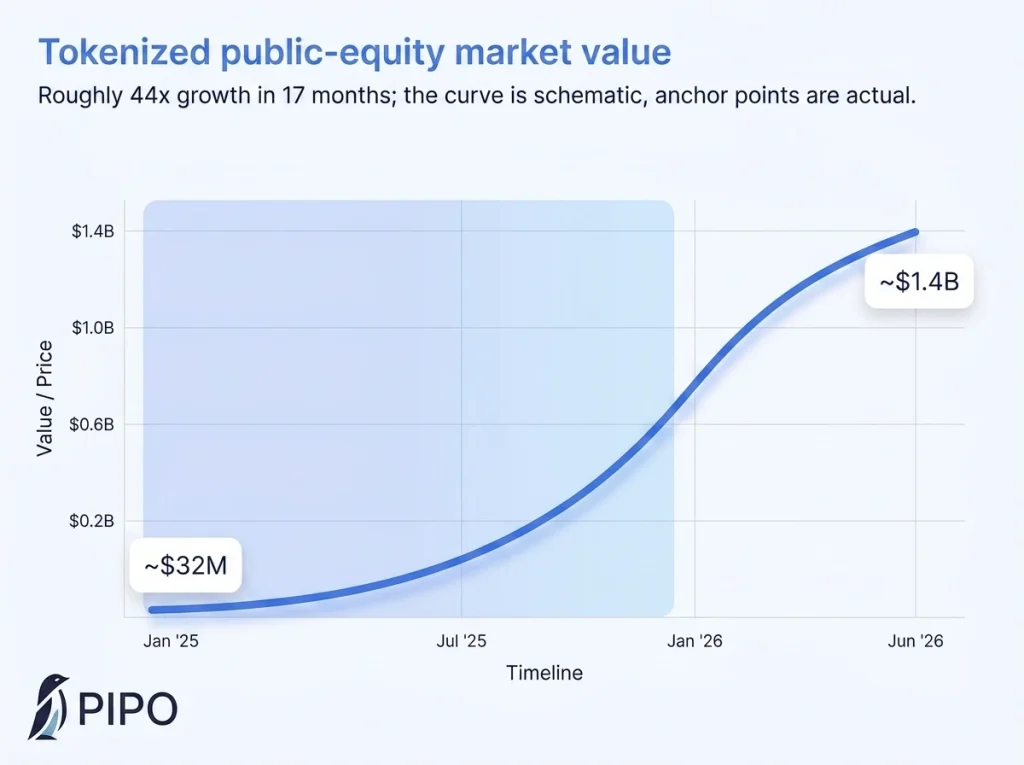
Tokenized public-equity market value over time (Jan 2025 ~$32M → Jan 2026 ~$963M → Jun 2026 ~$1.4B). Source: RWA.xyz / Sentora & DL Research.
Tokenized equities are no longer a thought experiment. According to a Sentora and DL Research report cited by CoinDesk on January 30, 2026, tokenized stocks “reached roughly $963 million in market value as of January 2026, representing a year-on-year increase of nearly 2,878% from just $32 million a year earlier.” That made equities the fastest-growing real-world-asset category, expanding several times faster than tokenized treasuries even though treasuries remain far larger in absolute terms (around $9.3 billion).
Through H1 2026, the numbers kept climbing. By March, monthly tokenized stock transfer volume hit an all-time high of $2.87 billion, up more than 80% in 30 days, with Ondo alone responsible for over $2 billion of that flow. Total holders moved past 200,000. By mid-June, RWA.xyz showed distributed tokenized stocks valued at nearly $1.4 billion across roughly 2,246 assets, up nearly 30% in a month, with a holder base of around 265,000 and a monthly transfer volume of about $3.24 billion. In May 2026, daily trading volume reportedly touched an all-time high of $3.57 billion, the same week the SEC published its innovation exemption.
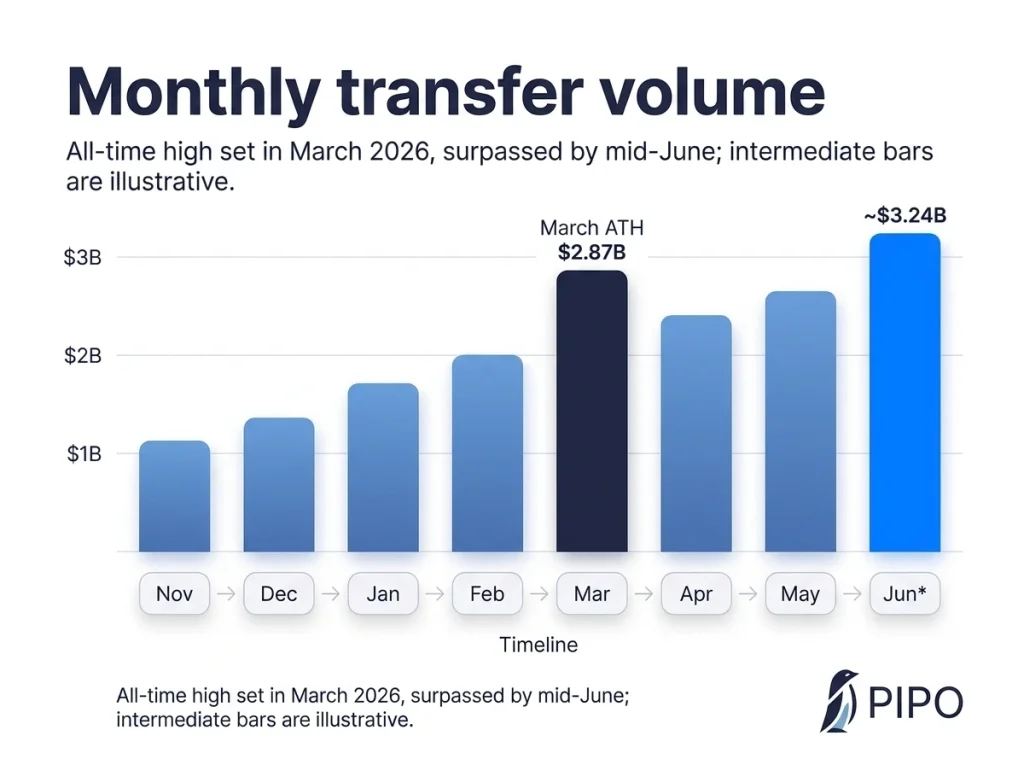
Monthly transfer volume growth (e.g., March 2026 $2.87B all-time high; ~$3.24B by mid-June). Source: RWA.xyz / Bitget News
To put scale in context: at ~$1.4 billion, on-chain stocks represent roughly 0.001% of the ~$134 trillion global equity market, the same fractional starting point stablecoins occupied in 2020 before growing into a category exceeding $300 billion. Tiger Research framed the long-term opportunity as a path from ~$500 million to as much as $1.34 trillion by 2030 if even 1% of global stocks are tokenized. I treat that figure as an aspirational projection, not a forecast, but the direction of travel is unmistakable.
2. Public versus pre-IPO: two different markets
Most coverage lumps “tokenized stocks” together, and that is a mistake. There are two fundamentally different markets here:
Tokenized public equities are already-listed stocks like Apple, Tesla, and Nvidia wrapped on-chain. They benefit from a continuous external price anchor (Nasdaq), deep arbitrage, and 1:1 custody. The value proposition is access and convenience: 24/7 trading, fractional ownership, instant settlement, and DeFi composability for non-US investors who otherwise face friction with foreign brokerages.
Tokenized pre-IPO equity is something else entirely. These are claims on private companies: OpenAI, Anthropic, Stripe, and Anduril of the world that have no public price, no daily NAV, and tightly restricted share transfers. This is where the real value asymmetry lives, and it is the segment PIPO, Jarsy, and xStocks were built for.
The case for pre-IPO is that structural companies are staying private much longer: per Jay Ritter’s IPO dataset (cited by VanEck), the median VC-backed tech company now goes public around 12 years after founding, versus roughly 4–6 years historically, with the 2022 and 2024 cohorts peaking near 14 years. As a result, the bulk of value creation now happens before the bell rings.
Andreessen Horowitz’s analysis shows companies that listed in 2014–2019 generated 80%+ of their market cap after going public, while the more recent cohort captured over 50% of their market cap while still private. a16z estimates private tech companies valued above $1 billion (~1,300 firms) now represent roughly $4.7 trillion in aggregate value, about 15% of the entire Nasdaq, and closer to 40% excluding the Magnificent 7. There are roughly 6x more private unicorns than public companies with a $1 billion+ market cap.
That is the wealth-creation gap: As our CEO Igor Lipovetsky puts it, “The gap between private and public markets is one of the most significant barriers to wealth creation globally.” For decades, access to that gap was gated behind accreditation rules of $200,000+ income or $1 million+ net worth in the US, and venture fund minimums of $1–10 million. The investors most systematically excluded are exactly the fastest-growing pool of global capital: retail and institutional investors in emerging markets. Closing that gap, compliantly, is PIPO’s entire reason for existing.
3. Key players in tokenized public stocks
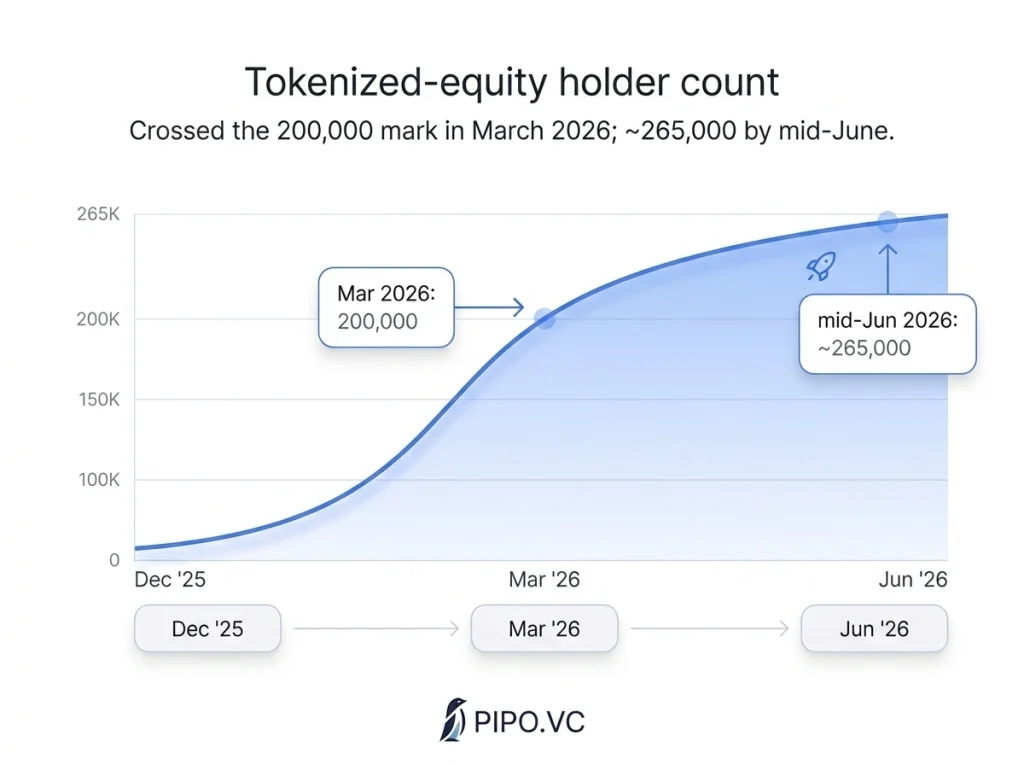
Holder count over time (crossing 200,000 in March, ~265,000 by mid-June). Source: RWA.xyz.
The public-equity segment consolidated fast around a few venues:
- Kraken (xStocks): Launched in June 2025 with Backed Finance as issuer on Solana, xStocks crossed $25 billion in cumulative transaction volume across more than 100 tokenized stocks within about eight months, including over $3.5 billion in on-chain activity from 80,000+ unique holders. By mid-February 2026, xStocks held eight of the top eleven tokenized equities by holder count. Kraken acquired Backed in December 2025. Not available to US users.
- Bitget (via Ondo Finance): Entered in September 2025 through Ondo’s Global Markets. Ondo became the largest tokenized stock platform within 48 hours of launch, hit $100 million TVL in week one, and now leads issuance, surpassing xStocks by total supply, with around $883 million in tokenized equity value and a ~60% issuance share by early 2026.
- Market-share shift: Per Dune Analytics, Kraken’s share of tradable tokenized stock value fell from about 97% to roughly 55% after Bitget/Ondo entered. Issuance leadership (Ondo) and trading leadership (Kraken) have decoupled.
- Gemini, Robinhood, and Coinbase: Gemini offers EU tokenized stocks; Robinhood launched tokenized US stocks for EU users in June 2025 on an Arbitrum-based L2 with 24/5 availability; Coinbase has signaled US commission-free tokenized stock/ETF plans contingent on regulatory clarity but has not gone live.
Infrastructure is spread across Solana (low fees, DeFi-native), Ethereum, Base, Arbitrum, and BNB Chain. Ethereum remained the largest base by TVL (~$330 million as of December 2025), with Solana second (~$159 million).
4. Key players in tokenized pre-IPO equity
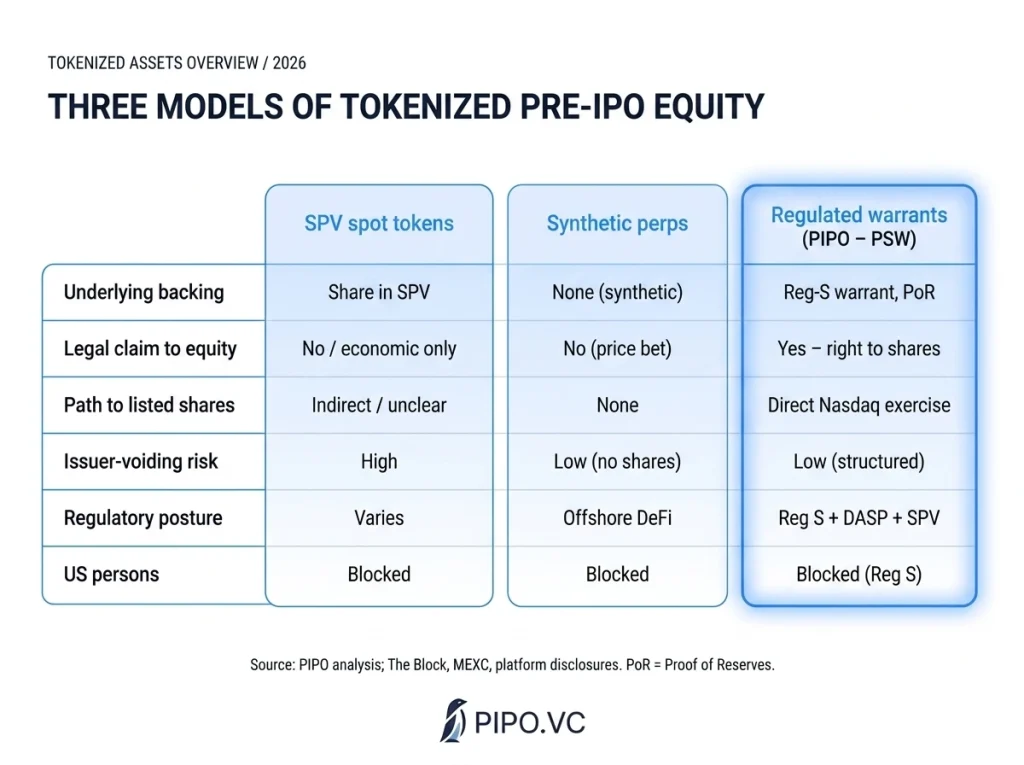
This is the segment that matters most to PIPO, and it is split into three competing models in H1 2026.
Model A, SPV-backed spot tokens: PreStocks (Solana, integrated with Jupiter and Meteora) is the category leader by volume, offering SPACEX, OPENAI, ANTHRP, ANDURL, and other names. By March 2026, PreStocks tokens had a combined market cap of about $13 million across nearly 13,000 holders; total tokenized pre-IPO volume reached $544 million. Jarsy (Base, backed by Breyer Capital) offers 1:1 economic-rights tokens from $10 via Delaware LLCs. Republic issues Mirror Tokens / structured products (preSPAX via Bitget IPO Prime). The shared weakness: each token requires acquiring a real underlying share, expansion is slow, and the legal claim is fragile. PreStocks itself states its tokens confer no ownership, voting, dividend, or other legal rights.
Model B, synthetic perpetual futures: Ventuals and Trade.xyz, built on Hyperliquid’s HIP-3 framework, lets traders take leveraged long/short positions on private-company valuations with no shares changing hands. These survived the May 2026 issuer crackdown precisely because they hold no shares, but they are, in the words of Arca’s CIO, “sentiment markets more than fundamental valuation markets,” with oracle and liquidation risk (Ventuals reportedly crashed ~45% on faulty oracle data, liquidating hundreds).
Model C, regulated warrants with a Nasdaq exercise pathway for PIPO.vc. This is our model, and I believe it is the only one structurally engineered to survive contact with both regulators and the underlying companies. PIPO doesn’t issue tokens itself; issuance is done by the issuers. What we did is design the instrument: the Share Subscription Warrant (SW), an ERC-20 security token built on Base (Ethereum L2). The issuer, a dedicated, unaffiliated Cayman Islands SPV, issues the SW under SEC Regulation S. Each SW is a “fixed-for-fixed” warrant under ASC 815-40, one token, one share, one strike price, which preserves the issuing company’s equity classification on its balance sheet, a critical requirement for a Nasdaq listing. Holders get American-style exercise (into physical shares any time after Transfer Agent onboarding), dual exercise options at IPO (physical or cashless), secondary liquidity via order book/OTC and approved CEXs, and model-based pricing using a modified Black-Scholes formula that provides continuous fair-value signals. As I have said, “The foundation of PIPO is regulatory compliance and structural integrity, ensuring that every investor, regardless of location, is investing through a Nasdaq-ready instrument.”
“For years, public markets have been split in two: one world where funds and family offices quietly enter pre‑IPO rounds, and another where retail is left with overpriced IPO listings. Our job is to erase that line with real tokenized equity rights and infrastructure, not buzzwords.” – Igor Lepovitsky, co-founder and CEO of PIPO.
The distinction matters because of what each instrument actually is. A PreStocks or Jarsy token is economic exposure to a share held in an SPV. A Ventuals position is a directional bet. A PSW is a legally structured right to acquire equity at a fixed strike, with a defined exercise pathway into the listed shares. PIPO backs this with Proof of Reserves (every mint is confirmed against custodian-confirmed asset purchases), Fireblocks MPC custody, Gnosis Safe multisig and protocol-level KYC/eligibility enforcement.
5. The regulatory landscape
United States (Regulation S and Project Crypto): Nearly every pre-IPO platform, including PIPO, operates under SEC Regulation S, which exempts securities offerings made entirely outside the US; as a result, platforms block US persons. The SEC’s January 2026 statement confirmed that a stock remains a security whether it is paper, a DTCC entry, or a token, and distinguished issuer-sponsored from third-party-sponsored tokenized securities. Under Chair Paul Atkins, “Project Crypto” and the proposed “innovation exemption” aim to let tokenized securities trade on-chain under lighter conditions; Atkins confirmed at Bitcoin 2026 that a tokenization sandbox would arrive “in weeks,” allowing issuance and trading for 12–36 months without full registration, subject to volume caps, KYC/AML, and reporting.
The GENIUS Act of 2025: Signed into law on July 18, 2025, the GENIUS Act created the first federal framework for payment stablecoins, requiring 1:1 reserve backing and monthly public disclosures, and excluding compliant payment stablecoins from the definitions of securities and commodities. It does not directly regulate equity tokens, but it matters enormously: stablecoins are the settlement currency of this entire market, and a regulated stablecoin base makes USDC-settled secondary trading more durable.
EU (MiCA): Under MiCA, tokenized shares that qualify as financial instruments under MiFID II fall outside MiCA and remain under MiFID II, the Prospectus Regulation, and related law. The MiCA transitional period expires July 1, 2026. This is why a pure pre-IPO equity instrument cannot simply “passport” into the EU under MiCA; it is a security, governed by securities law.
El Salvador (DASP / LEAD Law): El Salvador’s 2023 Digital Assets Issuance Law (LEAD), administered by CNAD, created a purpose-built regime for digital-asset issuance and service provision with 0% corporate, capital-gains, and VAT treatment for qualifying activities, a $5,475 government registration fee, and a 3–6-month process. PIPO registered a Salvadoran entity (PIPO Capital Markets, S.A. de C.V.) as part of a multi-jurisdictional structure spanning El Salvador, the DASP license providing the regulated platform and secondary-market wrapper, and the Cayman SPV providing the securities-compliant issuance vehicle.
6. Demand drivers
Why does any of this exist? Because the demand is real and structural:
- Most value creation now happens pre-IPO (see Section 2). Public-market investors increasingly buy in after the steepest part of the curve has passed.
- Fewer, later, larger IPOs. The number of US public companies fell from over 8,000 in the late 1990s to under 4,000; the median IPO market value rose from ~$105 million in 1980 (inflation-adjusted) to ~$1.33 billion in 2021.
- Marquee scarcity. SpaceX, OpenAI, Anthropic, Stripe, and Anduril these are the names retail globally wants and has historically been unable to get. SpaceX is the single most in-demand private name on private-market trackers.
- Global, non-accredited demand. Emerging-market investors are the fastest-growing capital pool and the most excluded. Tokenization with low entry barriers (no Reg S accreditation) is the bridge.
7. The SpaceX IPO: the stress test that proved the thesis
On June 12, 2026, SpaceX listed on Nasdaq under SPCX. Per CNBC, the company sold “555.6 million shares for $135 a piece,” raising $75 billion in a deal that “values SpaceX at $1.77 trillion, making it the seventh most-valuable U.S. company,” the largest IPO in history, more than triple the prior record. Demand exceeded $250 billion, over 3.5x the shares on offer; retail orders alone topped $100 billion. The IPO price was $135, the stock opened at $150, and closed the day at $161.11, putting the company’s valuation above $2 trillion.
Here is the lesson the entire industry just learned in public. Several major platforms, Binance, Bybit, Bitget, and MEXC, had marketed tokenized “IPO access” to SpaceX, all routing through xStocks (Kraken’s tokenized-equity arm) to source the actual shares. When xStocks could not secure the heavily oversubscribed allocation, those campaigns collapsed and refunded users. Per Dune Analytics data, Binance Wallet’s SPCXx campaign alone “drew roughly $557 million in USDC from 27,689 addresses in 28 hours,” with “more than 81% of wallets committing $20,000 or less, while 114 addresses pledged at least $500,000 each.” As a Dinari spokesperson told CoinDesk, “What appears to have gone wrong…is that demand significantly exceeded the available supply of underlying shares. If the underlying stock cannot be sourced, allocated, and held within the necessary regulatory framework, there is ultimately no asset to tokenize.” Ava Labs’ Olivia Vande Woude added: “Blockchain rails performed as designed. What broke was something older and more mundane: the work of actually sourcing the shares.”
Separately, in May 2026, OpenAI and Anthropic declared unauthorized share transfers void. Anthropic’s updated investor-warning page (May 12, 2026) stated: “We do not permit special purpose vehicles (SPVs) to acquire Anthropic stock, and any transfer of shares to an SPV is void under our transfer restrictions.” CoinDesk reported PreStocks’ Anthropic and OpenAI tokens “plunged almost 40% this week,” with the Anthropic token falling from $1,400 to $900 even as the platform’s dashboard showed Anthropic with an implied valuation above $1.5 trillion “despite the platform holding roughly $23 million in total assets” and on-chain liquidity of “just over $333,000 in stablecoins and $18,000 in solana.”
These two events are the clearest possible validation of PIPO’s design philosophy. Creating a token is trivial. Securing a binding, legally enforceable claim on the equity structured to preserve the issuer’s cap table and Nasdaq eligibility, with a defined exercise pathway, is the hard, unglamorous work that actually protects investors. That is what a warrant under Regulation S, issued through a ring-fenced SPV with Proof of Reserves, is engineered to deliver.
8. Challenges and risks
I am not going to pretend this market is without serious risk. Honestly:
- Most tokens are economic-exposure-only: The majority of pre-IPO tokens confer no voting, dividend, or ownership rights. Investors must know whether they hold an enforceable equity claim or an unbacked IOU.
- Issuer and counterparty risk: As OpenAI and Anthropic showed, companies can void unauthorized transfers, and legal structuring is the only defense.
- Regulatory uncertainty: Frameworks are still forming; Atkins and Peirce have both stressed that change will be incremental, and only Congress (via the CLARITY Act) can make classifications permanent.
- Custody and oracle risk: Synthetic models depend on accurate oracles; spot models depend on robust custody and proof-of-reserve.
- IPO timing risk: Warrants and pre-IPO claims depend on a liquidity event that may be delayed or never arrive.
9. Outlook for H2 2026 and beyond
I expect three things in H2 2026 and into 2027:
- Convergence of public and pre-IPO tokenization: As the SpaceX, Anthropic, and OpenAI IPOs pull pre-IPO names across the listing line, the instruments that captured value before the bell and that convert cleanly into listed shares at the bell will win. Nasdaq and NYSE/ICE are both building tokenized-securities venues; DTCC is slated to begin facilitating tokenized production trades in mid-2026.
- Regulatory onshoring: The SEC’s innovation exemption and sandbox could bring some activity onshore in the US for the first time, while MiCA’s July 2026 deadline and El Salvador’s maturing DASP regime sharpen the offshore map. Compliance-first platforms benefit; gray-zone platforms face pressure.
- A flight to structural quality: After the SpaceX campaign refunds and the SPV-voiding episodes, capital will migrate toward instruments with enforceable claims and clean Nasdaq pathways. This is the thesis PIPO has bet on from day one.
Recommendations
For investors, builders, and partners evaluating this market, here is my staged, concrete guidance:
- Start by classifying the instrument, not the brand: Before allocating, determine exactly what you hold: an enforceable equity right (e.g., a Regulation-S warrant like PIPO’s PSW), an SPV economic-exposure token, or a synthetic perp. The rights and risks are completely different. Threshold to change posture: if a product cannot demonstrate a binding legal claim and proof of reserve, treat it as speculative exposure only.
- Demand proof-of-reserve and a defined exit: Favor platforms with custodian-confirmed backing, segregated per-deal SPVs, and a documented conversion/exercise pathway. Benchmark: secondary liquidity depth relative to implied valuation (the PreStocks–Anthropic gap of ~$23M backing against a >$1.5T implied valuation is the cautionary extreme), and a published redemption mechanism.
- Map your jurisdiction first: Under Regulation S, US/UK/EU persons are generally excluded at launch; confirm eligibility before committing. Watch the SEC innovation-exemption rulemaking if it lands with workable volume caps and KYC, onshore US access could open, which would be the single biggest catalyst to re-rate the sector.
- Size for illiquidity and IPO-timing risk: Treat the illiquidity premium as part of expected return, not a footnote. Assume lockups, delayed IPOs, and thin secondaries.
- For builders and issuers: the SpaceX episode proved that distribution without a secured underlying is reputational risk. Build the legal and custody stack first. Trigger to act now: the convergence window with SpaceX public and Anthropic/OpenAI filing rewards instruments that convert cleanly into listed shares.
Caveats
- Several figures (e.g., Tiger Research’s $1.34 trillion-by-2030 scenario, SpaceX revenue growth projections of $190–474 billion by 2030, and “first regulated platform” claims) are projections or marketing assertions rather than established facts and are flagged as such.
- Market metrics (value, volume, holders) vary by source and date: RWA.xyz, Dune Analytics, CoinMarketCap, and exchange data sometimes differ because they measure different things (distributed value vs. tradable value vs. issuance supply). I have cited ranges where sources diverge.
- This report is for informational purposes only and is not an offer to sell or a solicitation to buy any security. PIPO Share Subscription Warrants are offered exclusively under SEC Regulation S to non-US persons in offshore transactions. All investments carry the risk of total loss.