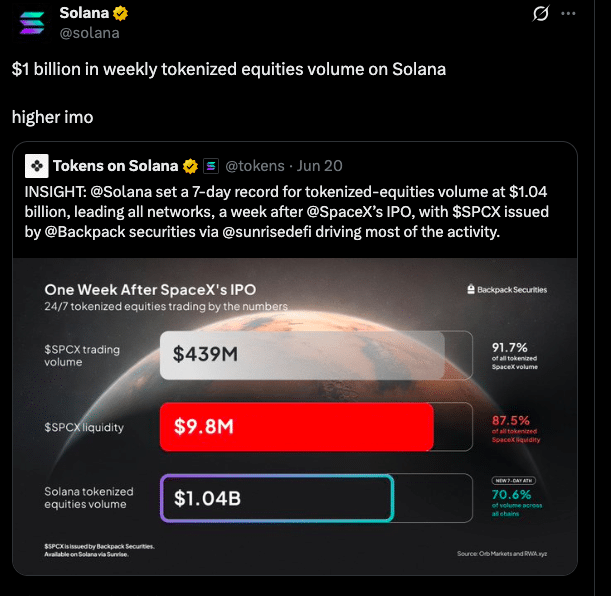
This article was first published on Deythere. Tokenized stocks have just hit a weekly trading volume of over $1.04 billion on Solana. The surge in activity is one of the strongest yet, that s
This article was first published on Deythere.
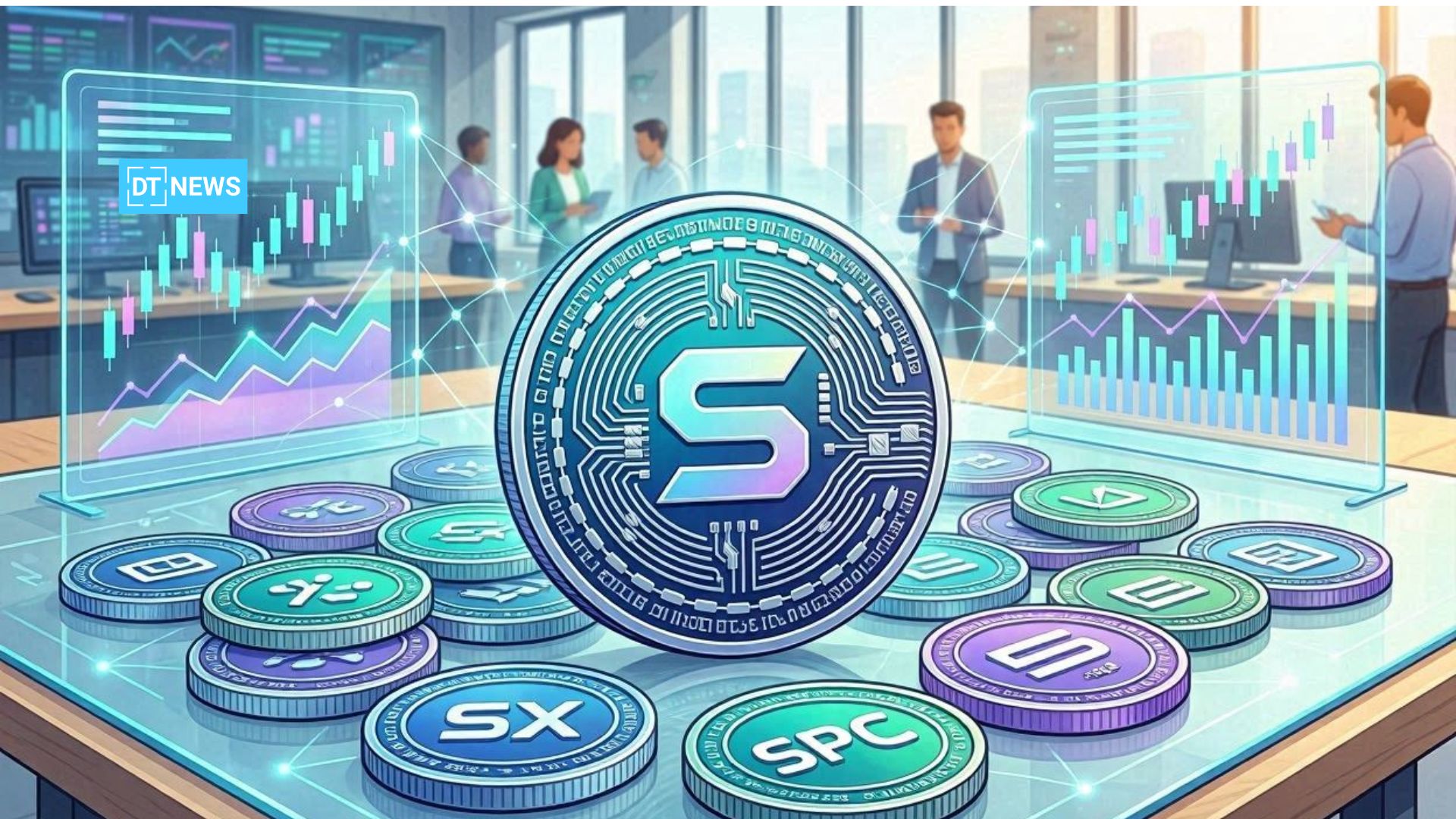
Tokenized stocks have just hit a weekly trading volume of over $1.04 billion on Solana. The surge in activity is one of the strongest yet, that shows tokenized stocks are now into active market participation.
However, this same rapid growth is raising a lot of questions too about liquidity, shareholder rights, custody arrangements and whether the demand for these products is beyond a handful of popular assets.
Data from Solana ecosystem channels and SolanaCompass has shown tokenized equities clearing over $1 billion in weekly volume around June 20. Much of that activity centered on SPCX, a token linked to exposure associated with SpaceX.
Industry dashboards are showing overall growth across the tokenized equity sector. RWA.xyz reported that tokenized stock markets were holding around $1.58 billion in distributed value and pushing over $6 billion in monthly transfer volume as of June 24.
SPCX Steals the Show
While tokenized stocks collectively generated over $1 billion in weekly trade, trading activity was concentrated around SPCX. This concentration shows genuine investors interest in assets that are normally out of reach for retail investors.
SpaceX remains a private company and SPCX is not the same as holding actual SpaceX shares. That ownership rights, redemption mechanisms and investor protections can vary between tokenized products and the actual securities they reference.
For a lot of traders though, accessibility is winning out over concerns. The ability to get exposure to high-profile private companies through blockchain-based instruments has become a major selling point for the emerging tokenized stocks market.
Solana’s Growth as a Leading Venue
The latest trading activity is emphasizing Solana’s role in real-world asset tokenization.
According to RWA.xyz, Solana has the majority of value within the xStocks ecosystem, accounting for more than 92% of the platform’s distributed asset value.
The ecosystem is benefiting from all the things that crypto traders love which include fast settlements, low transaction costs and continuous market access.
Unlike traditional stock exchanges that operate on a set schedule, blockchain networks let users trade tokenized assets 24/7 and that as a result, is changing investor expectations. Many traders are now expecting stock-linked products to function with the same speed and availability as cryptocurrencies.
Recent market data is also suggesting that monthly transfer volumes for tokenized stocks have been expanding rapidly during June, implying that interest in spreading beyond early adopters.
 Tokenized Stocks Cross $1 Billion Weekly Volume on Solana
The Rights Question Still Lingers
Despite all the enthusiasm, the growth of tokenized stocks has exposed a big challenge. Trading volume can grow a lot faster than the law keeps up.
Several providers are assuring that their products are backed by underlying assets. Kraken says that xStocks are tokenized representations of stocks and ETFs backed 1:1 by the underlying equity and issued as SPL tokens on-chain.
Yet backing alone does not automatically resolve every investor concern.
Questions still linger about redemption rights, voting privileges, corporate actions, who holds the custodian and what happens when markets get rocky. Investors may assume a token behaves just like the stocks they’re used to but the fact is product structures can be very different depending on who issued them.
 Tokenized Stocks Cross $1 Billion Weekly Volume on Solana
Can Tokenized Stocks Sustain Their Momentum?
A market driven by one high profile asset can generate impressive volume figures but in the long run, it is usually the participation across multiple securities that really drives growth.
Researchers studying tokenized real-world assets have also been warning that just because an asset moves on the blockchain doesn’t necessarily mean it is liquid and free of risk. It can be moving fast but still facing concentration risks or limited secondary-market depth.
If tokenized equity platforms can go beyond a handful of high profile assets and show they can deliver liquidity, clear investor protections and a decent secondary market, then maybe they’ll be here to stay.
Conclusion
The surge in tokenized stocks is a welcome sign that blockchain-based equity trading is attracting meaningful capital. The fact that Solana just hit a weekly volume of $1.04 billion shows that investors are prepared to trade stock linked assets at a pretty big scale.
But the truth is the market is still heavily concentrated around the likes of SPCX and other trendy products. The real test is no longer whether people want tokenized equities, It is whether platforms can deliver the transparency, liquidity, and investor protections needed to support long-term adoption.
Glossary
Tokenized Stocks – Blockchain based copies of traditional equities or ETFs.
SPCX – Token linked to SpaceX related value.
RWA (Real-World Asset) – Traditional financial asset moved onto a blockchain.
Liquidity – How easy or hard it is to buy or sell an asset without affecting its price.
SPL Token – A type of token used on the Solana blockchain.
Redemption Rights – The process by which holders can trade tokens for the underlying asset or equivalent value.
Frequently Asked Questions About Tokenized Stocks
Why is Solana seeing growth in tokenized stocks ?
Solana has the speed, low fees and strong support for tokenized asset platforms that traders and issuers are looking for.
What is SPCX?
SPCX is a tokenized product designed to give exposure to the value of SpaceX but it’s not the same as owning actual shares of the company.
Are tokenized stocks backed by real shares?
Some platforms, including xStocks, state that their products are backed 1:1 by underlying equities. Investors should review the specific terms of each issuer.
What kind of risks do tokenized stocks have?
The list of potential risks include low liquidity, redemption issues, custody worries, regulatory uncertainty and the fact that the rights attached to token ownership are often very different from the rights that come with owning a traditional stock.
References
RWA.xyz
Arxiv
Cryptoslate