On August 12, 2026, Crypto.com switched on a product in the European Economic Area that looks like buying shares and is legally something else entirely. It is called Tokenized Stocks, covers
On August 12, 2026, Crypto.com switched on a product in the European Economic Area that looks like buying shares and is legally something else entirely. It is called Tokenized Stocks, covers 1,500 US stocks and funds according to the company, and runs around the clock in the firm's own app. Germany belongs to the EEA, so the offering is aimed at you as well.
The provider's announcement contains one sentence that frames the whole thing: investors acquire no legal or beneficial ownership of the underlying assets and none of the shareholder rights attached to them. Anyone wanting to trade shares through a crypto app is not buying a stake in a company there but a contract on its price. This construction now turns up at several large trading venues. This article sets out what you hold, who stands behind it and how to recognise genuine ownership of a security.
Tokenized stocks are derivatives, not stakes in the company
A share is a stake in the share capital of a stock corporation. Membership rights come with it: a vote at the annual general meeting, a claim on the profit share, a subscription right in a capital increase, a right to information. Whoever holds shares in a securities account has a stake in the company, even where custody runs through a bank and a central securities depository.
A tokenized stock is an entry on a blockchain that refers to the price of that share. The issuer promises to align the value of the token with the price of the underlying and to redeem it at the prevailing price. In legal terms that is a derivative, that is, a claim against a company. The underlying expressly stays outside your assets.
Why the distinction blurs in everyday use
The interface makes it hard. The app shows the ticker of a well-known company, the price in real time beside it and a buy button underneath. The note on the legal nature appears only in the product description document, which you have to confirm but not read.
The announcement of August 12, 2026, issued from Limassol in Cyprus, names concrete figures. Tokens on 1,500 underlying stocks and funds are tradable, among them NVDA, TSLA and AAPL as well as commodity funds such as GLD and SLV. Trading runs around the clock and in fractions, according to the company. Commission is waived for an undated introductory phase; in the same paragraph the company notes that currency fees or spreads may nonetheless apply.
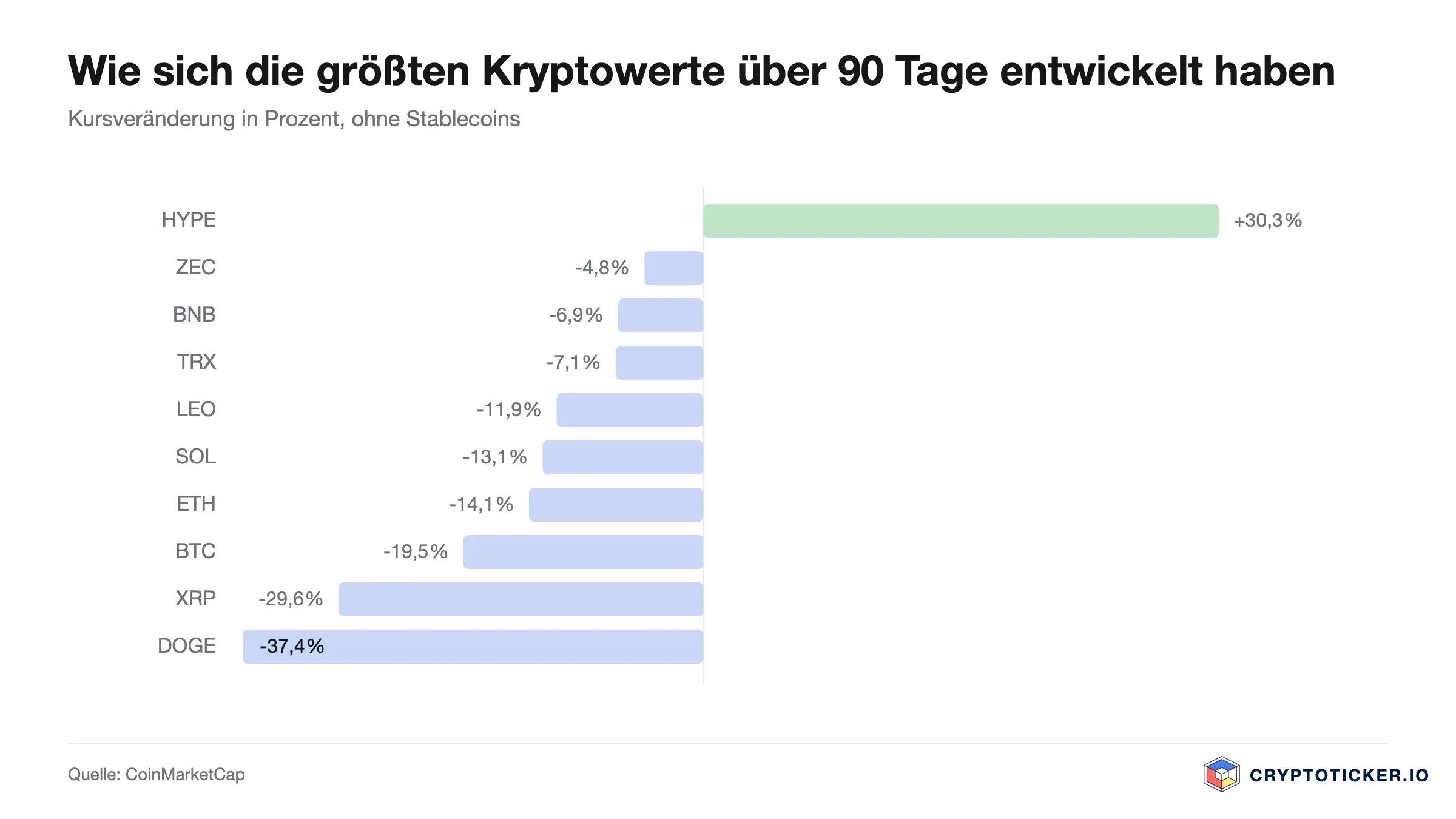
The largest crypto assets over 90 days, based on CoinMarketCap data
The model is not new. Binance had already introduced tokenized US stocks under the name bStocks in June 2026, and Robinhood and Coinbase are active in the field too. The launch is therefore less a novelty than an occasion to take the construction apart. The details come from the company's press release.
No ownership, no voting rights: the decisive sentence in the product text
The English original states that the tokens confer "no legal or beneficial ownership" of the underlyings. Both terms count: legal ownership means formal title, beneficial ownership the economic kind. Both levels are therefore excluded.
In practice that means you are not entered in any share register, you are not invited to the annual general meeting, you vote on no dividend and no supervisory board, and in a capital increase no subscription right accrues to you. Anyone who understands shares as a participation rather than a pure bet on the price loses, with this class of product, precisely the part that constitutes the participation.
Issuer risk instead of segregated assets: who ranks ahead of you in an insolvency
The economically weightiest difference lies in insolvency. An investment fund set up in Germany is segregated: the fund assets are separate from the assets of the management company and do not fall into the insolvency estate should it become unable to pay. Shares in your own securities account are protected in the same way, because the bank holds them for you.
With a derivative that does not apply. Your position is a claim against the issuer, and if the issuer goes insolvent you queue up as a creditor. The company names this risk in its own announcement and, alongside market and liquidity risk, expressly lists counterparty risk, together with the note that investors may lose part or all of the capital they commit.
Custody at a broker-dealer changes nothing about that
According to the announcement, the underlying assets are held at Alpaca, a broker-dealer regulated in the United States. That secures the issuer's position. It does not automatically create a direct claim for delivery on your part; whether you can reach those assets depends on the terms of issue.
Foris Capital CY Limited: what the CySEC licence and the EU passport cover
The issuer in the EEA is, according to the announcement, Foris Capital CY Limited, formerly A.N. Allnew Investments Limited. It is supervised by the Cypriot securities regulator CySEC; its authorisation as a Cypriot investment firm carries the number 344/17 under the Investments Services Law 87(I)/2017, with which Cyprus implemented MiFID II, and it is notified into other EEA states under the freedom to provide services.
The EU passport is a genuine protective mechanism, but it shifts responsibility. The home supervisor remains Cyprus, not Germany's BaFin. Complaints and out-of-court dispute resolution run through Cypriot bodies, as a rule in English. Anyone who cares where the supervisor sits should check this before opening an account; our comparison of regulated crypto exchanges lists which provider operates under which supervision.
Germany's Electronic Securities Act shows what genuine token ownership looks like
The claim that a security on a blockchain would inevitably be nothing more than a price replica is wrong. Germany has had its own legal framework for this since 2021. The Act on Electronic Securities permits a security to be issued without a certificate, by the issuer entering it in an electronic securities register. Where that register is kept on a decentralised recording system, the act speaks of a crypto securities register and of a crypto security.
The decisive element is a short provision in Section 2(3): an electronic security counts as a thing within the meaning of Section 90 of the German Civil Code. Ownership, possession and acquisition in good faith are possible in respect of it, just as with a printed certificate. Section 8 distinguishes collective entry through a custodian from individual entry, in which you personally stand in the register as the entitled party.
What the act permits for shares
The scope is narrower than many marketing texts suggest. It covers bearer bonds, registered shares and bearer shares, the last of these only in the central register. A token on a US share falls outside it in any case. But the act serves as a yardstick for what a paper looks like in which you genuinely hold rights.
MiCA does not apply: financial instruments are excluded from the crypto regulation
A widespread misconception holds that since MiCA every token in Europe has been supervised under the same rules. Regulation (EU) 2023/1114 says the opposite. Under Article 2(4)(a) it does not apply to crypto assets that are financial instruments. A derivative on a share is a financial instrument, so it falls out of MiCA and into the scope of MiFID II.
For you that means two things. There is no MiCA white paper you could take your bearings from. Instead the conduct of business rules from MiFID II apply, meaning the appropriateness assessment, cost disclosure and target market determination. That is not a worse framework, but a different one, and the documents are named accordingly.
Dividend equivalent instead of dividend: what happens on a distribution
If the company behind the underlying distributes a dividend, you receive none, because you hold no share. The announcement states that users may be eligible for "dividend equivalent adjustments", that is, for an adjustment corresponding to a dividend. The accompanying note is just as clear: such adjustments follow the respective product terms and are not guaranteed.
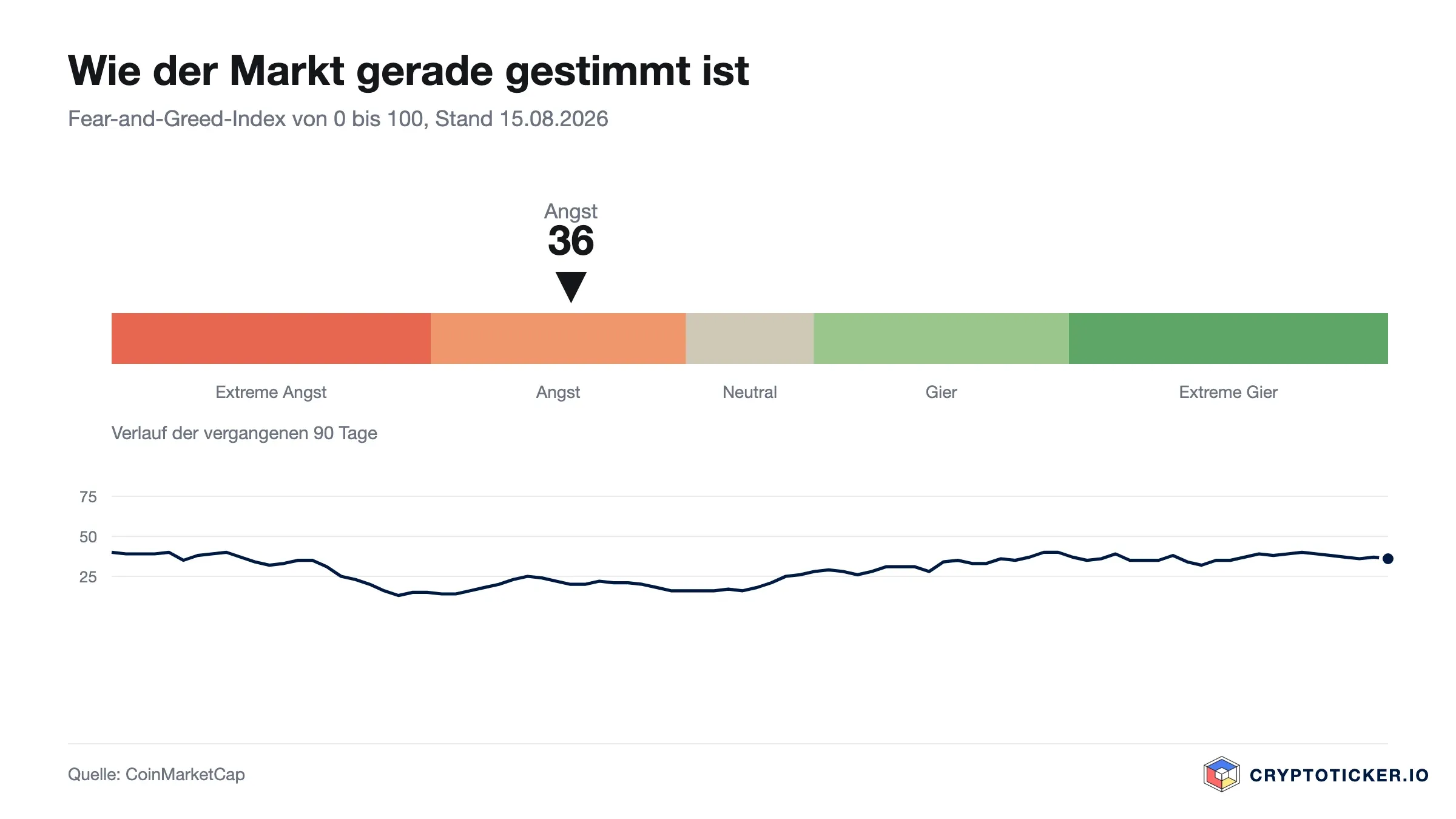
The Fear and Greed Index places market sentiment between extreme fear and extreme greed
The difference is more than a form of words. A dividend is a claim against the stock corporation arising from a resolution of the annual general meeting; an adjustment is a contractual payment by the issuer under its own terms. US withholding tax, partly creditable where a real share sits in a securities account, does not necessarily behave the same way here either. If distributions are a reason to buy, the point belongs looked up beforehand.
Round-the-clock trading: spread and liquidity outside exchange hours
The strongest selling point of these products is trading at the weekend and overnight. The underlying lies still at those times: the New York Stock Exchange is closed and there is no continuous reference price. The issuer quotes bid and offer prices all the same, and does so at its own risk.
That risk lands with you as the spread, the gap between the buying and the selling price. It widens when hedging becomes expensive for the issuer, on a Sunday evening for instance, or ahead of quarterly figures. On products denominated in US dollars the currency surcharge comes on top. Commission-free trading applies, according to the company, only to an introductory phase whose end is not stated.
For tax purposes the redemption claim separates two different regimes
In Germany the taxation of a token depends on how it is legally built. If it securitises a claim to repayment in money against an issuer, a monetary claim is the obvious classification: the gain then falls under investment income subject to the flat-rate withholding tax, regardless of the holding period. If no such claim exists, classification as another economic asset comes into consideration, with the one-year holding period for private disposal transactions.
This fork is why the ownership question is not an academic one. Which side applies to tokenized stocks we set out on August 10, 2026, including the route through the issuer documents and the question of which tax annex applies: taxing tokenized stocks in Germany. What matters there is that losses from investment income cannot be offset against gains from crypto assets, because the two sit in separate pots.
The checklist before your first purchase: five details from the product document
Every provider makes a product description document available before trading. These five points are the ones to look up in it:
- Issuer and supervision. Which company stands in the contract, where is it based, which authority supervises it and under what licence number?
- Legal nature of the position. Does it say derivative, debt security or security? Only the last of these gives you rights in the underlying.
- Backing and custody. Are the underlyings deposited, with whom, and do you have access to them in an insolvency or merely a claim?
- Treatment of distributions. Is there a dividend adjustment, is it guaranteed, and how is foreign withholding tax handled?
- All cost components. Commission, spread, currency surcharge, custody fee and the question of when a promotional phase ends.
If you find no clear statement on one of these points, that is information in itself. A product whose legal nature you cannot name after a quarter of an hour's reading does not belong in a long-term portfolio.
Buying tokenized stocks: what to take away
- Establish before you buy whether you are acquiring ownership or a claim. If the product document says derivative, you hold a claim against the issuer and carry its default risk. If you are looking for a regulated trading venue with clear allocation, you will find the providers in the comparison of regulated crypto exchanges.
- Compare total costs, not the commission. Spread, currency surcharge and the end of an introductory promotion weigh more heavily than a zero in the commission field. Which provider runs which structure is shown by the broker comparison.
- Document every position from the outset. Whether your gain falls under the flat-rate withholding tax or under the one-year holding period is decided by the legal nature of the product, and in case of doubt you have to be able to evidence it. Tools for that are in the comparison of crypto tax tools.
(As of August 15, 2026. This article is not investment advice. Prices and fee structures change; check the terms with the provider before you buy.)