Toncoin no longer exists, at least not under that name. Since June 15, 2026 at 12:00 UTC, the token of the network The Open Network has been called Gram again, and the symbol reads GRAM inste
Toncoin no longer exists, at least not under that name. Since June 15, 2026 at 12:00 UTC, the token of the network The Open Network has been called Gram again, and the symbol reads GRAM instead of TON. For you as a holder, the most important news is reassuring: you do not have to do anything. There is no swap, no bridge, no claim to register and no migration to a new chain. Balances, addresses, contracts, collectibles and running staking positions are unchanged; what changed is the name in the price ticker.
The second piece of news is the more interesting one. Telegram is now building the token directly into the messenger: since late August 2026 the Gram Wallet has been rolling out inside the app, initially for a limited group of users. This wallet is self-custodial, which shifts both the opportunities and the obligations. This article sets out what the rename means in practice, whether the wallet can be reached in Germany yet, how it sits with European supervisory law, and how much is left of the ecosystem that made headlines in 2024 with tap-to-earn games.
What happened to Toncoin: the Gram rename at a glance
The name Gram is not an invention of 2026 but a return. The project's original white paper called the token Gram; only after the legal dispute with the US securities regulator and Telegram's withdrawal from development did a foundation take over the network and carry the token on as Toncoin. The network voted on the return to the old name, and approval came in at 81.22 percent.
A rebranding is something different from a token swap. In a swap, an old contract is retired and you have to exchange your holdings for new units, usually within a deadline and often for a fee. Here only the label changed: the same contract, the same chain, the same keys. If anyone offers you an exchange page for "new GRAM", that is an attempted fraud, and the same applies to any message that pushes you to act because of the name change.
In practice that means the token may currently appear under both names in your wallet and at your exchange. Large market data providers list it as "Gram (prev. Toncoin)" so that the mapping stays unambiguous. The pitfalls sit wherever software has the name hard-coded, for instance in older tax tools or in spreadsheets you built yourself.
Do you have to do anything? What the Gram rename means for your holdings
No, and that is explicitly documented. The network operator has made clear that no action is required. A short review in three places is still worth the time.
First, your trading platform: check whether the trading pair has been renamed and whether deposits and withdrawals are running normally. Exchanges run short maintenance windows during renames, and transfers stand still while they last. Second, your tax records, on which there is more below. Third, your bookmarks and watchlists, because a price ticker under the old symbol can point at nothing.
If you want to place your holding for a possible purchase or sale, our last detailed assessment is in the buying decision on Toncoin from August 15, 2026, which still appeared under the old name. Current price action together with scenarios is covered on the Toncoin price prediction page.
Who runs the network now that Telegram replaced the foundation
The rename is the most visible part of a larger overhaul. On May 4, 2026, Telegram took the place of the Swiss-based TON Foundation as the network's largest validator. A validator is a machine that checks transactions and confirms blocks; whoever holds the largest voting weight largely determines which software changes go through. The step belongs to a multi-stage roadmap that Telegram founder Pavel Durov presented under the name "Make TON Great Again".
Technically the network has improved measurably this year. Transaction fees fell roughly sixfold according to the operator, and an upgrade in April cut the block time from around 2.5 seconds to about 400 milliseconds. The block time is the interval at which new blocks are created, and therefore the lower bound on how quickly a payment can be confirmed.
The price of that acceleration is concentration. A network whose largest validator also operates the app through which almost all users arrive is no longer a distributed system in the original sense. That is not a verdict on the product but a description of a risk you should know: decisions on fees, censorship and software are taken where the voting weight sits.
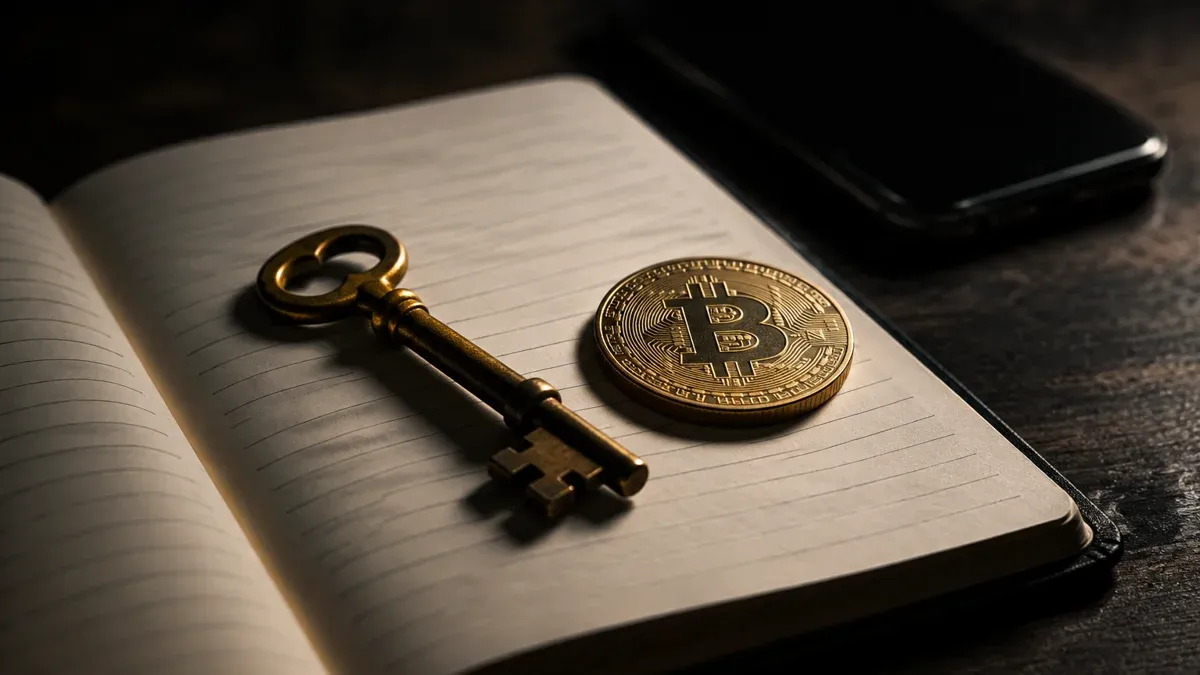
With a self-custodial wallet the recovery phrase sits with you, and nobody can replace it.
The Gram Wallet in Telegram: self-custodial, and what that means for you
On August 31, 2026, Durov announced that the Gram Wallet was finished inside Telegram and available to a limited group; the release was to be widened over the following weeks to the entire user base, which the company puts at more than one billion. Other accounts cite around 900 million users, and that range belongs in the picture.
The decisive point is the design: the wallet is self-custodial. That means the private keys sit exclusively on your device, not with Telegram. A private key is the secret number used to move funds; whoever holds it controls the money. The difference from a custodial solution is invisible in everyday use and decisive when things go wrong: at an exchange you can reset a password, under self-custody you cannot. If you lose both the device and the recovery phrase, the holding is gone for good, and no support desk can help.
Two concrete actions follow from that before you deposit amounts that would hurt to lose. Write the recovery phrase down away from the phone and store it separately from the device; a screenshot in your photo gallery is no backup but a target. And treat an app wallet as a current account rather than as a vault. Anyone holding larger amounts keeps custody away from the device in daily use; our hardware wallet comparison shows which devices support the network and what to look for when buying.
Is the Gram Wallet available in Germany yet?
What is documented is a staged rollout, not a release for everyone at once. Whether the wallet appears in your app therefore depends first of all on whether your account sits in the current wave. The company has not published a release list broken down by country, which is why a firm "yes or no for Germany" cannot be given at the moment.
Here is how to check for yourself, without relying on reports: open the settings of the app and look for a wallet entry. If it is missing, searching in third-party channels will not help, and there is no sign-up route that speeds up the queue. Any message promising you earlier access in return for a payment or for a recovery phrase is an attempted fraud. That is the most common damage in staged launches, and it regularly hits people who only wanted to be there sooner.
What MiCA means for a self-custodial wallet inside a messenger
For German users the supervisory classification matters more than any product announcement. The European regulation on markets in crypto-assets, MiCA for short, ties the licensing requirement to the provision of crypto services, which includes custody on behalf of clients. Where users hold the private keys exclusively themselves, the logic of the regulation means there is no custody in the legal sense: pure self-custody therefore falls outside the authorisation requirement for service providers.
What that means for you in practice is uncomfortable. At an authorised platform, duties on organisation, complaint channels and the separation of client funds apply. At a self-custodial wallet none of that applies, because no service provider stands between you and the chain. The protection you have at a regulated exchange is here your own procedure. Where you can trade in Germany under European supervision is set out in our comparison of regulated crypto exchanges.
One note on the situation, without a forecast: supervisory authorities in the EU and in the United States tightened the rules for transfers to self-custodial wallets in 2026. A function preinstalled in an app with one billion users will hardly escape the attention of regulators. How that affects deposit and withdrawal routes is open; anyone using the wallet should keep an eye on changes at their exchange.
How much the network actually carries today
An honest look is worth it here, even if it turns out uncomfortable. The total value locked (TVL) is the sum of the funds deposited in the applications of a chain, and the most common measure of a network's economic use beyond its price. Our own call to the DefiLlama interface on September 27, 2026 at 00:56 UTC returns around $56.6 million for TON.
For comparison, from the same call: Solana comes to about $6.62 billion, Base to around $6.28 billion, Polygon to roughly $794 million. The network with the largest potential audience in the industry thus carries less than 1 percent of the capital working on the leading chains. Reach and usage are plainly two different things, and anyone investing in Gram is so far investing in the expectation that the first will turn into the second.
That this can also move backwards is something the year has shown. The shutdown of a bridge to other chains hit the holdings of users who reacted too late; we broke down the deadline on August 21, 2026 and the remaining balances on September 1, 2026. If you still hold bridged units from that period, that is the more urgent task than any wallet news.
Of the tap-to-earn tokens of 2024, none has held on to the attention that made it big.
What happened to Notcoin, Hamster Kombat and DOGS
The games that pulled millions of people into the messenger in 2024 are the reason many German investors know about this network at all. The model was called tap-to-earn: users tapped the screen in a mini application and collected points that were later converted into tokens. The record two years on is sober.
At Hamster Kombat the user base has fallen from more than 300 million to about 41 million, according to a market data provider. The DOGS token trades around 96.8 percent below its all-time high, which was reached on August 28, 2024. We have no statement from any of these projects that operations have been discontinued; we therefore explicitly do not write that they have ended. What can be documented is the loss of attention and of market value.
The lesson from that matters more to today's reader than the retrospective. A token whose demand comes out of a campaign loses its basis along with the campaign. Anyone buying such assets should treat a total loss as possible, meaning the loss of the entire amount invested. Background on this class of token is collected on our meme token topic page. How quickly such an ecosystem can come to a standstill was shown by the price slump with network outage of June 6, 2026.
Gram price and all-time high in relation
Our own call to the CoinGecko market data interface on September 27, 2026 at 00:56 UTC returns a price of $1.59 for Gram at rank 30 by market capitalisation. The all-time high stands at $8.25, putting today's price around 80.7 percent below it.
That figure places the rename. A return to the original name and a wallet inside a large app are considerable steps for distribution. They have so far changed nothing about the distance to the peak price, and we name no price target here: how the market values distribution to one billion users is an open question rather than an arithmetic exercise.
Tax in Germany: holding period, the rename and what the tax office sees
For taxation the rename is the friendliest case there is. Because no swap took place, there is no disposal, meaning no event that triggers a taxable gain or loss. Your acquisition dates remain intact, and the holding period therefore runs on unbroken.
That is more important than it sounds. Private disposals of crypto-assets are tax-free under section 23 of the German Income Tax Act after a holding period of one year. Had the rename been a swap, the clock would have started again. In practice you should still do two things: check that your tax tool continues to assign the holding to the same position after the name change instead of carrying it as a new acquisition, and secure the records of the original purchase.
On top of that comes a deadline that concerns every German investor. The German Crypto Asset Tax Transparency Act implements the European reporting obligation DAC8; the 2026 calendar year is the first period for which trading platforms report data to the Federal Central Tax Office, and they have to do so by July 31, 2027. With a self-custodial wallet there is nobody who takes care of that for you: the burden of proof sits entirely with you. Anyone who starts reconstructing a history in the summer of 2027 is looking for data that by then often no longer exists.
The risks you should know before buying Gram
Three points belong together, and none of them is a recommendation for or against the token.
The first is centralisation. When the operator of the app is also the largest validator, network and company hang on each other. News about the company then acts directly on the token, regardless of how the technology performs.
The second is the weak usage, measured by the $56.6 million in TVL. A chain with little deposited capital has thin order books on its decentralised exchanges, which makes larger sales expensive. The third is the plain possibility of a total loss, which applies to every crypto-asset and deserves particular attention with a token whose prospects hang on a single company. Invest only amounts here whose failure would not touch your life plans.
Toncoin and Gram: what you take away
- The rename requires nothing from you. No swap, no deadline, no action. Anyone writing otherwise is after your keys. Just check that your tax tool carries the holding on as the same position.
- Treat the wallet in the app as a current account. Note the recovery phrase away from the phone and keep larger holdings separately. Which devices are suitable is set out in the hardware wallet comparison.
- Trade under supervision if you want to buy. A self-custodial wallet carries no investor protection; the platform you buy through is therefore the more important decision. The comparison of regulated crypto exchanges is the place to start. Reckon with the possibility of a total loss.
Sources to read on: the network's announcements are in the project's official channel, the usage figures of the chain on the TON overview at DefiLlama.
(As of September 27, 2026. This article is not investment advice. Prices and fee structures change; check the terms with the provider before you buy.)