Top Altcoins to Buy 2026: Key Narratives, Trends, and Market Insights Every cycle throws up names traders can't stop talking about, and every cycle proves that chasing one hot coin rarely wor
Top Altcoins to Buy 2026: Key Narratives, Trends, and Market Insights
Every cycle throws up names traders can't stop talking about, and every cycle proves that chasing one hot coin rarely works out well.
The search for the top altcoin to buy in 2026 has taken a different shape, with capital spreading across several stories.
Some coins win on raw execution speed.
Others win because banks and asset managers want on-chain exposure or because a council of household-name corporations backs them.
This piece covers six coins, each a separate narrative worth tracking.
Key Takeaways
Ondo Finance carries one of the strongest institutional narratives here, with real Treasury and stock tokenization volume behind it.
Cardano posted a double-digit rally this week, tied to a T. Rowe Price ETF allocation and its Dijkstra upgrade.
Hedera's governing council includes Google, IBM, Dell, and FedEx, a rare degree of corporate backing among altcoins.
What Is an Altcoin?
An altcoin is simply any cryptocurrency that isn't Bitcoin.
The term covers a wide range of projects, from high-performance Layer-1 networks to payment-focused tokens to coins built specifically for institutional finance.
Some altcoins aim to solve a technical problem, like faster transaction speeds or lower fees.
Others exist to serve a narrower purpose, such as enabling real-world asset tokenization or supporting enterprise-grade governance.
Knowing which category a coin falls into often matters as much as tracking its price.
What Makes an Altcoin a Top Pick in 2026?
A top altcoin to buy in 2026 usually combines a clear real-world use case with growing on-chain activity and enough market cap headroom left to expand.
Analysts point to four themes driving this cycle: high-performance execution, real-world asset tokenization, institutional-grade payments, and Ethereum-scaling infrastructure.
Coins that only chase hype without one of these anchors tend to fade quickly once sentiment shifts.
Named catalysts, whether a product launch, a governance vote, or a new institutional partnership, tend to separate durable picks from short-lived pumps.
That distinction matters more once a coin's price has already moved sharply in either direction, since a rally built on a real catalyst tends to hold up better under profit-taking than one built purely on social media attention.
How to Evaluate the Top Altcoin to Buy in 2026
Picking the right names takes more than watching green candles.
A few checks matter before adding anything to a list:
Market cap and rank: bigger caps usually mean deeper liquidity and less violent price swings during broad market pullbacks.
Circulating versus max supply: capped-supply coins behave differently than those with ongoing issuance, since new tokens entering the market can dilute existing holders.
Named catalysts: a real product launch, partnership, or governance vote carries more weight than social buzz alone.
Use case fit: a payments token and an RWA token respond to different market conditions, so mixing categories can smooth out portfolio swings.
With that framework in place, here is a closer look at six coins spanning six different narratives.
Six Altcoin Picks Across Six Narratives
Each of the following coins was chosen to represent a distinct corner of the market rather than to compete directly with the others.
None of them was picked because it is the single top altcoin to buy outright; each earns its place because it leads within its own category, whether that's execution speed, institutional trust, or payment infrastructure.
Reviewing them side by side makes it easier to see where each one fits and where the gaps in a narrower watchlist built around just one theme might show up over the coming months.
Three of the six lean toward infrastructure and execution, two lean toward institutional trust, and one focuses squarely on cross-border settlement, giving the list a spread that a single-narrative roundup would not offer.
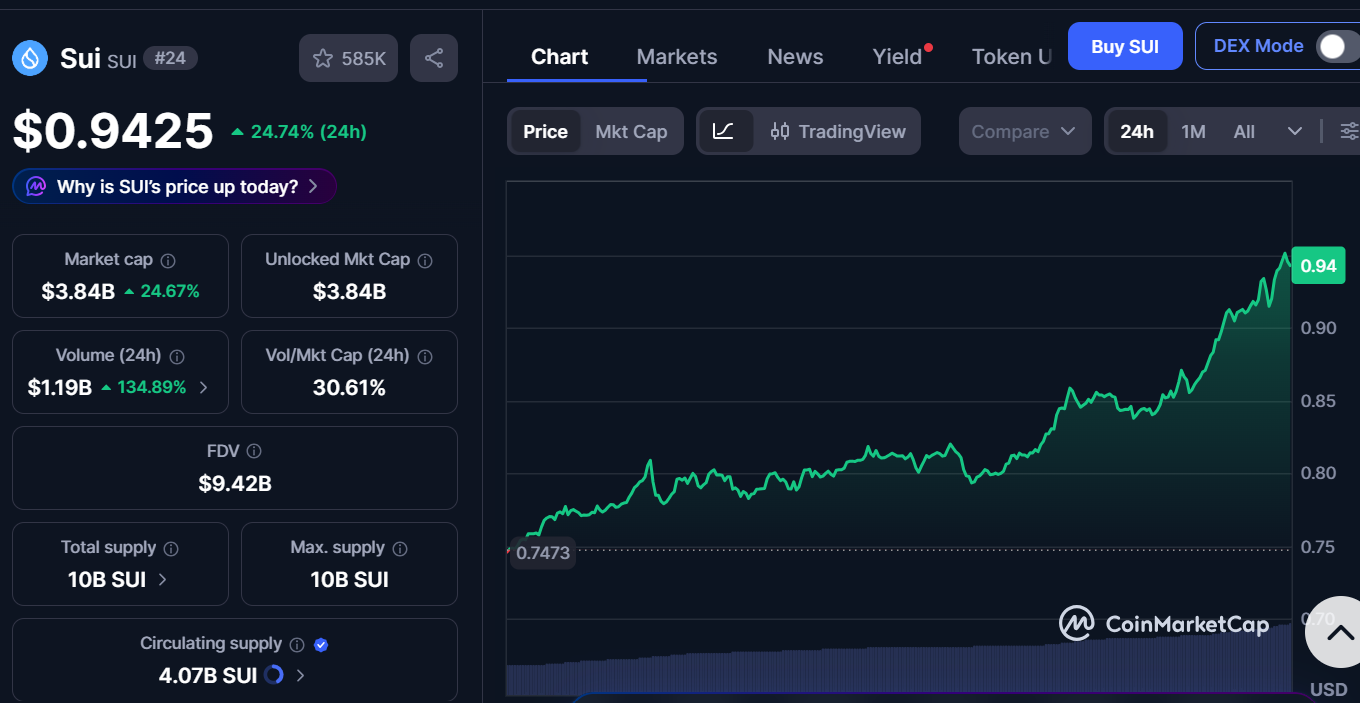
Sui is a Layer-1 blockchain built around an object-centric data model that allows parallel transaction processing, a design choice meant to keep fees low even as usage grows.
The network has leaned into institutional products lately, with Securitize, Ember, and Aftermath Finance expanding tokenized credit and derivatives activity on Sui in August, according to reporting on the network's recent integrations.
Source: SUI CoinmarketCap
SUI trades around $0.68, with a market cap near $2.8 billion, according to CoinGecko data from late August 2026.
The token remains well below its 2024 high, and CoinGecko's next scheduled unlock will release a small share of total supply in early September.
Weakness: SUI has spent months trapped below its 200-day moving average, and a large share of total supply is still locked, which could pressure price as future unlocks arrive.
Ondo Finance (ONDO): Riding the RWA Wave
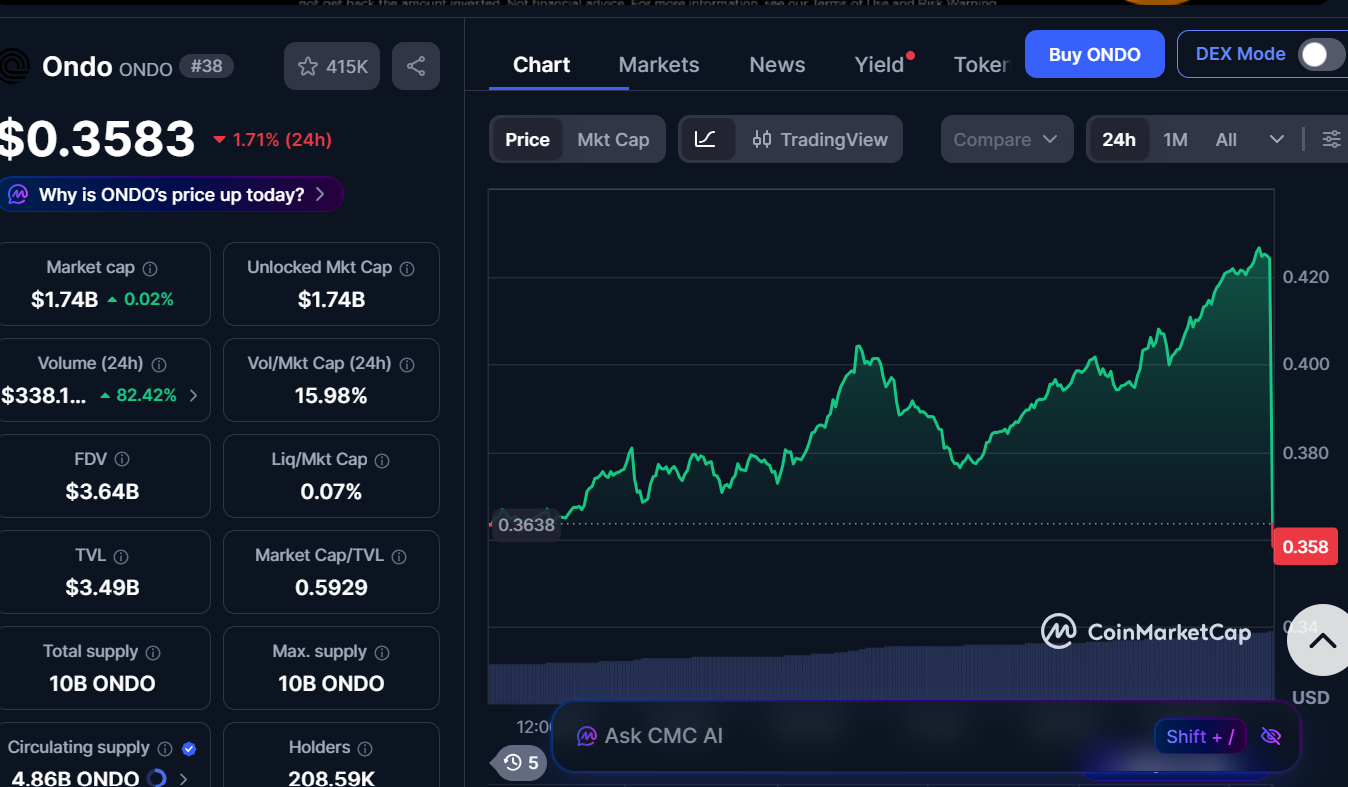
Ondo Finance bridges institutional-grade financial products with blockchain rails, tokenizing U.S. Treasuries and stocks through products like USDY and OUSG.
Allium Research places Ondo's platform assets under management near $3.4 billion, spanning eight chains, based on its own valuation report.
Source: ondo CoinMarketcap
ONDO trades near $0.38, with a market cap around $1.85 billion, per CoinMarketCap.
The Ondo DAO recently voted to burn 100 million tokens, permanently removing one percent of total supply, according to CoinMarketCap's coverage of the governance vote.
Weakness: ONDO's token price trades at a premium to the platform's actual earned revenue, meaning much of its current valuation still rests on narrative rather than present cash flow.
Competing RWA platforms could also pull institutional attention away if they land comparable partnerships.
Cardano (ADA): The Peer-Reviewed Contender
Cardano is a proof-of-stake Layer-1 network built on formally verified, peer-reviewed research rather than the move-fast approach favored elsewhere in the industry.
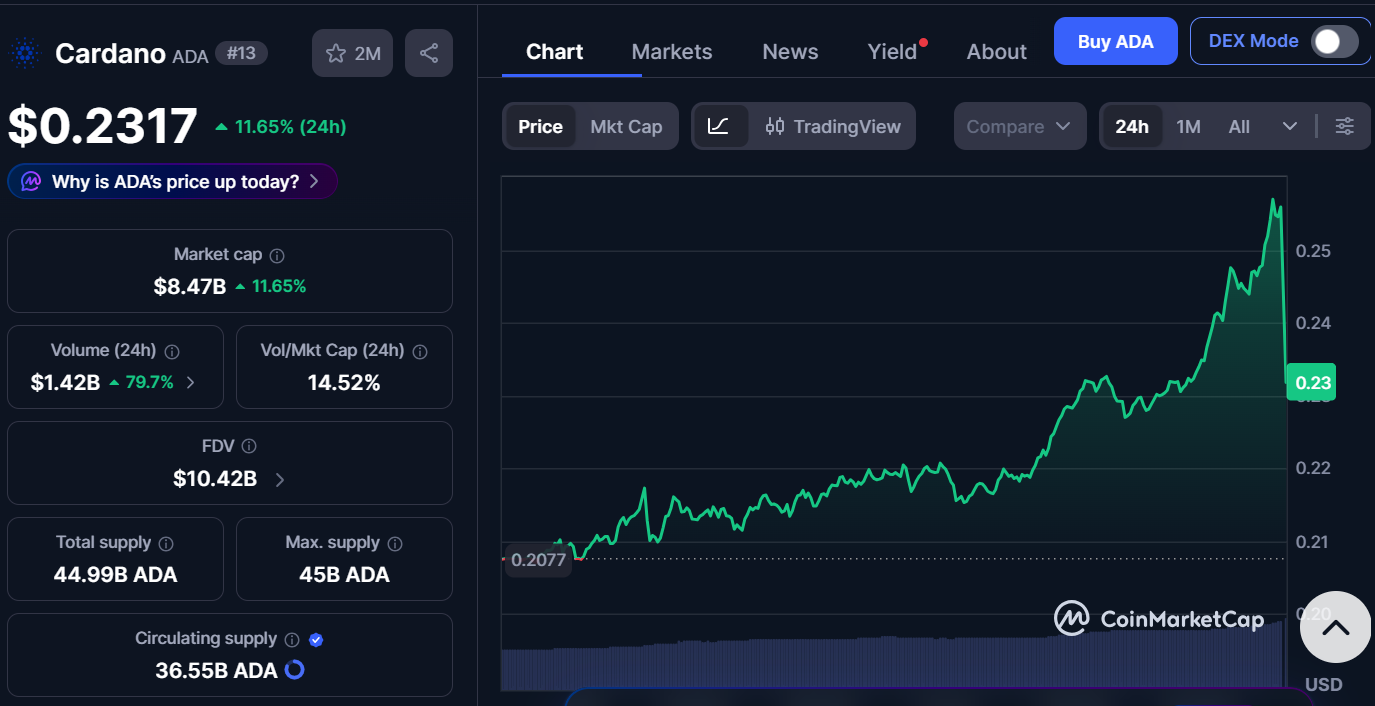
Its Dijkstra-era upgrade, aimed at boosting throughput through nested transactions and Linear Leios, began rolling out in stages, according to Cardano's own development roadmap.
Sources: Cardano CoinMarketCap
ADA trades around $0.20, with a market cap near $7.8 billion, based on CoinMarketCap figures from August 21.
T. Rowe Price, a firm managing close to $1.9 trillion in assets, added a small ADA position to its Active Crypto ETF, per CoinMarketCap's reporting on the allocation.
Weakness: Cardano's on-chain DeFi activity remains a fraction of larger competitors, and real-world adoption metrics have historically lagged behind its technical roadmap, even during periods of strong price performance.
Stellar (XLM): Built for Cross-Border Payments
Stellar is a payments-focused network designed for fast, low-cost transfers between different currencies and asset types.
Source: Stellar CoinMarketCap
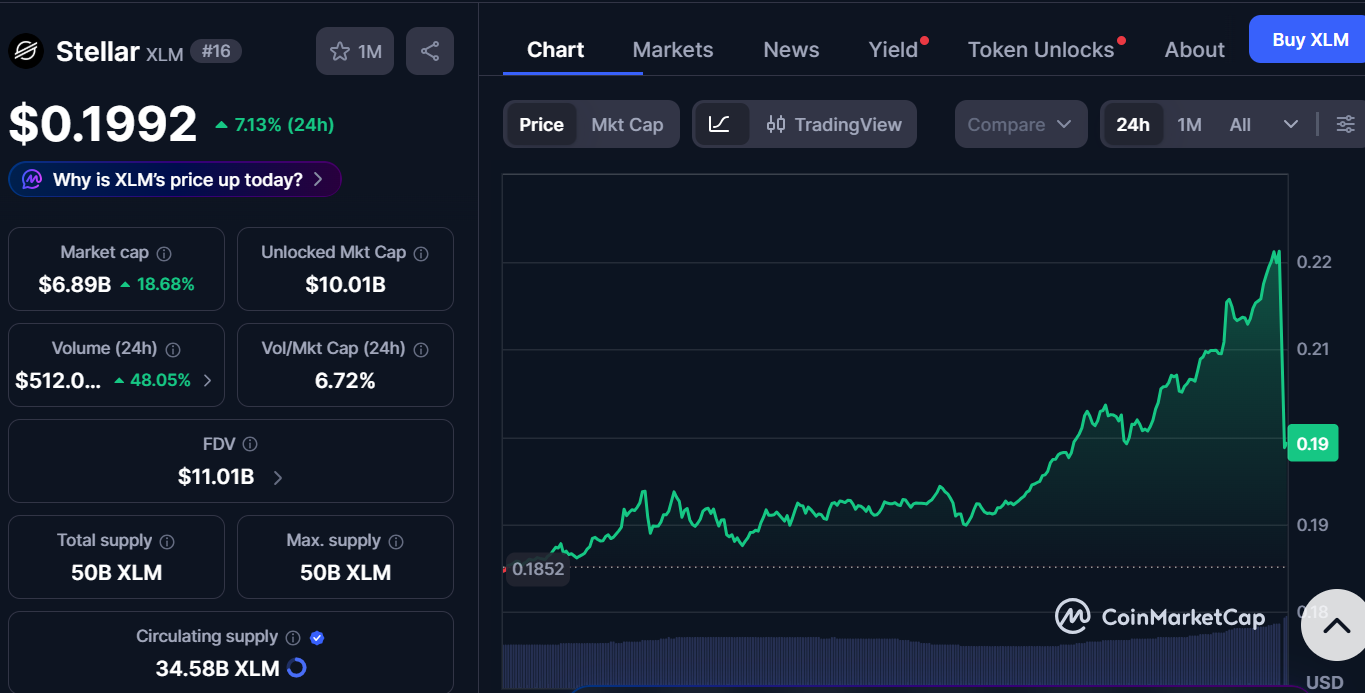
The Stellar Development Foundation reported $5.5 billion in stablecoin payment volume in the first quarter of 2026, and tokenized real-world assets on the network have since crossed $3 billion, according to RWA.xyz data cited by CoinMarketCap.
XLM trades near $0.19, with a market cap around $6.6 billion, per CoinMarketCap.
New Tier 1 validators, including MoneyGram and Figure Markets, joined the network in July, adding fresh institutional weight behind its payments push.
Weakness: XLM's price has lagged its network growth for months, and a sustained move below key support levels could open further downside regardless of how strong the adoption headlines look.
Hedera (HBAR): Enterprise Governance at Scale
Hedera runs on a hashgraph consensus mechanism rather than a traditional blockchain, and it is governed by a council that includes Google, IBM, Dell, and FedEx, according to Hedera's own governing council listing.
The network stays active in RWA tokenization, micro-payments, and automated transaction systems built for AI agents, using a fixed-fee structure aimed squarely at enterprise integration.
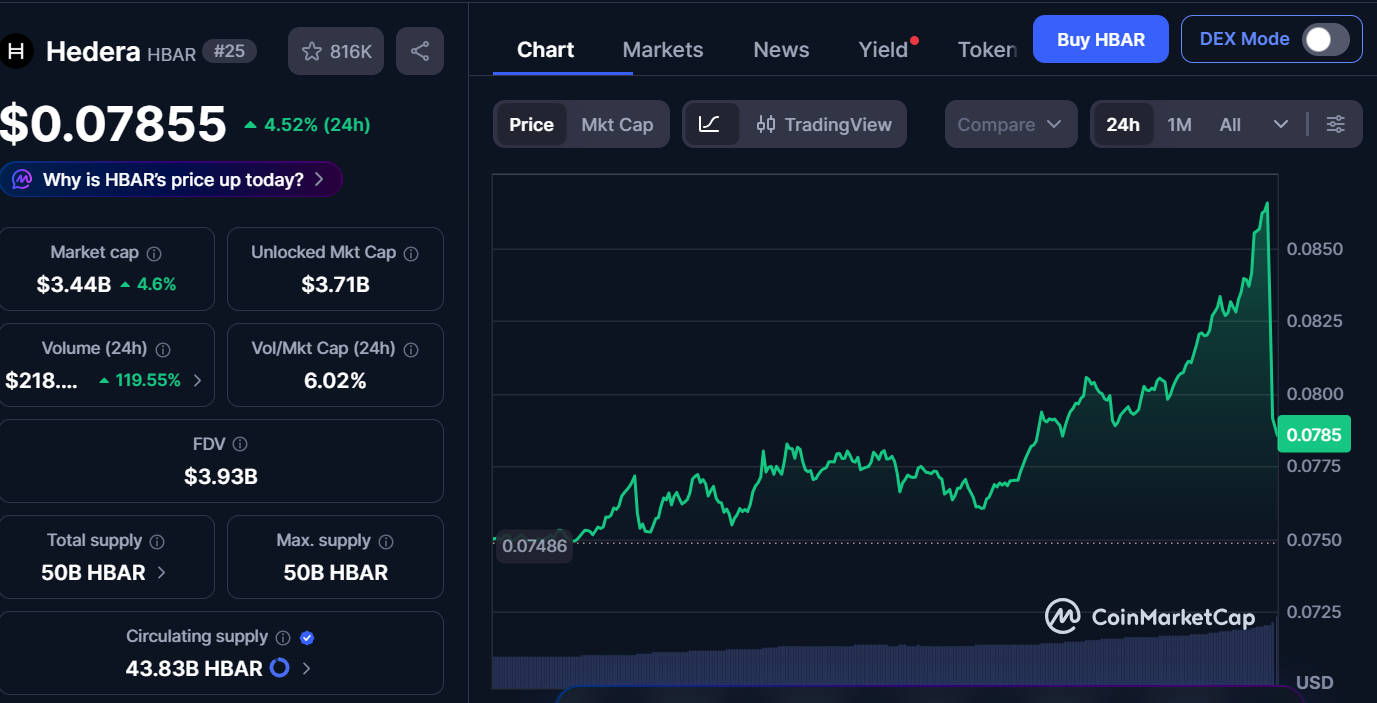
HBAR trades around $0.078, with a market cap near $3.4 billion, according to CoinMarketCap data from August 22.
The network recently set a daily transaction record, averaging over 290,000 transactions per day, per CoinMarketCap's network metrics.
Weakness: HBAR remains roughly 86 percent below its 2021 all-time high, and its price has historically lagged behind its enterprise adoption headlines, leaving a persistent gap between network activity and market valuation.
Polygon (POL): Powering Ethereum's Layer 2 Future
Polygon is the native token of a major Ethereum Layer-2 scaling ecosystem, and POL replaced the older MATIC token as part of the network's broader Polygon 2.0 transition.
Its AggLayer initiative aims to aggregate liquidity across multiple connected chains, cutting friction for apps built across more than one network, according to Polygon's own project documentation.
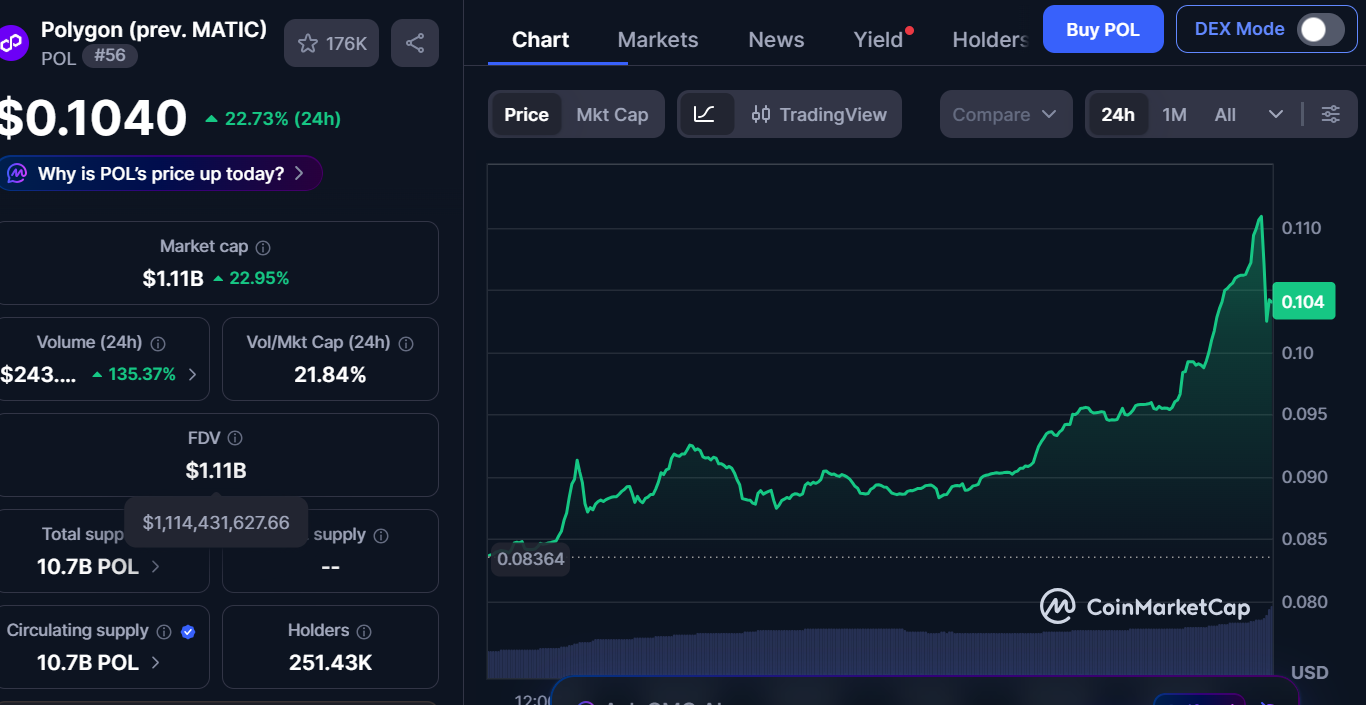
POL trades around $0.09, with a market cap close to $1 billion, per CoinGecko data from late August.
Global brands have used Polygon for web3 loyalty programs, NFT infrastructure, and gaming deployments, keeping developer activity relatively steady through the year.
Weakness: Layer-2 competition has intensified sharply, and on-chain growth has not consistently translated into price gains for POL holders, a disconnect that has persisted across much of 2026.
Comparing These Six Altcoins
Lined up together, these six coins split cleanly by narrative.
Sui and Polygon lean toward infrastructure and execution, Ondo and Hedera lean toward institutional and enterprise integration, and Cardano and Stellar represent two different takes on trust, one built around security-first design and the other around payments-first design.
That spread matters more than any single price chart.
A watchlist built entirely around one narrative, whether that's Layer-1 speed plays or payment tokens alone, carries concentrated risk if that specific theme cools off while others keep moving.
Spreading picks across categories is one way analysts suggest managing that exposure while still keeping upside potential intact.
It also means different coins on this list may perform well at different points in the cycle, rather than all moving together on the same news, since each responds to a different set of headlines and a different investor base.
Volume and Liquidity: What the Numbers Say
Price alone rarely tells the full story.
Cardano's trading volume topped $950 million in a single day during its recent rally, a level that points to genuine buying interest rather than a thin, easily reversible move, per CoinMarketCap data from August 21.
Stellar and Hedera, by contrast, have shown steadier but less explosive volume, which fits their positioning as infrastructure plays rather than momentum trades chasing short-term attention. Ondo's volume has been more sensitive to governance and TVL headlines than to broad market swings, reflecting its more specialized institutional audience.
Sui and Polygon sit somewhere in between, with volume that tends to react quickly to specific network announcements rather than holding a steady baseline.
Watching how volume responds to news, not just price, can help separate durable interest from short-lived spikes driven by social media chatter alone.
Quick Comparison Table
The table below summarizes the six picks side by side, using approximate figures as of late August 2026.
Coin
Price (Approx.)
Market Cap
Narrative
Sui (SUI)
$0.68
$2.8B
High-performance execution
Ondo Finance (ONDO)
$0.38
$1.85B
Real-world asset tokenization
Cardano (ADA)
$0.20
$7.8B
Peer-reviewed security
Stellar (XLM)
$0.19
$6.6B
Cross-border payments
Hedera (HBAR)
$0.078
$3.4B
Enterprise governance
Polygon (POL)
$0.09
$1.0B
Ethereum Layer 2 scaling
Cardano and Stellar carry the largest market caps on this list, reflecting their longer track records, while Polygon and Ondo sit at the smaller end, leaving more room for either upside or volatility depending on how their respective narratives develop through the rest of 2026.
Final Thoughts
Each of these six names occupies a different corner of the altcoin market, and none of them wins on every metric at once.
Analysts covering this cycle generally argue that a strong pick should be judged against the narrative it represents, not against unrelated coins chasing a different kind of growth entirely.
Institutional-facing names like Ondo and Hedera carry a different risk profile than infrastructure plays like Sui and Polygon, while Cardano and Stellar sit somewhere between the two, established networks working through slower, more deliberate upgrade cycles.
Investors weighing a top altcoin to buy in 2026 may find that a mix across these categories fits better than a single concentrated bet, though outcomes could vary depending on how each narrative plays out through the rest of the year.
Tracking named catalysts and volume trends alongside price remains more reliable than following any single chart in isolation.
Disclaimer
This article is for informational purposes only and does not constitute financial or investment advice. Cryptocurrency prices are highly volatile and can change rapidly. All figures are approximate and sourced from CoinMarketCap and CoinGecko as of August 22, 2026. These figures can vary on different platforms. Please do your own research and consult a qualified financial advisor before making any investment decisions.