The Bitcoin ETFs that matter most by AUM in 2026 are BlackRock IBIT, Fidelity FBTC, and Grayscale GBTC in the first tier, followed by ARK 21Shares ARKB, Bitwise BITB, VanEck HODL, WisdomTree
The Bitcoin ETFs that matter most by AUM in 2026 are BlackRock IBIT, Fidelity FBTC, and Grayscale GBTC in the first tier, followed by ARK 21Shares ARKB, Bitwise BITB, VanEck HODL, WisdomTree BTCW, Invesco Galaxy BTCO, Franklin EZBC, and Valkyrie BRRR.
IBIT alone accounts for more than half the category's AUM, a concentration pattern that became structurally entrenched within twelve months of the January 2024 spot ETF approvals.
FundOutstanding pointScoreOne-line noteBlackRock IBITLargest AUM; institutional distribution anchor5/5Promotional fee lapsed; Coinbase Custody concentrationFidelity FBTCOnly major fund with issuer-controlled custody4.5/5Fidelity Digital Assets eliminates third-party custodian riskGrayscale GBTCLargest pre-approval legacy vehicle3/51.50% fee drives sustained outflows; sticky holder base remainsARK 21Shares ARKBMost recognizable thematic brand in second tier4/521Shares European ETP experience; ARK retail followingBitwise BITBCrypto-specialist issuer with lowest fee tier4/5Research-led positioning; advisor platform adoption still limitedWisdomTree BTCWEuropean ETP heritage; established ETF operator3.5/5US market share modest despite institutional credibility
6 Top Bitcoin ETFs by AUM Reviewed (2026 List)
For context on how Bitcoin ETF flows connect to the broader tokenized-asset layer, the top tokenized Treasury funds in 2026 covers the adjacent RWA fund category. The top stablecoin issuers in 2026 addresses the dollar liquidity layer.
Below, each fund is reviewed against issuer structure, custody model, fee posture, distribution strength, and market role.
1. BlackRock iShares Bitcoin Trust (IBIT)
IBIT grew to the largest spot Bitcoin ETF within months of the January 2024 approvals, as tracked on the BlackRock iShares IBIT product page. BlackRock's advisor platform relationships and institutional distribution infrastructure drove adoption faster than any competing fund.
IBIT surpassed $70 billion in AUM by mid-2026, a scale that placed it among the 20 largest ETFs of any asset class in the US. IBIT has been accepted as collateral on multiple platforms, shifting its role from passive Bitcoin exposure toward settlement infrastructure. Farside Investors flow data shows IBIT's net inflows have repeatedly exceeded the total flow of all other spot Bitcoin ETFs combined.
Coinbase Custody holds Bitcoin for IBIT, GBTC, ARKB, BITB, BTCW, BTCO, EZBC, and BRRR (eight of the ten spot ETFs). Counterparty concentration at Coinbase Custody is a risk shared by most Bitcoin ETF products. At the fund level, the relevant risks are NAV tracking quality and operational continuity.
That access structure is what drove advisor adoption, not the Bitcoin thesis. Once inside an ETF, the conversation shifts from speculation to portfolio design.
For retail allocators choosing between the two leaders, BlackRock's liquidity depth versus Fidelity's custody independence is the recurring decision point.
Spot Bitcoin ETFs have absorbed over billion in net inflows from launch through mid-2026, with IBIT capturing the largest share per ValueAddVC institutional adoption tracking.
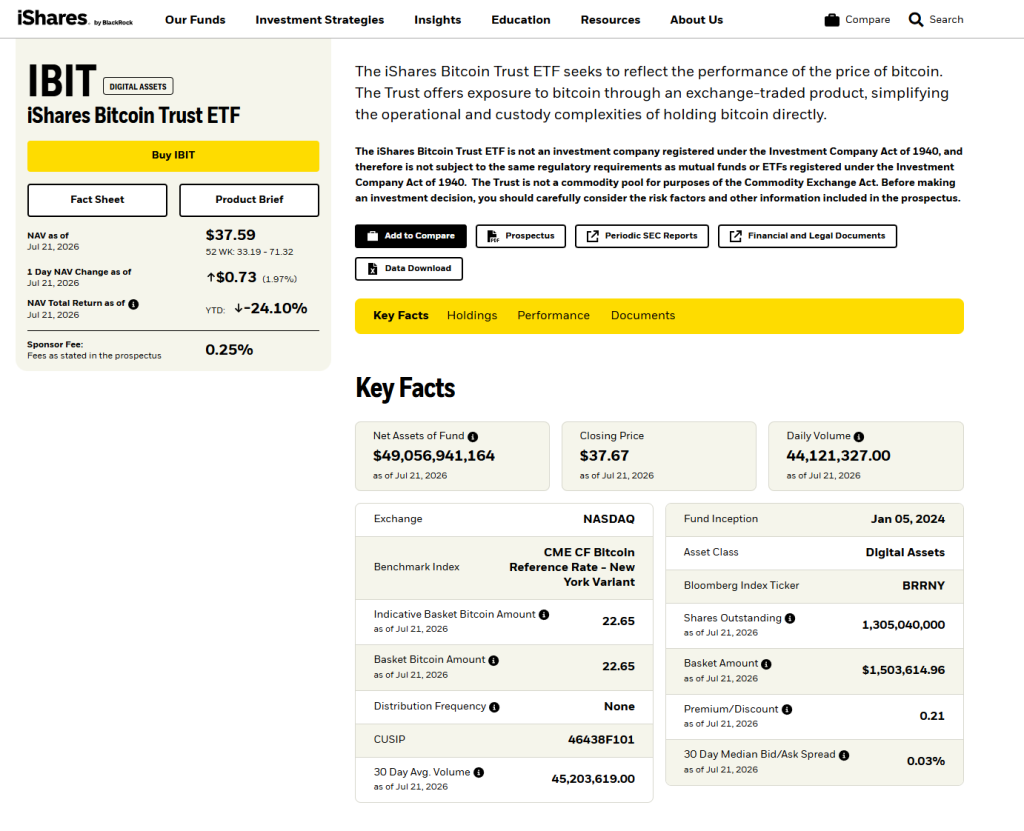
BlackRock IBIT product page captured July, 2026.
2. Fidelity Wise Origin Bitcoin Fund (FBTC)
FBTC is the only major Bitcoin ETF where the issuer also controls custody through Fidelity Digital Assets, making it the sole fund with full vertical integration from issuer to custodian. This vertical integration eliminates third-party crypto custodian dependency, a structural differentiator from every Coinbase-custodied peer.
Fidelity's retail client base and registered investment advisor network provide a distinct distribution path from BlackRock's institutional-first posture. FBTC AUM stood at approximately $25 billion as of mid-July 2026 per TipRanks flow tracking. Existing Fidelity brokerage customers can buy FBTC with no additional account setup -- it appears in the same interface as any equity ETF.
The custody tradeoff: Fidelity Digital Assets reduces third-party counterparty risk but concentrates operational risk within the same corporate family as the issuer. FBTC continued drawing inflows even during Bitcoin's Q2 2026 drawdown, suggesting institutional allocators treat it as strategic rather than tactical exposure.
That self-custody distinction shapes how retail investors frame the choice. The Bitcoin community consistently points to Fidelity's self-custody as the deciding factor over cheaper alternatives: Fidelity is an "OG Bitcoiner" that holds its own Bitcoin.
For existing Fidelity clients, the practical appeal is more straightforward: FBTC sits inside the same brokerage view as their equity and bond ETFs.
FBTC's market role is the strongest challenger to IBIT for traditional-finance advisor allocation, given Fidelity's existing client relationships and brand perception among retail investors.
3. Grayscale Bitcoin Trust ETF (GBTC)
GBTC converted from a closed-end trust to a spot ETF in January 2024, with current fund details on the Grayscale GBTC product page. The 1.50% management fee is the highest in the category by a significant margin, a consequence of maintaining the pre-approval fee structure.
Per Grayscale's SEC filings, GBTC recorded approximately $17.5 billion in net outflows during 2024 following the conversion, with investors rotating into lower-cost alternatives. At 1.50%, an investor holding $10,000 in GBTC pays $150/year in fees versus $25 for IBIT at 0.25% -- a $125 annual drag that compounds over a multi-year hold. The fund distributed approximately 26,936 Bitcoin (.76 billion) to seed the Grayscale Bitcoin Mini Trust (ticker BTC) at 0.15%.
Grayscale SVP Krista Lynch told TheStreet Roundtable that the remaining GBTC holder base is sticky, with many facing large capital gains if they sell. The Mini Trust targets the next wave of cost-sensitive investors.
The SEC approved in-kind creations and redemptions for crypto ETFs in July 2025, which Grayscale positions as a mechanism to attract crypto-native investors who want Bitcoin in an estate-planning-eligible account.
The fee gap drives most of the retail frustration. Investors in one investing community discussion describe rotating into IBIT or FBTC at the first opportunity, with little expectation that Grayscale will cut the 1.50% rate.
Whether the 0.15% Mini Trust makes GBTC redundant for new buyers is an open question in Bitcoin community forums. For tax-locked legacy holders, though, the answer is already settled: they stay.
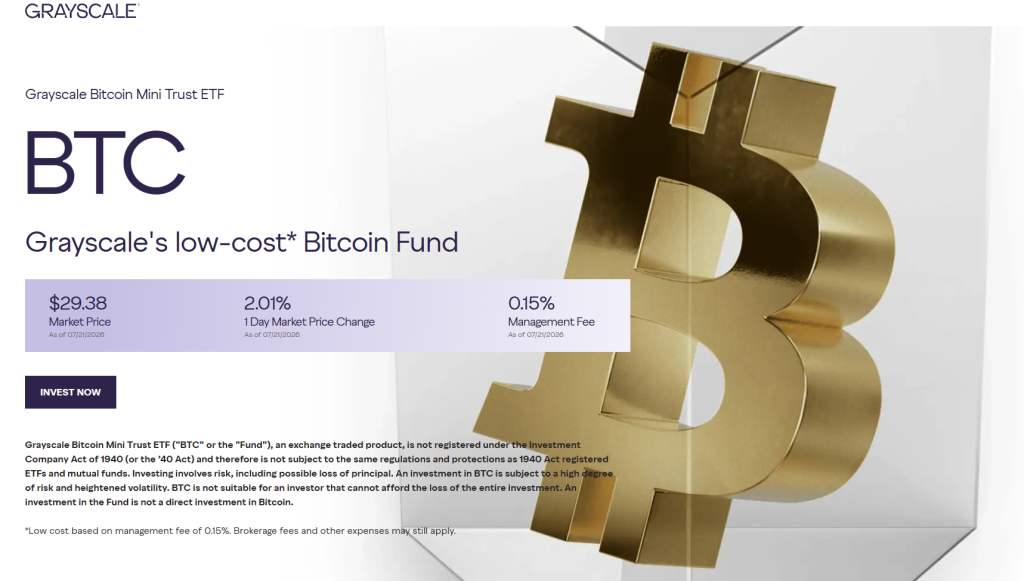
Grayscale GBTC product page captured July 17, 2026.
4. ARK 21Shares Bitcoin ETF (ARKB)
ARKB combines ARK Invest's thematic investing brand with 21Shares' European ETP operational infrastructure, with fund details on the ARK 21Shares ARKB product page. The 0.21% management fee is competitive with the category leaders.
ARKB held approximately $4.5 billion in AUM by mid-2026. The investor base skews toward ARK's existing thematic retail following, which has demonstrated higher fee tolerance for brand-aligned products. Institutional access is available but the product is less dominant in advisor allocation than IBIT or FBTC.
The differentiated risk is concentration in an investor base that may be sensitive to ARK's broader thematic performance and Cathie Wood's public market commentary. ARKB is the most recognizable challenger in the second tier.
That said, investor analysis of the fund points out that 21Shares' European ETP track record gives ARKB more institutional credibility than the ARK brand name alone implies.
ARK's public Bitcoin price targets cut both ways. A projected $16 trillion market cap by 2030 draws conviction buyers to ARKB but gives institutional due diligence committees a concrete reason to pause.
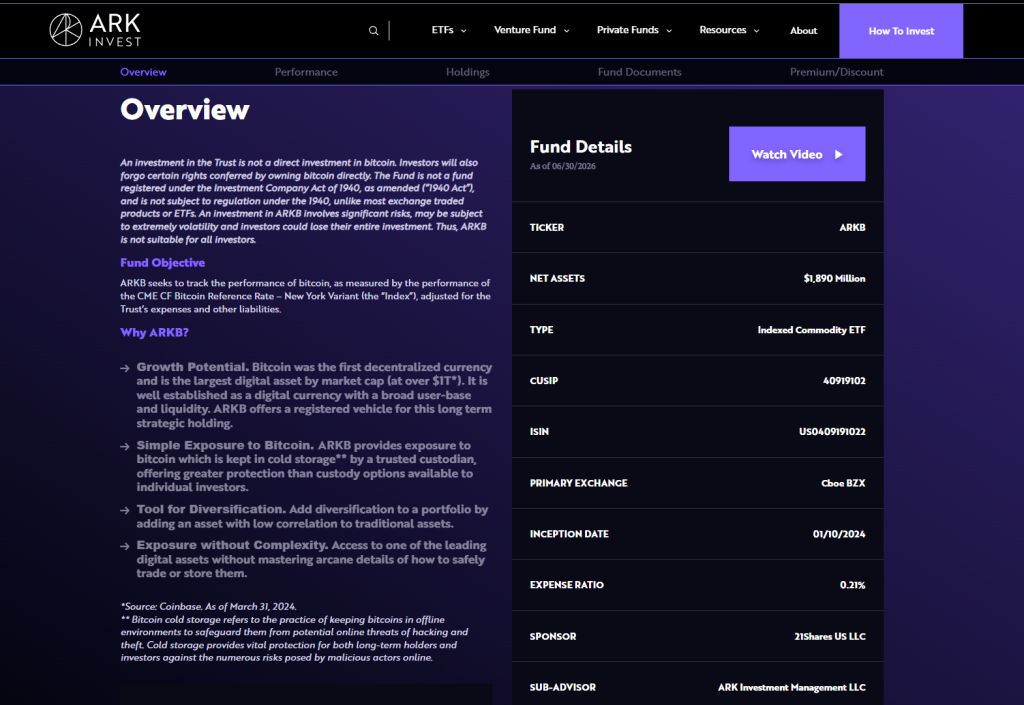
ARK 21Shares ARKB product page captured July 17, 2026.
5. Bitwise Bitcoin ETF (BITB)
Bitwise is a crypto-specialist firm with a seven-year track record managing crypto assets for institutional investors, with fund details on the Bitwise BITB product page. The 0.20% fee is among the lowest in the category.
Bitwise CIO Matt Hougan told CoinDesk that institutional ETF holders largely held through Bitcoin's roughly 50% price drop since October 2025, calling their capital "very sticky" due to the career risk of allocating to a non-consensus asset.
A Seeking Alpha analysis rated BITB hold, noting that despite competitive fees and tight trading spreads, market share has stalled due to limited advisor platform shelf space. Distribution, not cost, remains the primary barrier.
Bitwise's research head Andre Dragosch told DL News that Wells Fargo, Bank of America, and Vanguard opening Bitcoin ETF distribution to clients is the key 2026 catalyst for the entire category.
BITB held approximately $4 billion in AUM by mid-2026. Distribution is the barrier; the product itself has earned credibility. Publishing the fund's Bitcoin ETF holdings wallet address made Bitwise the only major ETF issuer with on-chain proof of reserves, which matters to crypto-native investors skeptical of traditional fund structures.
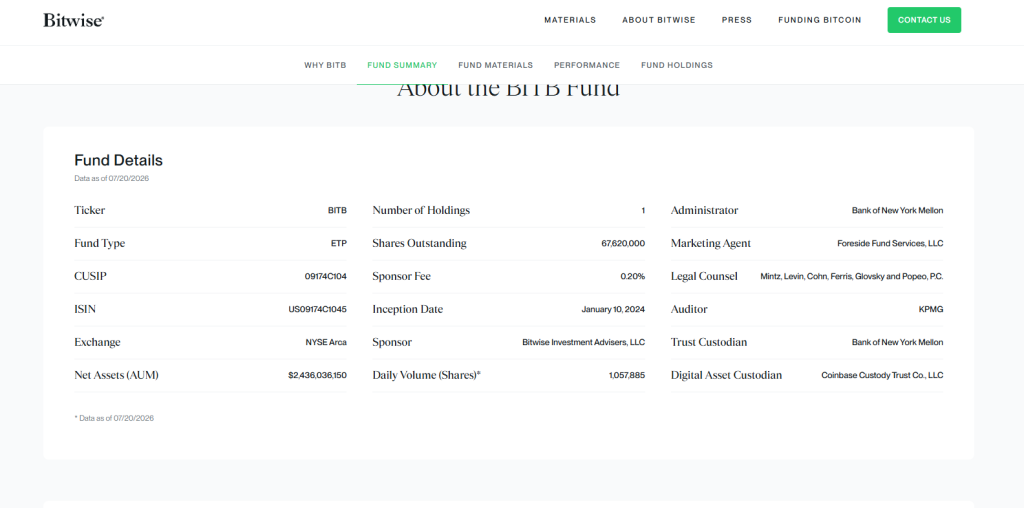
Bitwise BITB product page captured July 17, 2026.
6. WisdomTree Bitcoin Fund (BTCW)
WisdomTree is an established ETF operator with European Bitcoin ETP experience predating US spot ETF approvals, with fund details on the WisdomTree BTCW product page. The 0.25% fee matches the category average.
BTCW held approximately $1 billion in US AUM by mid-2026, a fraction of WisdomTree's much larger European Bitcoin ETP AUM. Distribution through standard US brokerage and advisor platforms provides institutional access, but BTCW has not captured meaningful advisor allocation away from the category leaders. US spot ETF flows have concentrated in IBIT and FBTC.
The market role is depth in the category comparison set, not leadership. WisdomTree's European ETP heritage provides credibility for institutional due diligence, even as US market share remains modest.
That institutional credibility does not translate to retail mindshare. In discussions among ETF investors on which fund is objectively best, BTCW rarely appears. The default picks are IBIT or FBTC, with ARKB and BITB as the secondary options.
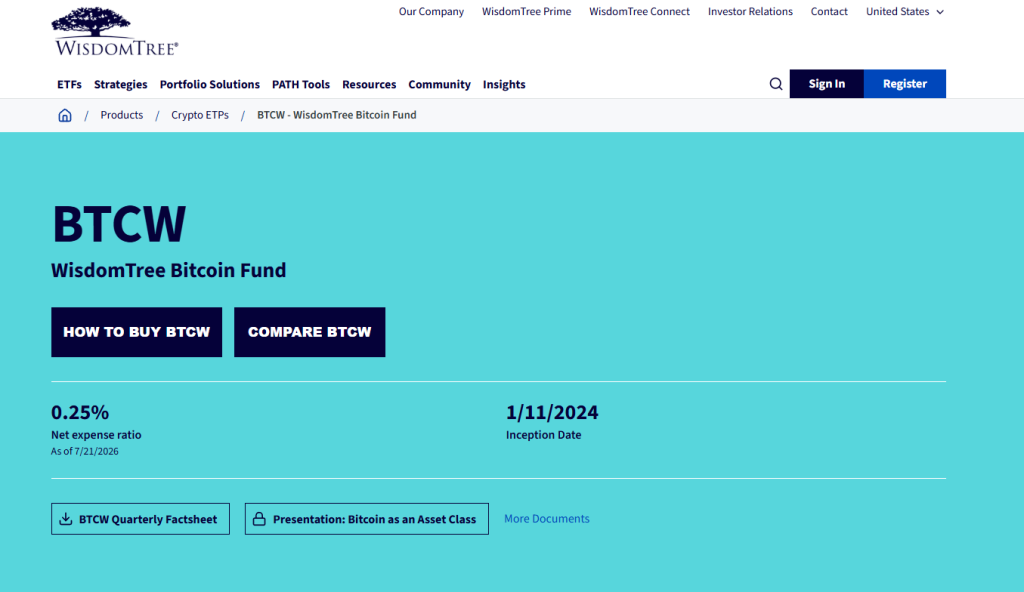
WisdomTree Bitcoin product page captured July 17, 2026.
Quick structural comparison
FundTickerIssuerApprox. AUM (mid-2026)Management feeCustodianPrimary distributioniShares Bitcoin TrustIBITBlackRock~+0.25% (0.12% promotional)Coinbase CustodyAdvisor platforms, institutionsWise Origin Bitcoin FundFBTCFidelity~+0.25%Fidelity Digital AssetsFidelity retail + advisorBitcoin Trust ETFGBTCGrayscale~+1.50%Coinbase CustodySecondary market legacy holdersBitcoin ETFARKBARK 21Shares~+0.21%Coinbase CustodyThematic ARK investor baseBitcoin ETFBITBBitwise~+0.20%Coinbase CustodyCrypto-specialist retailBitcoin ETFHODLVanEck~.5B+0.20%Gemini CustodyBroad ETF platformBitcoin FundBTCWWisdomTree~.5B+0.25%Coinbase CustodyInstitutional ETF platformGalaxy Bitcoin ETFBTCOInvesco Galaxy~.5B+0.25% (0.00% promotional)Coinbase CustodyInvesco distribution networkBitcoin ETFEZBCFranklin~.5B+0.19%Coinbase CustodyFranklin Templeton advisor networkBitcoin FundBRRRValkyrie~.5B+0.25%Coinbase CustodySpecialty crypto ETF distribution
AUM figures are approximate as of mid-2026. Source: public issuer disclosures and ETF flow data.
Ranking scorecard
Scored out of 10 per category. Total out of 60.
FundIssuer credibilityFee competitivenessCustody modelDistribution reachAUM durabilityLiquidity depth
TotalIBIT1087101010
55FBTC9810989
53GBTC727658
35ARKB797767
43BITB697556
38BTCW787645
37Scoring notes: Issuer credibility reflects brand recognition and institutional track record. Fee competitiveness scores the management fee relative to category average. Custody model scores the structural quality and independence of the custodian arrangement.
Distribution reach measures advisor platform availability and institutional access breadth. AUM durability reflects net flow trends and holder stickiness. Liquidity depth scores trading volume and bid-ask spread quality.
IBIT leads (55/60) on distribution and AUM durability. FBTC scores highest on custody model (10/10) due to vertical integration with Fidelity Digital Assets. GBTC scores lowest on fee competitiveness (2/10) at 1.50%.
Analytical framework
This comparison prioritizes issuer structure, fee posture, and distribution model over a single AUM snapshot. AUM captures where capital has concentrated historically, not necessarily where the strongest structural proposition sits.
A fund with a lower fee and a stronger custodian arrangement may be more durable than one that benefited from first-mover distribution.
Four dimensions matter: custodian concentration, management fee dynamics, issuer distribution reach, and how each fund has handled fee competition since approvals.
What this changes
The concentration pattern in spot Bitcoin ETFs is more structurally significant than a simple market-share ranking suggests.
IBIT's AUM dominance was driven by distribution leverage applied to an asset class that had no prior ETF structure. This was not purely brand recognition.
The category now functions as a two-tier system. The first tier (IBIT, FBTC, GBTC) captures the vast majority of institutional and advisor flows. The second tier captures the remainder through thematic brand alignment and specialist identity.
Moving from the second tier to the first requires a distribution event comparable to what IBIT had at launch: broad advisor platform approval and institutional default status.
The fee compression dynamic is not finished. Grayscale's 1.50% anomaly will likely compress further. Franklin's 0.19% represents the current low end. Watch whether any second-tier fund moves below 0.15% as an aggressive distribution strategy.
Why you can trust this guide
This comparison is based on live public product pages, issuer fee disclosures, and ETF flow data reviewed in July 2026. Five of six fund product pages were loaded and captured directly.
Fidelity FBTC product page was not directly captured due to a network block during the capture session. AUM figures are approximate and reflect publicly available data as of mid-2026.
What was not verified: real-time AUM from a single authoritative source, and fee promotional period end dates confirmed directly with each issuer. These require independent verification.
Disclaimer: This article is for informational purposes only and does not constitute financial or investment advice. Cryptocurrency and digital asset markets carry significant risk. Always do your own research before making decisions.
The post Top Bitcoin ETFs by AUM in 2026: Structure, Fee Posture, and Category Role Compared was initially published on Coincu.