Travala, the Singapore-based crypto travel platform, unveiled what it describes as the first agent-enabled AI travel protocol on Base, enabling artificial intelligence agents to search, reser
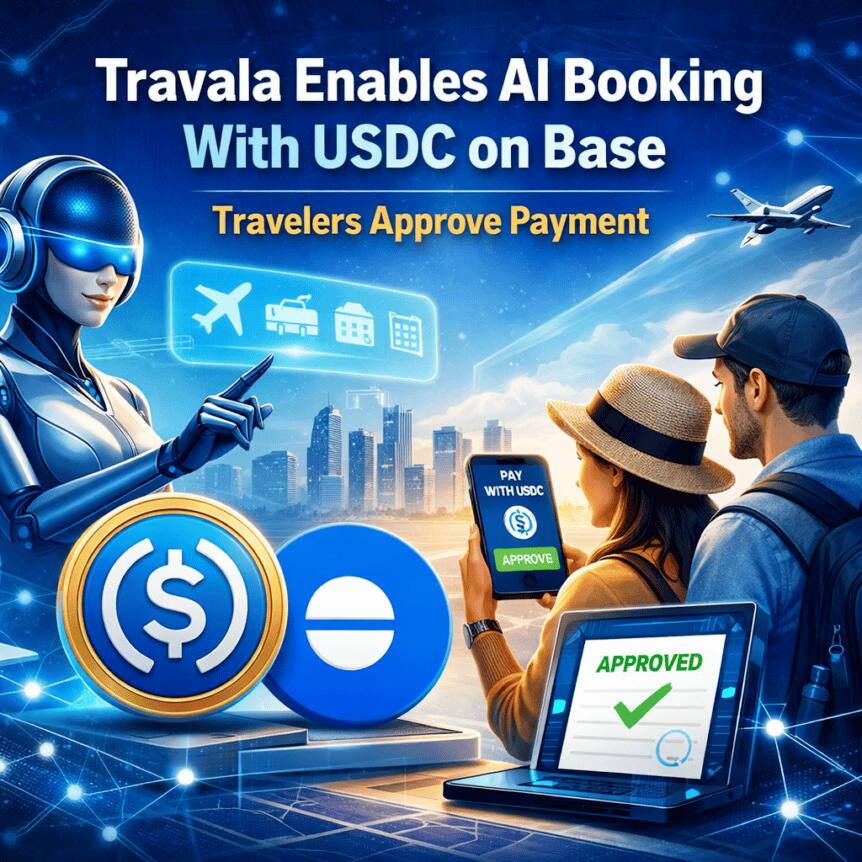
Travala, the Singapore-based crypto travel platform, unveiled what it describes as the first agent-enabled AI travel protocol on Base, enabling artificial intelligence agents to search, reserve, and pay for hotels using USDC. The Travala Travel MCP (Multi-Channel Protocol) is live via Claude Desktop and opens to external developers who want to integrate their own travel agents with Travala’s hotel inventory.
The company says the system links Travala’s hotel inventory to AI agents through the Model Context Protocol, an open standard for connecting AI apps to external tools. Payments flow over Coinbase’s x402 protocol on Base, delivering gasless USDC transactions, near-instant settlement, and projected transaction costs around $0.01 per booking. Final payment authorization, however, still requires manual approval from the traveler, so the workflow remains semi-autonomous rather than fully automated.
Key takeaways
- The world’s first agentic AI travel protocol on Base enables AI-driven hotel bookings using USDC via the x402 framework, with gasless transactions and sub-cent costs per booking.
- Ultimate payment approval stays in the traveler’s hands, making the system more a guided automation than a full-autonomy checkout.
- Travala’s protocol provides access to more than 2.2 million hotel listings, including properties from Marriott, Hilton and IHG, and supports integration with third-party travel agents.
- Beyond hotels, Travala plans to extend the protocol to other travel products such as flights, with its AVA loyalty token poised to enable future MCP use cases.
How the AI-enabled travel protocol works and why it matters
At the core, Travala’s Travel MCP connects its hotel inventory to AI agents using the Model Context Protocol, a framework designed to let AI applications interact with real-world tools and data. This setup is paired with ERC-7715 session keys, allowing an AI agent to request a payment while preserving final signing authority within the traveler’s own wallet. In practice, a user can initiate a search and booking flow with an AI agent, and the agent will trigger a payment request that the traveler can approve, all within a single, continuous chat thread that preserves context across searches, bookings, and cancellations.
Travala emphasizes that the payment layer operates on Base via Coinbase’s x402 protocol, which enables gasless USDC transactions and faster settlement without the typical on-chain fee burden. The company estimates booking costs around $0.01 in transaction fees, a tiny fraction by crypto standards, though the exact figures can vary with network conditions and off-chain processing. In a nod to real-world practicality, the protocol does not eliminate human oversight—travelers must authorize every payment, ensuring consumer protection and control remain central to the experience.
Branding the move as a step toward a more autonomous travel economy, Travala’s leadership frames it as a shift away from the traditional checkout button. Chief Executive Juan Otero described the launch as “the death of the checkout button” and framed it as the opening salvo in a broader transition toward AI-driven bookings—while still keeping the traveler in the loop for final decisions.
The protocol’s architecture is designed to maintain continuity across the entire trip lifecycle. From a user’s initial search to a potential cancellation, the AI agent can operate within a single conversation, pulling in live inventory, rates, and terms without forcing the user to repeatedly re-enter information or re-approve steps in separate flows. The design aims to streamline user experiences and reduce friction in AI-assisted travel planning.
As part of the rollout, Travala is offering developers a 10% Coinbase Wrapped BTC (cbBTC) rebate on completed stays booked through its AI agents, providing a tangible incentive for integrating with the protocol and building out new use cases for AI-driven payments in travel.
A broader context: a wave of AI-agent payment infrastructure
The Travala announcement sits within a growing wave of crypto infrastructure aimed at enabling AI agents to transact. Cointelegraph reports that x402-linked wallets on Base have surpassed 100 million transactions, underscoring the momentum behind agentic payment rails on Layer 2. The ecosystem has seen a string of product launches from notable names, including Fireblocks, MoonPay, Exodus and Oobit, all pursuing AI-centric stablecoin payment capabilities to power autonomous or semi-autonomous workflows for users and businesses alike.
Travala also notes that its protocol taps into a broad pool of hotel inventory, with listings drawn from major brands via aggregator partners. In total, the platform’s catalog covers more than 2.2 million hotels, including properties from Marriott, Hilton and IHG. Beyond hotels, the company intends to extend the MCP to other travel components, notably flights, while the AVA loyalty token could underpin future MCP use cases as adoption grows.
From a competitive standpoint, Travala’s move shifts the frame from traditional crypto-enabled checkouts to AI-agent-enabled booking infrastructure. The company previously positioned itself as part of a competitive ecosystem that includes Sleap.io and Alternative Airlines, but the current announcement emphasizes infrastructure for AI agents, with a focus on seamless, agent-mediated payments rather than purely crypto-only checkout experiences.
What to watch next for AI travel and payments
Travala’s foray into agentic travel payments raises several questions for stakeholders: How will final-approval controls evolve as AI agents learn to anticipate user needs? Will more airlines and hotel chains join the Model Context Protocol ecosystem, and how will loyalty programs like AVA adapt to machine-to-machine or agent-mediated bookings? Regulators may also scrutinize semi-autonomous payment flows to ensure consumer protections keep pace with technology.
For developers and investors, the key signals will be how quickly the MCP gains traction across the travel vertical, how easily third-party agents can integrate, and whether cost savings from gasless Base transactions translate into measurable efficiency gains or improved customer experiences. Observers will also be watching how the wider crypto payments landscape adapts to growing AI usage, including the balance between automation and human oversight in financial transactions.
As the technology matures, travel participants—consumers, developers, and hospitality partners—will need to assess how far AI-driven, semi-autonomous bookings can improve convenience without sacrificing control or safety. The coming months should clarify how broadly the Model Context Protocol-based integrations will expand, which travel segments will follow hotels into automation, and what policy guardrails will shape the adoption of agent-based payments on Layer 2 networks.
This article was originally published as Travala Enables AI Booking With USDC on Base; Travelers Approve Payment on Crypto Breaking News – your trusted source for crypto news, Bitcoin news, and blockchain updates.